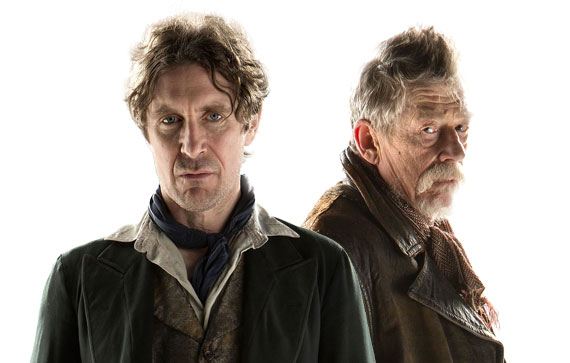
The BBC’s statement this week on the future of Dr Who has provoked a lot of comment, not least because it whiffs of a chaotic rush job to mask behind the scenes issues. For this viewer since 1963, there is a sort of sadness but not a lot of surprise.
Cards on the table, the idea of contracting production to a company other than Bad Wolf under a lead writer other than Russell T Davies is necessary, not because I have any particular animus towards them but because I think their time has run its course. Spectacle and melodrama have increasingly nudged thoughtful writing aside and the show got caught up in a doom loop of diminishing returns soundtracked by Murray Gold’s over-wrought incidental music that never shuts the fuck up. Yes there were latterly some very good episodes, but they shone against a dimming background.
Dr Who has a long history of experimentation, exploration and invention, balanced by an equally long history of bathos and ridiculousness; each of those things lie behind both its persistence and charm as well as those moments that invited things to be thrown at the TV screen. This is not just a New-Who thing: critics of modern incarnations often forget that both Colin Baker and Sylvester McCoy had to put up with some seriously weak material, Baker especially, before the show was put out of its misery and placed on its long hiatus.
Dr Who is, in many respects, a victim of its own longevity and also labours under the expectations of vocal, online fandom [as I’ve said before, fans are great but fandoms cleave to toxicity.] The well is poisoned by notions of canon and rigid canonicity is policed by obsessives with nothing better to do but whinge on YouTube. Even so, despite having all of time and space to play with, somewhere along the way the producers ran out of ideas about what the programme could be, or perhaps they knew it but no one had the courage or vision to carry it through except in occasional flashes and glimpses, most consistently recently in the Peter Capaldi incarnation.
What if?
Writing has moved on since 1963 as has televisual language, not just in terms of major points of reference like Twin Peaks, Sense8 or Buffy the Vampire Slayer, but in the conceptual possibilities of all genre and cross-genre programming. Dr Who was conceived in the era of Robin Hood just like Star Trek was Wagon Train in space. As I write, I’m rewatching the magnificent Arrival which, like the story it came from, Ted Chiang’s Story of Your Life, exemplifies a way of treating time and language and adventures in time in a thoughtful, emotional and intelligent way that Dr Who has rarely approached. Can you even begin to imagine Arrival or Project Hail Mary scripted by RTD?
There have been some very, very good stories told, notably in the Steven Moffat era, but we’ve also had a succession of good actors doing good work over increasingly short tenures and having to do their best with shallow or inadequate material, or good material produced on the cheap, or stories that fail to rise above a premise, with poor dialogue and a lack of substance. Jodie Whittaker, whose Doctor I liked, also had to contend with Covid and lockdown.
Would a general audience respond well to a Dr Who that cloned the off-kilter modernism of Twin Peaks, the Return and mixed in Arrival or Annihilation? Probably not (though I would), but it would respond to a writing and production team with an expanded conceptual language. I do not suggest a complete reimagining but I would like a conceptual regeneration featuring coherent stories by talented writers that engage at least two of the following three: my emotions, my imagination and my intelligence. I’m not expecting Andre Tarkovsky or Denis Villeneuve or Alex Garland, and at heart Dr Who is a family show, but a tangible sense of meaning and depth wouldn’t go amiss.
The danger is that the BBC will award the production contract to a company that promises more of the same, that the corporation will run scared of the creative imagination. That is, after all, what it normally does. How much better would it be to honour the original vision of Verity Lambert and give us something that finally matches the unworldly possibilities of Delia Derbyshire’s original and unmatched realisation of the theme
[Added after first posting, it occurs to me that Dr Who would benefit from a spin off that stands in much the same relation to it as Andor does to the main Star Wars corpus. This does not mean a war between the land and the sea.]
Despite the metabolic havoc wreaked by hormone implants, I was delighted and relived to find out this week that my HbA1c remains in the ‘normal’ range (34mmol/mol, 5.3%). I was concerned that the weight gain caused by the hormones had messed with my type-2 Diabetes ‘in remission’ status; happily, it has not. I’m also happy to report a weight loss of 1kg (2.2lbs) over the past few days, so perhaps that is on the turn.
***
I found a passing mention of a book called Wisconsin Death Trip by Michael Lesy published in 1973, based on his PhD thesis. The book reprints articles and news items from Jackson County, Wisconsin, primarily from 1885 to 1900. The book also includes photographs by local photographer Charles Van Shaike and the articles are primarily from the Badger State Banner as well as records from the local mental hospital.
Unfortunately, the book is now quite expensive, however a film adaptation was made for the BBC’s Arena, broadcast in 2000, narrated by Ian Holm. The film is very much available to view in excellent quality on BBC iPlayer and in lower quality on YouTube (links below). I watched the film twice, enthralled. It is very dark (and some may find it upsetting), the more so because the stories are narrated straight without commentary. And the music choices are excellent.
I found the objectivity of it very affecting, especially the many, many human tragedies. I had a powerful sense of the fragility of life and a dissociation from the usual internal narrative of what it is to be human. I sometimes get this in Family Tree Research which, at its most basic, revolves around a narration of birth, procreation and death. Some of that was on my mind when I had my initial cancer diagnosis although it also helped reconcile me to the diagnosis and informed my determination to live life to the full while I’m here.
Wisconsin Death Tripadded something else, a feeling of the shallowness of so much of life, of the wasted potential of our species that has such a high opinion of itself.
I am on the next stage of recovery, resistance work in the local gym. I am following a set of core exercises suggested by an exercise specialist at Prostate Scotland. Today was my third session.
The core issue is that the hormone implants and radiotherapy tend to reduce muscle mass and the resistance work is intended to restore it and also help create a cancer-suppressive environment in the body. The exercises I have are targeted at the main muscle groups and include deadlifts, a first for me. I’m not a complete stranger to resistance work but in the past it has always been as an adjunct to cardio training, mainly running; this time the resistance work is the main course and any cardio is an adjunct to it, at least for the first few months until things get back into balance.
The target is to find the weight for each exercise where I can manage 8 – 10 repetitions before having to stop, then doing three sets of them. Once I get used to that weight and can do, say, 10 to 15 repetitions, I raise the weight a notch, and so on. I would like to get back to running, but it isn’t a priority at present.
I won’t know how well the hormones and radiotherapy worked until early June when tests are scheduled.
***
I’ve been reading a lot lately. I mentioned Stevie Smith a couple of posts ago but I’ve also been dipping into Thomas Hardy’s poetry (there is a lot of it, of varying quality), Malcolm Guite’s first volume of the Arthurian corpus in epic verse, Galahad and the Grail, and Patricia A McKillip’s Ombria in Shadow. The latter is an object lesson in writing Fantasy to a very high standard and has given me plenty to think about as regards craft and technique in general.
I also read The Hobbit for the first time since the girls were small; it is an odd book. I enjoyed revisiting it but every so often the writing irritated me. Still, I enjoyed it enough to make the mistake of revisiting the first of the Peter Jackson Hobbit films to see if time has improved it; it has not.
I completed my course of radiotherapy today. No doubt I’ll have more to say about it as the results become clearer in time and when I’ve had some time to reflect, but it’s worth recording the date.
I have been lucky. The radiographers treat anywhere between 180 and 240 people per day using 6 machines. and I know from chatting to people in the waiting room that some of those people have much more significant and life-changing cancers than me and face more intense side effects. Cancer, and the waiting rooms, are great levellers.
***
Team Doolally
Late to the party, I caught up with Dept Q, scandi-noir transplanted to Edinburgh with a magnificently sweary Matthew Goode taking the lead in a very strong cast. I binged it over two nights and am looking forward to the next series when it finally appears. Also, I enjoyed playing the game of spotting Edinburgh locations and noting when they did not match geographically.
At a loose end, I revisited Matrix : Resurrections which I thought I’d written about here previously but seemingly not. The first part of the film is funny and clever; unfortunately the second half is a boring retread of stuff we’ve seen before. It was a good earner for most of the Sense8 cast who appear in it, cast adrift when that series was cancelled, but not a particularly good film overall. I suspect that had a lot to do with it being the work of only one Wachowski: Lana.
In other news, Jon Anderson, erstwhile lead singer of Yes, is touring this year. He is 81. Touring with the Band Geeks, the show will be dominated by Yes classics played at their original tempo. I have, of course, already bought a ticket.
At the time of writing I have complete 14 of 20 fractions of radiotherapy; to the best of my knowledge it is going well. The side-effects, principally tiredness, come and go and I just have to go with them. I’ve learned that Bluetooth and earbuds are the solution to TV noise in the waiting room. I have many playlists and sometimes particular songs bring joy. Pet Shop Boys are always a cert, and three others are posted at the end of this. Most days the actual time under the beam is around 90 seconds, although once every week they also do a scan to check everything looks good.
Early in the week I took time to go to a couple of local gyms to check prices and also to ask if instructors were OK to work out a programme focused on recovery from the impact of the hormones and the radiotherapy – primarily addressing potentially reduced muscle mass and possible issues with bone density (although prescription calcium/vitamin D supplements should have helped with that.) As the androgen inhibition impacts of the hormones wears off I can build in cardio, I think. The key is not to be heroic, just to do some focused work. I get a heavily discounted rate with the local authority gym through MacMillan Cancer Care, though the private gym is the nicer (and closer) facility. Probably I’ll use the cheaper options while I can, then reconsider.
One of the books I read in the waiting room and at home was William Gibson’s Neuromancer (pub. 1984) It is justly seen as a formative work in modern SF and you can pretty much see the future being written, although as ever what is a warning about a techno dystopia seems to have been taken as a blueprint and call to action by the tech industry. It functions as a novel by being a fast-paced caper thriller presented in what was then a novel setting (the term cyberspace comes from it) using tech neologisms. I enjoyed it and can understand why it is so well regarded, but it will go back to the charity shop I got it from.
In TV viewing, after a shaky start Star Trek: Star Fleet Academy delivered what I thought were two decent episodes in episodes 4 and 5. I gave up on Star Trek: Discovery during its third season for several reasons, one of which was its tendency to inspiring speeches. The first three episodes of Academy leaned into this with ‘teachable moments’ delivered with that aura of cloying, earnest sentimentality that is uniquely American. Episodes 4 and 5 succeeded by largely dispensing with that and were much the better for it.
In the meantime, I took the opportunity of rewatching all of the TV adaptation of Deborah Harkness’s A Discovery of Witches. I think I’ve mentioned before that I very much prefer the books and had problems with the way the narrative was compressed for TV. In fairness, I enjoyed it more in this binge watch, albeit that I fast-forwarded through some scenes. As I’m avoiding anything particularly intellectually challenging I may read the books again. That isn’t to disrespect the books which I enjoy and are layered, but they’re not Pynchon. Of the five so far published the first three are by far the strongest, however I’ll give Prof Harkness a pass because she too was public about her encounters with cancer.
It isn’t quite a month since my first hormone implant and I’m beginning to feel its impact now in two ways. The first is that I find myself getting tired by late afternoon. I keep active, but a weariness descends; I do pick up again after supper though: the second is that it is changing trips to the bathroom – I’m peeing a bit more often and with greater urgency. I’m due another implant in January and I’m told that further and increasing weariness is an expected side-effect of the radiotherapy, which starts at the end of January and runs through February.
The idea, by the way, is that the hormones block testosterone which starves the cancer (and shrinks the prostate) and, under radiotherapy, cells are damaged but healthy ones grow back whereas cancerous ones don’t.
***
I continue to write despite tiredness and make a point of writing at least a paragraph a day. In practice I find I have two or three productive days of several hundred words followed by a couple of days off during which I read. I’m quite happy with the direction the new novel is taking, albeit that it is in first draft and it will need a lot of kicking into shape when the first draft is done, especially around pacing and structure. How to fix both of those becomes clearer when the whole story is told and I can take a big-picture view. I don’t expect to get to that stage until later in 2026 once the radiotherapy is over and I get back to my normal routines.
***
Meanwhile, I’ve been watching assorted programmes (online) including a spy series produced by Yorkshire Television in the late 1970s: The Sandbaggers. Unusually for a spy series, and possibly taking its cue from Len Deighton, it spends a lot of time on inter-Whitehall rivalry and manoeuvring, only occasionally venturing into action sequences and cynical brutality. It is undoubtedly ‘of its time’ in production values, stuffed full of tobacco products and, of course, rotary telephones with never a mobile or laptop computer in sight. Enjoyable.


Recent Comments