
Bryter Layter
Bryter Layter is an album I’ve owned for a long time but rarely listen to; in fact I don’t play Nick Drake’s music much at all these days. This isn’t because I don’t appreciate or like him (Things Behind The Sun from Pink Moon is a long-time favourite by any artist), just that I have to be in a particular mood to listen to him.
There’s some confusion about the actual release date of Bryter Layter, but 1 November was, I believe, the intended date, and when promo copies were released. My cd is copyrighted to 1970 rather than 1971. The Melody Maker review below is from February 1971.
Whatever. Coming at it almost fresh, I have to say that Bryter Layter, his second album, is a strange beast. It’s worth saying at the start this this is not folk music or folk-rock; if I had to put it into a bucket I would mark it singer-songwriter, vague though that category is. There is a distinct middle-of-the-road lounge-jazz feel about a lot of it, something emphasised by Robert Kirby’s string and brass arrangements. Hazey Jane II has a pop vibe.
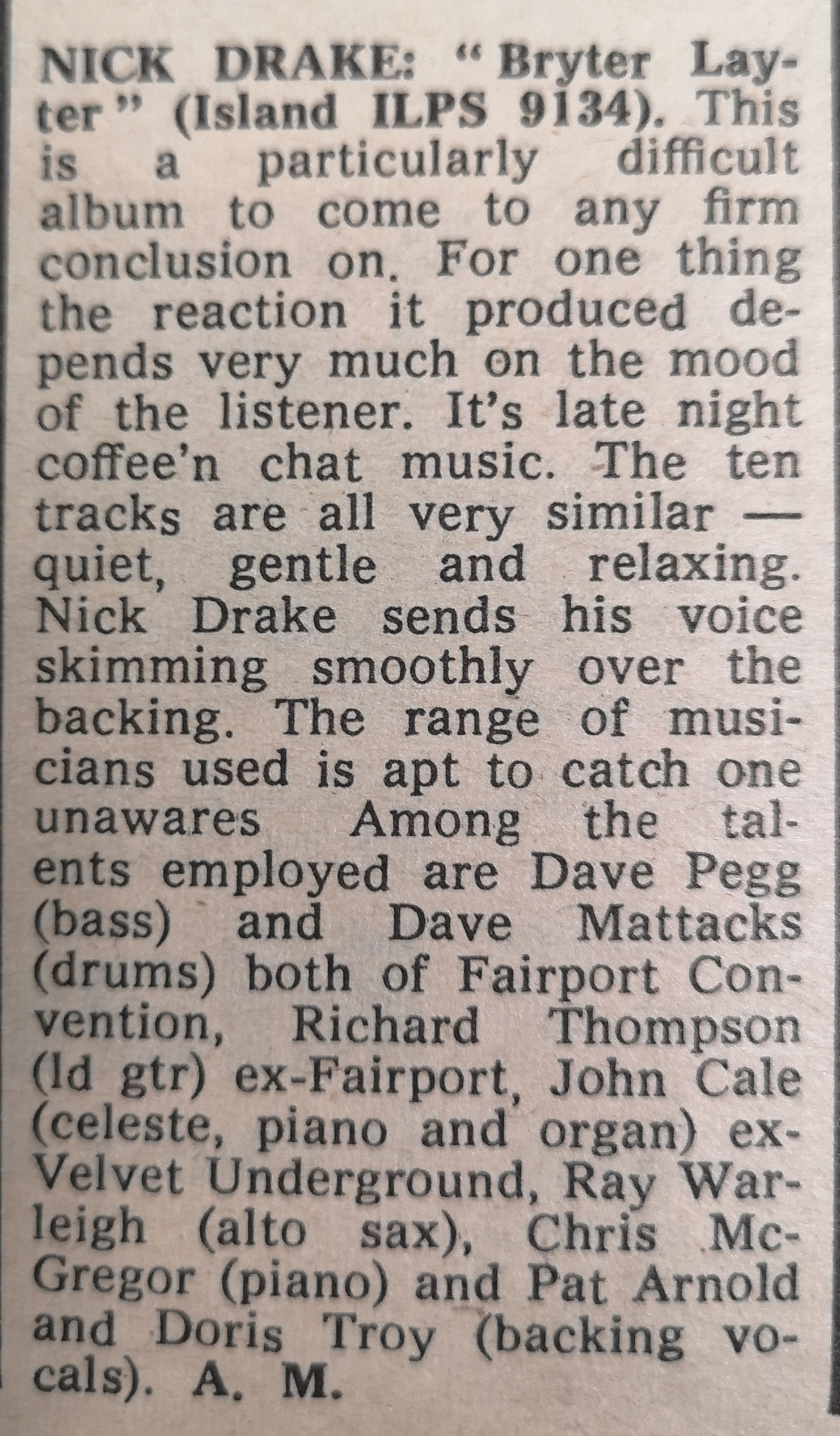
Melody Maker 20 February 1971
Of course, the listener is beguiled by Drake’s voice, wistful, and oddly distant. The melodies are undemanding and rarely stray from what is suggested by the chords, and I have a sense, notably on At The Chime Of A City Clock that they started life as chord sequences to which lyric and melody were added. Lyrically, well that’s where things get odd.
Because of the direction of his life prior to his early death, caused in part by the failure of this album to make an impression at the time, there is a temptation to read his later life back into the earlier lyrics, looking for clues, so to speak. To do so would be to assume that the narrators of his songs are expressing Nick’s own interior thoughts and feelings, and I’m wary of making that assumption.
In any event, the quest for meaning is sabotaged by the lyrics themselves, some of which are painfully adolescent in their rhymes. More to the point, I’m coming to the conclusion that the lyrics, by accident or design, suggest meaning while being so opaque as to defy meaning. Like the music itself, there is an element of tone poem in these songs. In this he differs from the songs and poems of his mother, Molly, whose meaning is always clear.
I found it interesting to listen to this again in the context of ten months immersed in the music of 1970. Reviews these days call Bryter Layter his ‘masterpiece’ and wax eloquent about it. I’m conscious of swimming against the tide when I say that this is a good album, but, in a year of good albums, it doesn’t stand out from the crowd as anything special. Pleasant and beguiling though it is, it doesn’t surprise me at all that it sank without trace.
I listened on CD, but it’s available everywhere including Spotify and multiple YouTube playlists, one of which is below.

Recent Comments