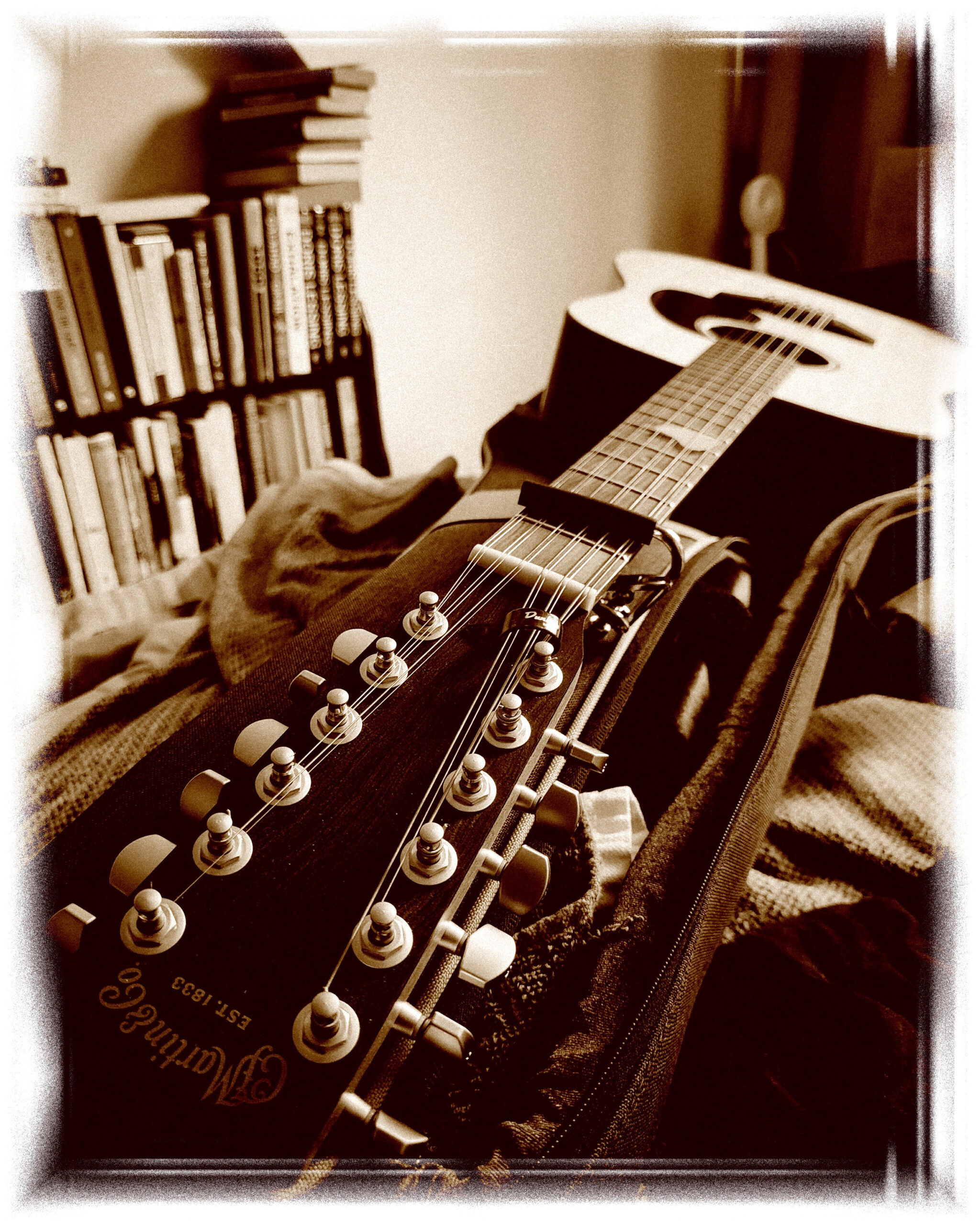
I bought a 12-string guitar. For the nerds amongst you it is a Martin MX X Series D-X2E (MX meaning built in Mexico rather than Pennsylvania.) It is at the low end of the Martin range but it does what I need it to and does it well and certainly came out ahead of a Taylor I tried for comparison, to my ears at least: the Taylor was in many respects a ‘better’ guitar but I preferred the Martin’s low and mid-range response. I could probably have done better on the used market but used means no warranty or aftercare.
I bought it for two reasons, the first being simply that I wanted a 12-string guitar. The second is because I’m playing some songs with a friend of mine at an open mic and, if that continues (and I think it will) a 12-string adds to the harmonic possibilities for at least some of the songs we’re working on.
However, now that I’ve played it for a while other thoughts occur. It seems to me that, at least in terms of possibilities, the 12-string is a different instrument to the 6-string.
Way back in the 1970s when I started playing guitar my interests grew beyond strumming into finger-picking and the kind of playing to be heard on the UK folk scene mostly, though not entirely, influenced by Davy Graham and Martin Carthy. Later, I heard blues and ragtime players and tried to learn some of that and messed around with altered tunings. I’m not claiming to have been any good at it, but it kept me amused and out of mischief and the influence lingers.
I’m getting a similar feeling as I mess around with the 12-string. There are some obvious technical differences in playing such as favouring chord voicings with open strings and the trickiness of catching the string courses properly with a thumb-pick to get the effect, but there are others. In particular, I think there are possibilities from treating the octave strings as more than just resonating strings. I’m having a hard time finding people who have done that whom I can initially copy as I figure things out, though Leo Kottke and Mark Spoelstra in America and Michel Gentils in France spring to mind, as does John Butler in Australia. And inevitably, my mind turns to a second, used 12-string to tune to DADGAD and explore possibilities. I dislike the term ‘Celtic’ for lots of reasons, but I think what has come to be called ‘Celtic Music’ is full of possibilities on 12 strings.
To be clear, I have no plans to buy yet another guitar, but if I spotted a 12-string in a charity/thrift shop with a neck that wasn’t pulled out of shape then I’d find it hard to resist.
I’ve had some lovely comments on my last post on social media and by email, for which thanks. We took a break for a couple of days at Beamish Museum and at Durham Cathedral, and I enjoyed both very much. Beamish particularly tickled my memories because some of the exhibits are from the town my Dad lived in until national Service intervened, and which I visited a lot as a child. I also very much liked the draught brown ale from the Firebrick Brewery in the 1900’s pub. Beamish is somewhere I’ve wanted to visit for a while and it didn’t disappoint. If I get my act together I’ll put some photos up here.
Otherwise the week has been quiet and I’ve vegged in front of the screen. I’m not generally a fan of DC films and TV but I did enjoy Lanterns. Back in the 1960s I enjoyed the Green Lantern comics (and wish I still had them). I also watched Spider Man: Brand New Day which is a decent film. Tonight I revisited Thor: Love and Thunder which is a bit too jaunty but on a rewatch is better than I remember it from first time round. Marvel has lost its mojo somewhat and there isn’t much due that I’m interested in; I’m certainly not interested in the forthcoming Russo Brothers Avengers spectacular. The last two were triumphs of spectacle over substance. You might object that I shouldn’t expect substance from superhero material but at their best they can be good vehicles for metaphor as well as just plain entertaining. The more recent Avengers films have been neither metaphor nor entertaining.
Yesterday our central heating was turned on, though one of our apple trees still has a lot of fruit waiting to be picked. A job for the weekend if the weather holds. Also, as autumn sets in I have writing to do.
I’ve had some fun putting together a playlist of music from each of my 67 years. I’ve linked to the playlist below but I’ve also written a sentence or two about each piece, so this is a very long post.
My self-imposed rules were that a named artist should only appear once and that I would forego any progressive rock epics. I also put aside any notion of guilty pleasures – I’m too old for that shit. Beyond that my criteria were fuzzy; mainly they are songs that I was listening to at the time and that I associate with periods in my life; a couple are songs I associate with my kids. Most are relatively short, though one or two stray over the five-minute mark.
The list is one remembered soundtrack amongst several.
I have not selected things I later discovered that younger me hadn’t heard yet. The obvious exception to that is Miles Davis because, despite rumour to the contrary, I didn’t come out of the womb listening to modal jazz. Some of the late 1960s songs were ones I discovered in the early 70s but in the circumstances I’m OK with that.
Several things about the playlist strike me when I look at it. One is the change in popular music over nearly seven decades and the eclecticism of my changing tastes; another is that as the years went on I had a decided preference for female artists/vocalists. Four years refused to be constrained by one song: what could I do except allow them two entries? Also, looking at this list you would think that punk passed me by; it didn’t. As I said, this is one soundtrack of my life amongst several.
The playlist is only on Spotify. My original plan was to create it on two or more platforms but it got too unwieldy. If you decide to have a listen, my suggestion is that you play it ‘cold’ without looking ahead to see what comes next, and if you don’t like a song, another will be along shortly. On the whole, it benefits from being played loud. A couple of songs have language you wouldn’t expect to hear at your gran’s on Sunday unless grandad has been on the idiot broth.
The notes on the songs are below the link: 72 songs, 4 hrs 28 mins
1959 So What? The longest track on the list. I have a diary entry from 5 August 1998 that reads, ‘The Singapore skyline on a sultry night with Miles Davis’ Kind of Blue insinuating itself is just magic.’ I was playing it as loud as I could on an early Toshiba laptop with plug-in speakers.
1960 Apache. Deeply engraved on the British psyche, and mine.
1961 Andante in C. Guiliani, better know as the theme to Tales From the Riverbank. The first of all of these tunes/songs that I clearly remember from childhood, watching on a tiny black and white TV that was next to the coal fire in our front room.
1962 Fireball XL5 theme. Mum tells me that I was a fan of Supercar before this, but I don’t remember that. Fireball XL5, Stingray and Thunderbirds are firm in my memory though, not least because of TV Century 21 comic, first published in January 1965.
1963 Dr Who original theme realised by Delia Derbyshire. Mum tells me I watched the first episode in November 1963 or, at least, was sitting in front of the telly while it was on. Famously, that was the day JFK was assassinated and CS Lewis and Aldoux Huxley died. 1963 was the annus mirabilis when the 1960s began (between the Chatterley ban and the Beatles’ first LP).
1963 All My Loving. And boom! it’s the sixties. One of Macca’s most overlooked bass lines, especially in the context of 1963 pop music
1964 Downtown. The joint best record Jimmy Page ever played on (the other is Goldfinger).
1964 Another You. I’ve many times said that I’d start a Seekers tribute band like a shot if I could find someone who sang anything like Judith Durham.
1965 Moanin’ When I started playing guitar, Davy Graham’s Anji was the thing to learn, albeit via Bert Jansch and Paul Simon. When I bought Graham’s Folk, Blues and Beyond around 1977 (an original mono pressing on Decca, for pennies, that Davy later autographed for me) this version of the Bobby Timmons classic buried into my brain on first hearing and wouldn’t come out. The sound of swinging London.
1966 Take a Giant Step. A Goffin-King song from the Monkees’ debut album, which I still have in a very battered state. The show first aired on British telly in December 1966 and I remember watching it.
1967 Lucifer Sam; Piper at the Gates of Dawn is the best Pink Floyd album and this is a favourite track on it.
1968 Those Were the Days. A TV and radio memory from the time. I had lots of cooler songs I could have chosen for 1968 but I’ve always liked this and I bet you’re singing along too. Macca is on this as well, though not as lead artist so that’s alright (he persuaded Mary Hopkin to sing it, produced it, and probably played guitar on it.) In 1968 I saw Yellow Submarine twice in one afternoon around my ninth birthday (when I also saw a Brian Clough-managed Derby County beat Preston North End 1-0 at the Baseball Ground. Alan Hinton scored).
1969 Mrs. Robinson. I was a big fan of Simon and Garfunkle and Paul Simon through the 70s to today. I think the EP of Mrs Robinson was the first thing of theirs that I bought, at a jumble sale. I still have it. We left Derby on March 9 1969 and moved into a brand-new house in East Kilbride the next day. It brought gas central heating and culture shock.
1970 Ride a White Swan. This and Jeepster were the sound of primary school, although I asked for Abbey Road (1969) as a Christmas present in 1970 and still have that copy. Wear your hair long, babe, you can’t go wrong.
1971 Mythical Kings and Iguanas. I heard Dory Previn at a friend’s house around this time and taped both this and On My Way To Where. The benefits of friends with big brothers and sisters. I was too young to get what all of her songs were about but I grasped that I was listening to something special and that it was qualitatively different from The Partridge Family. I saw Dory at the Apollo in Glasgow in 1977, my second gig (support was Jane Relf’s Illusion). Her later Mary C Brown and the Hollywood Sign cropped up as a poem in an English class at school.
1972 Mama Weer All Crazee Now. The first single I bought with my own pocket money. The second, a week later, was The Jean Genie.
1972 Sylvia. The tune that made me want to learn guitar. This was on Focus 3 which I didn’t get until later, but Moving Waves and Hamburger Concerto were mainstays throughout the 70s, and I still play them. 1972 was also Hawkwind, Alice Cooper, Roxy Music and Wizzard.
1973 Hard Rain. Brian Ferry at his best. One the greatest Dylan covers, perhaps the greatest. I have a distant memory of hearing it playing over the speakers in the music section of Boots in East Kilbride. Try telling that to the kids today. 1973 was also the year of Tales From Topographic Oceans, Dark Side of the Moon, Brain Salad Surgery, Sabbath Bloody Sabbath and David Essex’s Rock On. I think it was August 1973 that I went to a Radio1 Roadshow in Largs hosted by Stuart Hendry; I have a vague memory of the Waverly passing the Promenade while Life On Mars played out under a hot evening sun.
1974 Free Man in Paris. First heard on John Peel one evening in 1974 and soon sourced on cassette via a schoolmate. Court and Spark may be my favourite of Joni’s albums in a strong field. Yes released Relayer which was played in its entirety on late-night Radio 1 with Rick Wakeman commenting. I recorded that show but the tape is long gone. Relayer was my point of entry into Yes.
1975 Maid in Heaven. I also first heard BeBop Deluxe on Peel. I think I’ve had the album it came from, Futurama, in one form or another ever since, initially on cassette (home taping is killing music, kids). A life-long liking of Bill Nelson resulted. I went on a summer schools cruise on the SS Uganda in July 1975 and bought Blue Öyster Cult’s Secret Treaties in Helsinki, another I still play, first heard on the Alan Freeman Saturday Rock Show; not ‘arf.
1975 Goin’ Back Home. Like many others I first saw Dr Feelgood on The Old Grey Whistle Test and was instantly hooked. This song was an enduring standard in Wilko’s post-Feelgood shows.
1976 Oxygene Pt.4. I never really got into Jean Michel Jarre’s music as a whole but I did like this and it’s been an ever-present ever since. Fun fact: when I got quite ill in China in 2016, I listened to this on repeat for a large part of the long flight home. Also in the frame for this year: Year of the Cat, Car Wash, (Don’t fear) The Reaper, Don’t Touch Me There, Coyote, Hurricane and several others that could easily have been here instead. I attended my first gig in April 1976 – Camel at the Glasgow Apollo. I remember we listened to Olias of Sunhillow a lot too.
1977 Wonderous Stories. Yes had to be on this list somewhere; even so I swithered between this, Pretty Vacant and Birdland amongst others. The year I came to Edinburgh and started university on my eighteenth birthday, and the idea of being 67 was a ridiculous notion for the far distant future. In my first week another new student and now old friend played me Mississippi John Hurt and my musical world changed.
1979 There Ain’t Half Been Some Clever Bastards. The B side of Hit Me With Your Rhythm Stick. This was the year I made my mind up to switch around what I was doing at university and focus on the academic rather than vocational side of theology.
1980 The Game’s Up. I had a thing for Sniff’n’the Tears at the time and played them a lot. I think this was the first of several albums by them that I bought. I was also listening to a lot of Frank Zappa and made my first visit to the Cambridge Folk Festival where I first saw the great Leon Redbone live, and also one of the greatest live acts I’ve ever seen (Rockin’ Dopsie and the Cajun Twisters); Richard and Linda Thompson, Leo Kottke, Vin Garbutt and Don McLean amongst many others performed.
1981 Help Me Somebody. My Life in the Bush of Ghosts and Talking Heads generally, were favourites in my student crowd. I bought two copies of the album, one as a gift and one to keep, the original version with Qu’ran. And I might be old but I saw Jerry Garcia play live, Edinburgh Playhouse, 30 September 1981.
1982 Golden Brown. A staple of the Potterow Student Union jukebox in my final year. The year compact discs first appeared in Japan. On 27 April 1982 I saw Marillion for free in Chambers Street Student Union downstairs bar. We stayed for half a dozen tunes then left for whatever we had planned for that evening (I had a dissertation to finish). I remember that they were OK but thought they wouldn’t get far with such a daft name.
1983 Moonlight Shadow. 1983 was a strange and ultimately tough year personally and at the time I found the straightforward melodicism and darkness of this comforting. I remember playing it a lot on the jukeboxes of various Edinburgh pubs.
1984 Will The Wolf Survive. Los Lobos. Played to death at the time on an a pre-recorded cassette that, remarkably, I still have and play.
1985 Ghost in the Music. I got into New Country via Andy Kershaw. There was no internet then so imported LPs came on mail order from Mike’s Country Music Room in Aberdeen, from whom I received a regular stock list in the post. Early Nanci Griffith, before the Nashville star machine took over, was a favourite.
1986 Guitar Town. Another Kershaw discovery, another import purchase. Also big on my record player at the time, Elvis Costello, King of America.
1987 Disturbance at the Heron House. I had an REM obsession for a while; this is one of many songs that stick forty years later.
1988 Fast Car. All over the radio at the time and still great.
1989 Eat For Two. 10,000 Maniacs. I listened to this a lot while we were expecting our first daughter. Not especially appropriate lyrically in the verses but the chorus resonated.
1990 Birdhouse in your Soul. Once heard, instantly smitten. Released late December 1989 but I didn’t hear it until 1990, the year I started my second degree.
1991 My Affair. Kirsty had to be here somewhere, I have all her mainstream albums and could have picked loads of tracks from any of them.
1992 Sheela-na-gig. Another that I first heard on a Peel Session. I later had it on a running playlist on an iPod Mini Shuffle. I’ve used the Peel Session version from 1991 here. Another option I considered was something from Loudon Wainwright’s History, which I played a lot around that time.
1993 Big Time Sensuality. The video was a staple of MTV while I was finishing up a Diploma in Legal Practice. The Diploma was intensely boring so I took a course called Scots Law and the Western Legal Tradition out of interest. It turned out to be one of the most engaging and stimulating courses of my entire time at university and a big influence even now (class medal, I’ll have you know.).
1994 Anchor Me. New Zealand’s finest. I have most of the Mutton Birds’ releases but this was the first song I heard by them, on Radio 1, while making supper.
1995 Missing. I wasn’t much for remixes until I heard a bunch of EBTG remixes and this one stuck. Fun fact: the line I need you like a desert needs rain appears in Love Buzz by Dutch popsters Shocking Blue in 1970.
1996 Wasteland of the Free. Iris deMent came to prominence with My Town, a melancholy, elegiac take on small town America. Then she delivered this righteous slice of angry prescience.
1997 Firewalker. Rickie Lee Jones is an artist whom I will always go and see given the chance. A colleague at work said Ghostyhead was her weakest album; he was as wrong about that as he could possibly be.
1998 Drivin’ South (alternative take). Recorded 6 October 1967 but not released until 1998. The 3 versions of Drivin’ South on the BBC sessions are, imo, the best things he ever recorded.
1999 Constitution March. The great Norman Blake. Fun to listen to and fun to play when my fingers work as they should.
2000 Solitary Man. I have Cash’s two prison LPs from the 60s and got them quite early in the 70s but then drifted away from him until the American Recordings series came along. A Neil Diamond song.
2001 Walk Through The Fire: from one of the greatest hours in modern television history, first broadcast 6 November 2001, Buffy the Vampire Slayer’s Once More With Feeling. Apocalypse: we’ve all been there.
2002 Willow Tree. I knew Anglicana was going to be here as a nod in the direction of the Carthy/Waterston clan and this is a favourite track.
2003 Going Under. I took my elder daughter to her first gig, Evanescence, on 4 November 2003 at the Carling Academy in Glasgow, and enjoyed it a lot myself. Also played a lot this year, the soundtrack to A Mighty Wind.
2004 Fires of Edinburgh. I first encountered Nick Keir in the early ’80s, upstairs in the Waverley Bar on St Mary’s Street by the Netherbow where he was playing a set to a very small audience. The album this is from, All Over This Town, is one I play a lot. The song describes an Edinburgh I knew well when I first came here in 1977 but is disappearing under the weight of tourism now.
2005 Elfin Knight. From my Kate Rusby period and one I still listen to. I was sorely tempted to put Porcupine Tree’s Arriving Somewhere But Not Here in the 2005 slot, because I played (and play) it a lot, but it’s 12 minutes long so I forbore. 2005 also saw a new album and a joyous reunion tour by Van der Graaf Generator, which also tempted me here.
2006 Good For Me. I came to Above & Beyond late when this turned up on the soundtrack to Sense8 season 2 and I bought the album the next day. Gets played regularly in the shed.
2007 Artificial. Martha Tilston was another love at first listen artist.
2008 A&E. I could have picked a number of Goldfrapp tracks but this is one I listen to a lot on playlists.
2009 Gone, Gone, Gone. I never really liked Led Zeppelin back in the day, but I do like Plant’s work freed from the Led shackles. His collaboration with Alison Krauss was great.
2010 Kolnidur. Jonsi. I first heard this as the music on a timelapse video of the Eyjafjallajökull eruption and tracked it down immediately. (the video is still there: https://youtu.be/9EVPHmhOtmo)
2011 London. Thea Gilmour. The BBC used this a lot in 2012 for their London Olympics coverage which was where I first heard it. Bought the album and still play it. Lyric by Sandy Denny.
2012 Call Me Maybe. Great pop song and one I associate with my younger daughter while she was in China.
2013 Delta Dreams. I first saw Martin Simpson at the 18th Cambridge Folk Festival in 1982 and kept up with his work. I liked this one the minute I heard it.
2014 Do You Believe in Me? Late-career Peggy Seeger. My copy of this is signed.
2015 Go! The tune that ignited my love for PSB.
2016 Achmed Flyger. I think I bought this Dungen album on the recommendation of Sid Smith.
2017 Los Ageless. I bought this and other material by St Vincent after seeing her on telly at Glastonbury.
2018 Feel Good. When they were young women, Ace of Cups played with the Grateful Dead and opened for Jimi Hendrix. Then they got the band back together as grandmothers. Love this. (https://youtu.be/6KqPCFw-VHQ). Denise Kaufman (lead vocals and bass on this) was known as Mary Microgram back in the day when she boarded Ken Kesey’s bus.
2019 Erin-go-bragh Dick Gaughan. Recorded live in 1982 but not released until 2019 and an instant buy.
2020 Betty. Easily my favourite Taylor Swift song, because I was an idiot 17-year-old boy once too, and the least said about that the better.
2021 Smile. Wolf Alice were another Glastonbury find.
2022 Continuum. My first encounter with Tangerine Dream was Phaedra, released in 1974. After their classic era I lost interest but I like their most recent albums and Raum from which this is taken is a regular on the cd player.
2023 Status Report. Most of 2023 I spent listening to Blue Note and ECM jazz, The Grateful Dead and Phish, which aren’t really suitable for here. I can’t think of any releases from the year that made any impression. But. Star Trek: Strange New Worlds did a musical episode, Subspace Rhapsody. A most confounding thing, it took a lot of its cues from Buffy’s Once More With Feeling (see 2001). It was cheesy and silly and hard-core Trekkers professed to hate it; I loved it, downloaded it and watched it a number of times (and still do).
2024 White Rabbit. Molly Tuttle being both serious and whimsical. Not an obvious cover, and Molly doesn’t have the raw power of Grace Slick’s voice, but it works.
2025 Falmouth Electrics. I could have had Half Man Half Biscuit in the list for many years (and did in earlier iterations). Another must see when they come through town. 2025 was the year of my cancer diagnosis and I spent a lot of time in medical facilities trying to reach some kind of dissociative mental state while I was scanned, sampled and prodded; the soundtrack to that was either ambient burblings or extended jams by Goose. The Biscuits gave welcome relief. A’ ye go’ any Gauhaus?
2026 Grooved Whale Hybrid 2. My initial choice for 2001 was going to be Lisa Walker’s fabulous Grooved Whale but it isn’t on Spotify. Just in time, she has some new music out 🙂 If not for Lisa, I would have selected something from the new Ozric Tentacles album.
‘And all I ask is a merry yarn from a laughing fellow-rover,
And quiet sleep and a sweet dream when the long trick’s over.’
Cancer changes you. There is a distinct ‘before and after’ from the time a doctor first calls to say something is up. That call came for me late afternoon 3 January 2025 and even then, according to my journal, I knew that it was the day when I had to start working out what was important to me and discarding the rest. My PSA was at a level where, statistically, cancer was more likely than not.
The mental change persisted through the protracted process of diagnosis. My GP thought the most likely cause of my high-ish PSA was benign prostate enlargement and so did the urologist. An MRI was inconclusive and the consultant recommended a biopsy to confirm the diagnosis of benign enlargement. The transperineal biopsy was undignified,uncomfortable and unpleasant though not acutely painful. The medical team were great and also reassuring based on the MRI scan. That was Saturday 28 June; the following Thursday I ran 5K with no great difficulty. On 16 July it was confirmed that the biopsy had found cancer. It was only then that I talked about it with anyone other than Kirstin.
Despite it all, I was sleeping well and was reading Rick Rubin’s The Creative Act, a book that has a mixed press but which I like as a series of short pieces that provoke thought whether you agree with them or not. It reinforced my view that creativity is resistance. I kept up the creativity through the whole period of diagnosis, decision making, treatment and recovery but its expression varied. I made some notebooks/journals, rebound an old copy of The Lord of the Rings, wrote some dodgy poetry and tried to keep going with the novel-in-progress, though the latter was difficult. I began a separate journal dealing with what might loosely be called Spirituality trying to deal with thoughts that arise from that ‘before and after’ moment. Lately I’ve been playing guitar more.
And through it all, the thoughts of reinvention in the face of (averted) mortality continued, but the thing is, once you have been confronted by potential mortality, the encounter does not leave you unscathed and the need to reconcile oneself to it remains.
And so, reading John Masefield’s great Sea Fever in bed the other night, the final couplet quoted above packed a powerful metaphorical punch. I don’t know if Masefield actually intended the poem as a metaphor for life and death, but it read that way and once seen can’t be unseen. What was once something of an old warhorse suddenly overflows with meaning.
To be clear: I’m fine, just changed a bit and working through the changes.
I must go down to the seas again, to the lonely sea and the sky,
And all I ask is a tall ship and a star to steer her by;
And the wheel’s kick and the wind’s song and the white sail’s shaking,
And a grey mist on the sea’s face, and a grey dawn breaking.
I must go down to the seas again, for the call of the running tide
Is a wild call and a clear call that may not be denied;
And all I ask is a windy day with the white clouds flying,
And the flung spray and the blown spume, and the sea-gulls crying.
I must go down to the seas again, to the vagrant gypsy life,
To the gull’s way and the whale’s way where the wind’s like a whetted knife;
And all I ask is a merry yarn from a laughing fellow-rover,
And quiet sleep and a sweet dream when the long trick’s over.
There’s a saying, attributed to Peter Drucker, that if you can’t measure something you can’t manage it. The unspoken corollary in an age of KPIs and data tracking is that if you can’t measure it then it isn’t important. For a long time I’ve held the opposite view, that the things you can measure are often the least important.
That’s a broad rule of thumb: some numbers are important and worth tracking such as, in my case, HbA1c, blood pressure and PSA, but others are a problem, which brings us to Orthosomnia. Orthosomnia is a relatively recent (2017) term for becoming obsessively focused on sleep tracking information from a smart watch and incurring damage because of it. There’s more information here:
I have a couple of smart watches (one ancient and near end of life and one more recent) that I find useful when I’m exercising and have tended to keep on my wrist all the time. They gave me useful information about heart rate and the like, but both of them are now turned off and in a drawer because I caught myself looking at the data all the time and sometimes feeling anxious about it. Some of that was to do with sleep but some was to do with the other notifications and tracking that the watch does, or purports to do, and I was getting irritated with the scolding quality of the notifications. And there were some odd ones: you’ve had a stressful day it would nag as I sat in a recliner with a book, or conversely you’ve had a relaxing day when I’d been to the gym and been more active than usual. Also the messages seem to be calibrated towards a notional person in their thirties rather than a man in his sixties recently treated for cancer. That isn’t a huge surprise with a mass-consumer product, and some personalisation is possible, but not much and not enough.
In any event it isn’t entirely clear what the watches are measuring, and a lot of what is being ‘measured’ as a health statistic is not something that can reasonably be called manageable in a cause and effect kind of way. In principle I could just look at trends, but that is to make the best of an unhelpful situation when it is easier just to cut it adrift.
There is also significant disruption in my current ‘health statistics’ because of the impact of the hormone implants on my metabolism and sleep patterns. The bigger picture is summarised well in the following extract from recent correspondence with a doctor:
Androgen deprivation is a very powerful intervention, and what you’re describing is a direct consequence of how it works rather than a sign you’re doing something wrong. Cancer treatment involves specific and very influential medications, and when those are in play, diet and lifestyle often don’t shift weight and appetite the way they otherwise would. What worked for you in 2021 [to put type-2 diabetes into remission] may simply not behave the same way now.
What I can say is that the foundations haven’t changed. Sleep still matters enormously, and it’s worth protecting properly. So do stress levels and social connection, which get far less credit than they deserve. Eat whole foods, broadly Mediterranean in shape. Keep moving, and lift weights, which I’d emphasise more than usual given what hormone therapy does to muscle and bone over time. Those things are the right thing to do whatever else is going on, and at your stage they’re probably the highest value things available to you.
The medication that caused this is almost certainly the same medication that bought you your outcome. Some of what you’re living with now is the price of something that worked. That doesn’t make it less annoying, but on the whole it’s a good problem to have.
Eating whole foods to a Mediterranean-style diet (so-called), exercising with weights and aiming to get decent regular sleep are things that I do, and I don’t need to be hectored by a watch in pursuit of an illusory ‘perfection’ based on questionable metrics; what is more important to me is the very real sense that I’m feeling fine and doing the right things.
I’ve been in a strange mood of late, and two things are on my mind; one is global heating, the other is the state of the economy in the age of Mango Mussolini.
In the case of the former, the overwhelming public discourse is around how this has been an ‘exceptional summer’ in the northern hemisphere and tropics. The missing context is that this year’s summer will, short of a major volcanic eruption (which will bring its own problems), come to be seen as cool by comparison with what’s to come. We are firmly on course for an uncontrolled global temperature rise of at least 2° above the historic average (however that is baselined) and that will be catastrophic.
This isn’t a new thought: it has been a constant in this blog and its predecessor; it underpins my second book of what are ostensibly vampire stories, The Butcher Bird. The background of those stories is that emissions have been halted but changes already in the system continue unabated. When writing that book I kept up to date with the science and every time I thought I’d gone a bit too far for dramatic effect I would later have to turn the dial up a bit more. Perhaps there’s another book there; hooray.
In the case of the economy, so much of the world’s finances and institutional investment are now tied up in the multiple Ponzi or Ponzi-adjacent schemes and corruptions in the US markets that, to use a well-worn metaphor, one domino brings the rest down in a way that makes the great liquidity crisis of 2008 look like a dress rehearsal. I’ve long thought that we never properly addressed the structural and behavioural issues that underpinned 2008, especially network interconnectivity and interdependency, and the consequences of those issues will manifest with the inevitability of earthquakes releasing tectonic stress. Whatever triggers the collapse of the AI bubble, the rippling impact will be immediate.
The impacts of both the above are likely to strike and strike hard within the ten years, probably well within that period, and the impacts will compound. We are, of course, wholly unequipped to deal with either let alone both. The warnings have been there for years if not decades; I have no expectation at all that our political classes will do anything substantive to find and implement mitigations. I stick to my view that the notion of ‘net zero by 2050’ is a useless form of words used to disguise doing nothing at all; a manufactured fantasy to ignore the science. Indeed the current mood in the USA is to decry the science as fake and consciously sabotage mitigation efforts; this is dreadful but only an extreme example of the general trend of elevating political and financial expediency over physics. And there’s no excuse.
None of this means that we should do nothing, but it does set the context for whatever it is we do even if that is too little too late. The first step is to change our relationship with the petro-chemical industry utterly and decisively. Given the widespread devastation caused by fire and floods this year one might hope that the penny might drop where it counts, but it won’t.
I published a couple of parallel pieces on Substack, one to do with physical consequences of cancer treatment, and one on creative consequences. If you’re interested, you’ll find them here:
I decided to call my ADT-induced moobs Liam and Noel because they are a pair of useless tits who won’t go away.
More seriously, talking with other men in a similar situation, it is/was naive of me to think that as the hormones wear off the side effects will just roll away. I think the only way to counteract the impact of the hormone treatment is to go back to the diet and exercise disciplines I adopted to get rid of type-2 diabetes four years ago. Here we go again.
***
For various reasons I have bought a ticket for each night of the Rush shows in Glasgow next March and have been making my way chronologically through their back catalogue. I am forming opinions and in due course will express those opinions here. I suspect a lot of long-time Rush aficionados will disagree with those opinions. I’m looking forward to it.
***
I haven’t yet seen Christopher Nolan’s Odyssey but I have watched two of this year’s other releases, albeit on the small screen, The Mandalorian and Grogu and Supergirl. Both were very efficient, well-made pieces of corporate entertainment; both were formulaic and empty.
I’ve spent most of the month since I last posted sitting out under a sun umbrella either reading or trying to write. A lot of the reading has been research for the writing, and has included spells in the National Library, Edinburgh Central Library and the National Records. In terms of fiction I’ve been deep diving once more into Dorothy Dunnett; I really enjoyed her second series of historical novels, the House of Niccolo series set in C15 but have always found her earlier series, the Lymond novels (C16) harder to get into and that’s my current task. So far so good.
I thought writing would flow more naturally once the worry about cancer receded but I’m finding it tough to get back into it. My process is to turn up for work every day with notebook or MacBook and trust that sooner or later the Muse will come and join me. I’m getting there but it’s slow going.
***
I have occasional conversations with other men who have been through, or are still in the middle of, the prostate cancer experience. Those of us who have had the hormone treatment tend to gripe about the inexorable weight gain that is common amongst us. One chap said that he had named his moobs Thelma and Louise and I got to thinking about mine – Agnetha and Anna-Frid? Althea and Donna? Suggestions on a postcard, etc.
Added: since writing and publishing this my perspective has shifted somewhat. Stay tuned for further thoughts 🙂
Rush is a band that has never done much for me. I recognise the quality of the musicianship but the music itself has never grabbed me. I have several of their CDs, the ones the hardcore fans talk about, that I bought cheap some years ago and every so often I put one on to see if I like Rush yet and the answer is always no.
I mention this because Rush are making waves with a reunion tour with Anika Nilles taking the drum seat left by the death of Neil Peart in 2020. Despite my general feelings towards Rush, I enjoyed the first appearance of the ‘new’ Rush (which includes Loren Gold on additional keyboards) at the Canadian Juno Awards (embedded below) and have been dipping into fan footage of the first shows of the tour.
The musicianship is evident as is the fun and joy on stage. Anika is a force of nature and made the vacant chair her own on the first night of the tour proper; judging by the big cheesy grins on the faces of Alex Lifeson and Geddy Lee they know it too. A lot of the footage has been of them playing Tom Sawyer which, although this is a cliché, is one of the few of their songs I like – musically at least, I have no idea what is going on in the lyric. I’ve also embedded the performance of the song from night 3 of the tour and it is evident at the very end just how much fun they’re having; Lifeson’s face (around 5’16”) in particular is a picture of happiness.
Anyway, two things have come out of this. The first is that I checked out the prices of their Glasgow dates next March thinking it might be nice to tick them off the list of bands I’ve seen. I looked at the numbers then put my credit card away again. The second is that I had another listen to one of their popular albums: I was part way through track two when I turned it off. Still no.
Added: since writing and publishing this my perspective has shifted somewhat. Stay tuned for further thoughts 🙂
Recent Comments