The BBC’s statement this week on the future of Dr Who has provoked a lot of comment, not least because it whiffs of a chaotic rush job to mask behind the scenes issues. For this viewer since 1963, there is a sort of sadness but not a lot of surprise.
Cards on the table, the idea of contracting production to a company other than Bad Wolf under a lead writer other than Russell T Davies is necessary, not because I have any particular animus towards them but because I think their time has run its course. Spectacle and melodrama have increasingly nudged thoughtful writing aside and the show got caught up in a doom loop of diminishing returns soundtracked by Murray Gold’s over-wrought incidental music that never shuts the fuck up. Yes there were latterly some very good episodes, but they shone against a dimming background.
Dr Who has a long history of experimentation, exploration and invention, balanced by an equally long history of bathos and ridiculousness; each of those things lie behind both its persistence and charm as well as those moments that invited things to be thrown at the TV screen. This is not just a New-Who thing: critics of modern incarnations often forget that both Colin Baker and Sylvester McCoy had to put up with some seriously weak material, Baker especially, before the show was put out of its misery and placed on its long hiatus.
Dr Who is, in many respects, a victim of its own longevity and also labours under the expectations of vocal, online fandom [as I’ve said before, fans are great but fandoms cleave to toxicity.] The well is poisoned by notions of canon and rigid canonicity is policed by obsessives with nothing better to do but whinge on YouTube. Even so, despite having all of time and space to play with, somewhere along the way the producers ran out of ideas about what the programme could be, or perhaps they knew it but no one had the courage or vision to carry it through except in occasional flashes and glimpses, most consistently recently in the Peter Capaldi incarnation.
What if?
Writing has moved on since 1963 as has televisual language, not just in terms of major points of reference like Twin Peaks, Sense8 or Buffy the Vampire Slayer, but in the conceptual possibilities of all genre and cross-genre programming. Dr Who was conceived in the era of Robin Hood just like Star Trek was Wagon Train in space. As I write, I’m rewatching the magnificent Arrival which, like the story it came from, Ted Chiang’s Story of Your Life, exemplifies a way of treating time and language and adventures in time in a thoughtful, emotional and intelligent way that Dr Who has rarely approached. Can you even begin to imagine Arrival or Project Hail Mary scripted by RTD?
There have been some very, very good stories told, notably in the Steven Moffat era, but we’ve also had a succession of good actors doing good work over increasingly short tenures and having to do their best with shallow or inadequate material, or good material produced on the cheap, or stories that fail to rise above a premise, with poor dialogue and a lack of substance. Jodie Whittaker, whose Doctor I liked, also had to contend with Covid and lockdown.
Would a general audience respond well to a Dr Who that cloned the off-kilter modernism of Twin Peaks, the Return and mixed in Arrival or Annihilation? Probably not (though I would), but it would respond to a writing and production team with an expanded conceptual language. I do not suggest a complete reimagining but I would like a conceptual regeneration featuring coherent stories by talented writers that engage at least two of the following three: my emotions, my imagination and my intelligence. I’m not expecting Andre Tarkovsky or Denis Villeneuve or Alex Garland, and at heart Dr Who is a family show, but a tangible sense of meaning and depth wouldn’t go amiss.
The danger is that the BBC will award the production contract to a company that promises more of the same, that the corporation will run scared of the creative imagination. That is, after all, what it normally does. How much better would it be to honour the original vision of Verity Lambert and give us something that finally matches the unworldly possibilities of Delia Derbyshire’s original and unmatched realisation of the theme
[Added after first posting, it occurs to me that Dr Who would benefit from a spin off that stands in much the same relation to it as Andor does to the main Star Wars corpus. This does not mean a war between the land and the sea.]
Increasingly, Murrayfield is used for major concerts – I saw the Rolling Stones there some years ago, and since then it’s hosted Live8, U2, Harry Styles, Beyonce and Bruce Springsteen that I remember off the top of my head. This weekend has been Taylor Swift. The headline attendance numbers are impressive in themselves -71,000 on day one, 73,000 last night and a similar number tonight, but there is something else going on. These have been more than just concerts, these have been events. They not only transcend the current pre-election nonsense but also put the often twee and self-satisfied cultural scene in Edinburgh, including the Fringe, in perspective.
This ain’t the Chelsea Hotel
It’s not only that I can’t think of another act that could have achieved those numbers or triggered such a civic response or even brought such generalised financial benefits to the central belt of Scotland, it’s to do with what she represents.
Most of the gigs I go to are older acts, now well beyond pension age – in recent years these have included Van der Graaf Generator, King Crimson, Nick Mason’s Saucerful of Secrets and Yes. In the UK at least, the audience for these shows include a great many men of my generation, stroking their beards appreciatively while trying to tap out 11/16 rhythms during the toe tappers and murmuring obscure lyrics. These audiences are not exclusively male, but they predominantly are.
Even other bands I go and see with a more mixed audience and contemporary approach are still touring medium to large theatres with maybe a couple of thousand people attending. Folk and blues tends to be in pubs and clubs.
Taylor Swift’s audience is something else entirely: 70-odd thousand women (mainly, though not exclusively) singing, laughing, dancing and living their best lives for three and a half hours with an artist who has the knack of making a rugby stadium feel like an intimate space while playing and singing her own songs live (no lip-syncing). Walking through Corstorphine surrounded by shiny happy Swifties and excited families on their way to the show, it’s hard not to feel the pull of the palpable joy the audience feels for being with their people. This isn’t just about the songs or the music, it’s about belonging.
And I’m envious of those who had tickets.
***
TV watching has been fairly low-key. I skimmed through the final season of Star Trek: Discovery and didn’t see any reason to think it had improved. Much more pleasurable has been the new season of Dr Who. I’ve been ambivalent in the past about Russell T Davis and Who (although I was wholly caught up in It’s A Sin), but this season has consistently been a joy to watch so far. The new Star Wars show, The Acolyte, has started well.
A general election is called: the country rejoices. I confess that I’m disappointed by the number of Tories jumping ship – I want to see their smug wee faces crumple as they try – and fail – to hold back the tears in their losers’ speeches. George Bush famously sought a thousand points of light; I’d settle for 650 crying Tory candidates. Gits and spivs the lot of them.
***
I was in Glasgow on Friday to see Yes again. I’ve yet to see a bad show by this line up of the band. I suppose their live future is conditional on Steve Howe’s continuing enthusiasm for touring (he’s 77) but their last two albums have been good and they seem to be enjoying themselves. Their set covered most of their 56-year history with the notable exception of the long stretch when Howe wasn’t there but Trevor Rabin was, and that’s fine with me.
***
Dr Who is back and I’m enjoying the new series and the performances of Ncuti Gatwa and Millie Gibson. I’ve been with Who for the long haul – Mum says I watched the first episode in 1963 although my first real memory is probably Patrick Troughton and the yetis. I do remember us all making Dalek voices in the playground, though, which would be 1964. That means I’ve seen a lot of good stuff and quite a lot of crap over those 61 years. I’ve had my thoughts about Russell T Davies and Who in the past, but this is good stuff. Last night’s episode, 73 Yards, is a classic.
***
It’s taken a while, but I completed a revision of the work-in-progress. I have around 85,000 revised words and no longer have any excuse not to write the concluding stories. This collection continues and probably concludes the sequence I began in Coyote in the Corner and takes me into unexplored territory. My influences, if you want to call them that, have not really been ‘horror’ but Christopher Priest, M John Harrison and Paul Auster, not so much in the content of the stories but in how I’m approaching the writing itself.
This sounds self-indulgent, but one of the things about self-publishing without expectation of financial return (though that would be nice) is that I can write whatever I want in whatever way makes sense for me. It needs to work for the reader too, of course, but that is a concern for later in the editing process; right now it is about creativity, imagination and freeing my subconscious.
I’ve been working on a playlist made up of bangers from the 80s and it has been a disorienting experience. There’s joy in rediscovering some of this stuff, including material I didn’t especially like at the time, but some of the songs – from 1980 to 82 – have triggered full on flashbacks to sitting in Student Union bars with them on the jukebox, flashbacks so real I can taste the cheap beer and smell the tobacco smoke and hear the clack of the snooker balls.
But there are one or two songs that have provoked sudden moments of melancholia, the awareness of the passage of time from when I was young and Kirstin and I were engaged and getting married and setting up home together.
As I write, Cher is wishing that she could turn back time, and so do I. In some cosmologies and philosophies, all times are happening simultaneously. I’d like that to be true and that those days remain as real as they were when they flew past and I’ll get to live them again.
Also, I don’t think I ever got the answer – is Vic there?
Re-activating the ‘Covid-19 Diary’ category to note that Kirstin and I got our boosters yesterday. We were given Moderna this time (it was Astra-Zeneca last time) and I felt this one in ways that normally I don’t. I suspect the nurse wasn’t quite as precise as others have been. My arm still aches and I’m feeling a bit out of it. In fairness, I’m still feeling out of sorts as a result of the switch to a low-carb diet, but I’m hoping that sorts itself out over the next couple of days. I slept for 9 hours last night and expect the same tonight. We have someone coming round to do some maintenance work in the garden tomorrow, so I’ll need to be up.
I have mixed views on the boosters. The dominant one, of course, is that I’m pleased to have had it, but I am acutely aware that there are several billion people in the world who haven’t had any vaccine at all. I don’t mean the ideological anti-vaxxers, for whom I have neither time nor tolerance – I mean all those who have never had any chance of being offered the vaccine in the first place. From my earliest posts under this category, I have said that I am aware of my privilege; that privilege is on a global scale, not just local.
***
Doctor Who has hit a streak of form. It is the final set of episodes with Chris Chibnall in charge and Jodie Whittaker as the Doctor. Frustratingly, it is only in this season that Whittaker’s potential is being realised. Reactions online are ‘mixed.’ There are a lot of people who don’t seem to get the idea that in a multi-part story, it isn’t going to get wrapped up in episode three. Social media is dominated by the furious shooting their mouths off in incoherent rage: the rest of us, who enjoyed it, just wait for the next episode in anticipation.
***
COP26 ended with politicians saying that it was, on balance, a success, and scientists calling it a disaster. When push comes to shove, I’ll side with the scientists. I cannot see this ending well. All the troubles we currently have with flows of refugees are nothing to what is coming. Borders will either hold, or they won’t, but they’ll certainly be fortified. My guess is that, once the politicians finally wake up to what’s happening, we’ll see substantial erosion of what we consider to be social norms. It is going to get messy in the medium to long term.
There are several things I ought to write about here, not least the visit to Rome at the start of October. Instead, here are some thoughts on the small matter of the Dr Who 50th anniversary.
According to my mum I watched the first episode (I had just turned 4 at the time) but I can’t honestly say I remember it. I do have vague early memories of dalek toys and making “exterminate” voices in the playground when I started school but the memories are generic rather than specific. The first episode I clearly remember watching was was when Patrick Troughton emerged from a cave in the Himalayas to meet the yeti. I have watched pretty much continuously since then, with a few breaks in the early eighties when I was at University. Everyone of a certain age has “their” Doctor and mine was Troughton and to a certain degree Jon Pertwee.
I also have a deep and abiding regard for the original version of the theme tune and its co-creator Delia Derbyshire whom I wrote about here in 2002. (nb some of the links on that page are old and I haven’t tested them).
I have watched every episode since its return, mostly with pleasure. There have been a few duff episodes and I almost gave up in the latter part of the Russell T Davis/David Tennant era but I’ve stuck with it.
The Beeb have been making a big deal about the 50th anniversary and quite right too. Despite its ups and downs and occasional longueurs the Doctor has been a fixture for almost all of my life. If the celebrations have threatened to go way over the top, for the most part they haven’t and have instead produced Mark Gatiss’ wonderful “An Adventure in Space and Time” and, last night, the 50th anniversary episode: “The Day of the Doctor”. We should draw a quiet veil over the execrable “After Party” on BBC 3 of which about a minute and a half was sufficient to confirm its awfulness.
What follows is based on having now watched The Day of the Doctor three times. The first time through I enjoyed it but thought the pacing was a bit off in the first half; the second time through I changed my mind about that, the third time it was simply great.
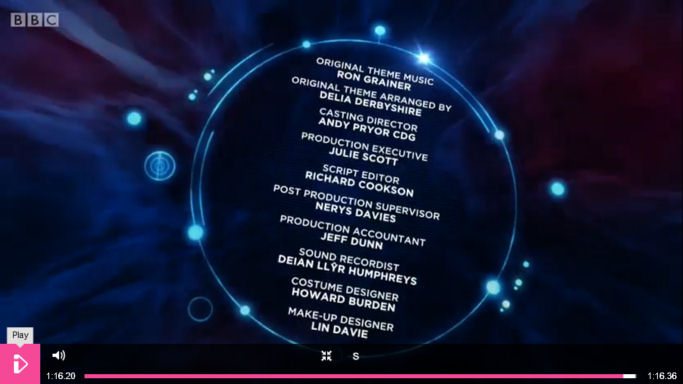
I had an immediate fanboy moment when they started with the original music and titles, (compounded when, for the first time in 50 years, Delia got her credit in the closing credits). What followed was a clever story that was coherent in itself, mostly, paid its dues to the past and set up the future in interesting ways.
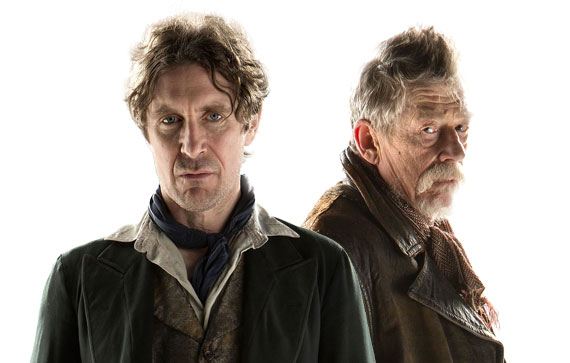
With one exception the story was internally consistent and, as Steven Moffat had promised, was a story about the Doctor rather than one featuring the Doctor. It addressed at least some issues from his recent past and healed the Doctor’s timeline. Taken together with the Paul McGann short “The Night of the Doctor”, there is apparent continuity now of The Doctor as distinct from the entity that calls itself The Doctor. It made sense that the story would feature the Doctor from the Time War and his successors, with the regrettable exception of Christopher Eccleston. The main blip in the internal consistency was the involvement of all 13 incarnations in the final denouement – but given the occasion that was understandable.
The final appearance of Tom Baker was a delightful touch but also a master-stroke. On first watching I wasn’t paying sufficient attention to what he actually said but actually it repays attention. Firstly he is the Curator of the Under-gallery and that is a role to which the Doctor was personally appointed by Elizabeth (18 minutes into the episode). Secondly it is deliberately not clear whether he is a future or past generation of the Doctor (who might, he says, choose to revisit some of his former faces at some point in his future) or something else. Thirdly, it seemed to me that it introduced an element of weirdness about the Doctor’s identity that we haven’t really had since the latter days of Sylvester McCoy and the so-called “Cartmel Masterplan”.
Billie Piper was excellent as the AI of The Moment – a Doomsday Weapon – which adopted the form of the Bad Wolf. Jenna Coleman played a blinder and, true to “The Name of the Doctor”, it was she who was exactly what the Doctor needed at the right time even as the events of that episode have not yet been settled.
John Hurt was outstanding and brought a gravitas and maturity to the character that we have not seen in a long time.
And it was great to see David Tennant and Matt Smith together, something which reaffirmed why I have preferred Smith’s tenure – underneath the madcap persona there is a nuanced characterisation that shone through.
My only real doubt was about Joanna Page as Queen Elizabeth. This isn’t because of Ms Page’s undoubted talents but because, just as Patrick Troughton was “my” Doctor, so Glenda Jackson will forever be “my” Elizabeth.
And so we have the end of a chapter, or perhaps the end of volume one of the Doctor. He has run away from his heritage and has now saved it, in the process healing himself. Now we have to see how he goes forward with his new knowledge and how the weirdness, the “otherness” represented by the Curator, plays out.
Here’s to Chapter 2
ps – one final ambiguity: we saw John Hurt start his regeneration but we didn’t see him complete it. I know what we’re supposed to think but…


Recent Comments