
“My” Doctor
The BBC’s statement this week on the future of Dr Who has provoked a lot of comment, not least because it whiffs of a chaotic rush job to mask behind the scenes issues. For this viewer since 1963, there is a sort of sadness but not a lot of surprise.
Cards on the table, the idea of contracting production to a company other than Bad Wolf under a lead writer other than Russell T Davies is necessary, not because I have any particular animus towards them but because I think their time has run its course. Spectacle and melodrama have increasingly nudged thoughtful writing aside and the show got caught up in a doom loop of diminishing returns soundtracked by Murray Gold’s over-wrought incidental music that never shuts the fuck up. Yes there were latterly some very good episodes, but they shone against a dimming background.
Dr Who has a long history of experimentation, exploration and invention, balanced by an equally long history of bathos and ridiculousness; each of those things lie behind both its persistence and charm as well as those moments that invited things to be thrown at the TV screen. This is not just a New-Who thing: critics of modern incarnations often forget that both Colin Baker and Sylvester McCoy had to put up with some seriously weak material, Baker especially, before the show was put out of its misery and placed on its long hiatus.
Dr Who is, in many respects, a victim of its own longevity and also labours under the expectations of vocal, online fandom [as I’ve said before, fans are great but fandoms cleave to toxicity.] The well is poisoned by notions of canon and rigid canonicity is policed by obsessives with nothing better to do but whinge on YouTube. Even so, despite having all of time and space to play with, somewhere along the way the producers ran out of ideas about what the programme could be, or perhaps they knew it but no one had the courage or vision to carry it through except in occasional flashes and glimpses, most consistently recently in the Peter Capaldi incarnation.
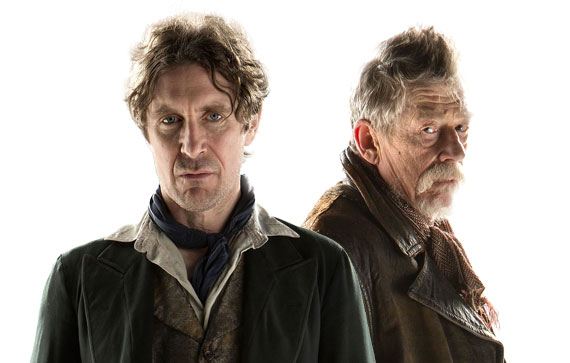
What if?
Writing has moved on since 1963 as has televisual language, not just in terms of major points of reference like Twin Peaks, Sense8 or Buffy the Vampire Slayer, but in the conceptual possibilities of all genre and cross-genre programming. Dr Who was conceived in the era of Robin Hood just like Star Trek was Wagon Train in space. As I write, I’m rewatching the magnificent Arrival which, like the story it came from, Ted Chiang’s Story of Your Life, exemplifies a way of treating time and language and adventures in time in a thoughtful, emotional and intelligent way that Dr Who has rarely approached. Can you even begin to imagine Arrival or Project Hail Mary scripted by RTD?
There have been some very, very good stories told, notably in the Steven Moffat era, but we’ve also had a succession of good actors doing good work over increasingly short tenures and having to do their best with shallow or inadequate material, or good material produced on the cheap, or stories that fail to rise above a premise, with poor dialogue and a lack of substance. Jodie Whittaker, whose Doctor I liked, also had to contend with Covid and lockdown.
Would a general audience respond well to a Dr Who that cloned the off-kilter modernism of Twin Peaks, the Return and mixed in Arrival or Annihilation? Probably not (though I would), but it would respond to a writing and production team with an expanded conceptual language. I do not suggest a complete reimagining but I would like a conceptual regeneration featuring coherent stories by talented writers that engage at least two of the following three: my emotions, my imagination and my intelligence. I’m not expecting Andre Tarkovsky or Denis Villeneuve or Alex Garland, and at heart Dr Who is a family show, but a tangible sense of meaning and depth wouldn’t go amiss.
The danger is that the BBC will award the production contract to a company that promises more of the same, that the corporation will run scared of the creative imagination. That is, after all, what it normally does. How much better would it be to honour the original vision of Verity Lambert and give us something that finally matches the unworldly possibilities of Delia Derbyshire’s original and unmatched realisation of the theme
[Added after first posting, it occurs to me that Dr Who would benefit from a spin off that stands in much the same relation to it as Andor does to the main Star Wars corpus. This does not mean a war between the land and the sea.]
Recent Comments