
The Least We Can Do…
End of February, and another album about which I struggle to be objective; I could listen to it all day and always find something new in it.
This is the album where the classic VdGG sound came together: virtuoso playing, fully committed, aggresively melodramatic, interspersed with passages of beauty. Core to the sound were the drums of Guy Evans–surely one of the great, unheralded drummers in popular music; the treated organ playing of Hugh Banton, much closer to church organ than the Hammond-driven R and B sound; the dual sax and flute attack of David Jackson; and the voice of Peter Hammill.
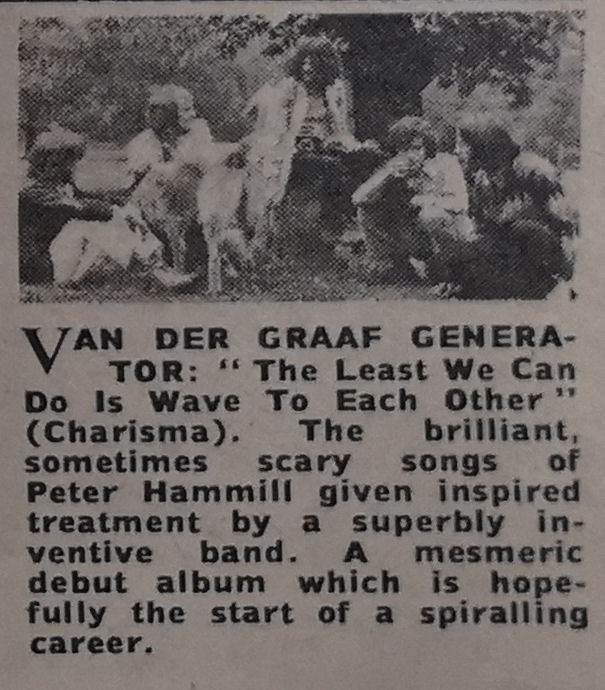
Melody Maker
For this album they were also joined by Nic Potter on bass and electric guitar.
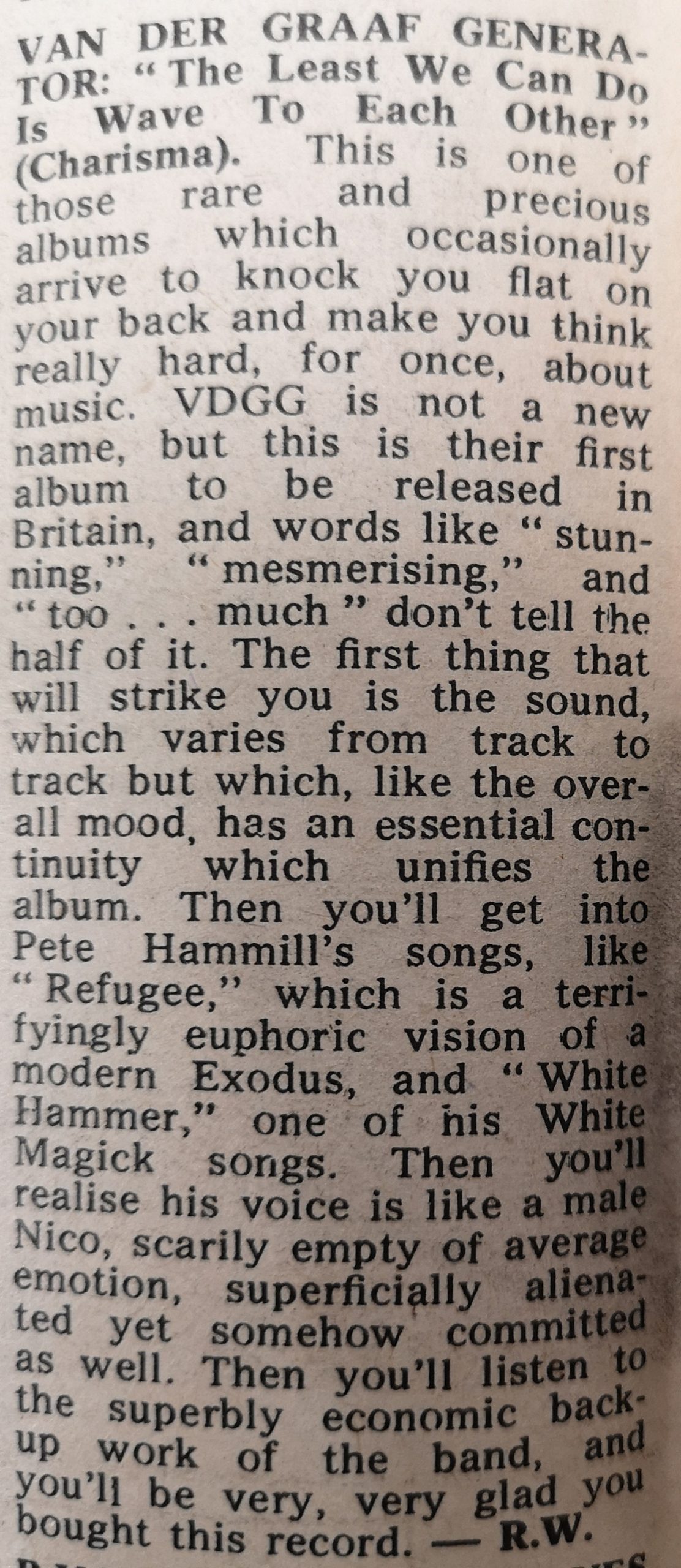
Melody Maker
An adjective I’ve used quite a lot here about bands and artists I like is singular. VdGG are the epitome of singularity: there is no one quite like them. Yes you can hear influences if you listen closely, but they are buried deep within the sound. You might think David Jackson’s flute is reminiscent of Ian Anderson, but that’s because both were admirers of Roland Kirk, from whom Jackson also took his habit of playing tenor and alto sax simultaneously.
In 2016, theGuardian commented on VdGG that:
It takes a great deal of fearlessness and determination to make deeply peculiar music for 50 years, but Van der Graaf Generator were never a band inclined to toe the line… their 1971 masterpiece Pawn Hearts exhibited a precocious and prescient disregard for just about everything else that was going on during prog’s initial heyday. Vocalist and chief songwriter Peter Hammill’s lengthy and elaborate but thrillingly untamed and spiky compositions, full of churning riffs and brutal dynamics, tapped into something darker and more primitive than anything you could have found amid ELP’s virtuoso showing off or Yes’s quasi-spiritual opulence.

New Musical Express
I don’t like the ‘Prog’ adjective; I think it’s a retrospective gloss that’s applied to create a ‘movement’ that never was. As the article makes clear, part of the motivation of the band was that while everyone else was trying to make music they were having just as much fun making a racket. The closest analogue at the time was probably King Crimson, but it’s a fairly weak analogue.
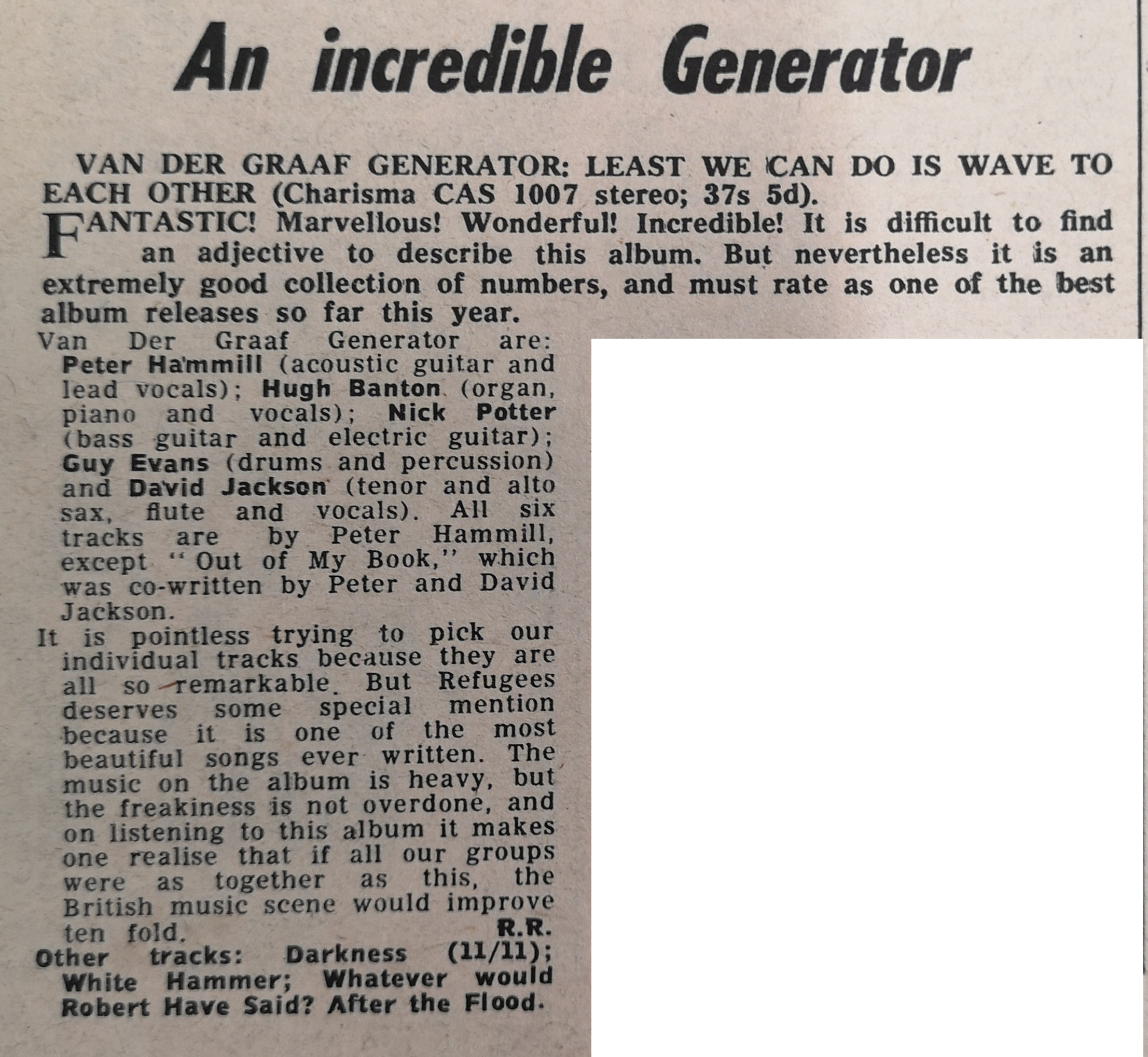
New Musical Express
And Crimson didn’t have Peter Hammill as lyricist and front man. Hammill’s stark voice, shifting from sweet to harsh in a single line, playing the dynamics of the words, as happy musing on being separated from friends as early-modern persecution of witches, dominates the aesthetic of the band.
Long experience has taught me that VdGG are not for everyone; putting on one of their albums is often a simple way to clear a room. Me, I love them and have done since I don’t know when. And I’m going to see them again in a couple of months.
I’ll leave the last words to that Guardian article.
Being awkward bastards is a noble mission that somehow makes even more sense with a bus pass in your back pocket.
“We still believe in the power of music, and that there will always be people who do care and are moved by it, and not just as a fashion accessory,” Hammill says. “We didn’t want to be a part of anything when we started, and we still don’t. If one thing has been the abiding deal with us, it’s that we have not wanted to be trapped in a box. And we haven’t been.”
It’s all on Spotify, and versions of the songs are playlisted on YouTube.
Recent Comments