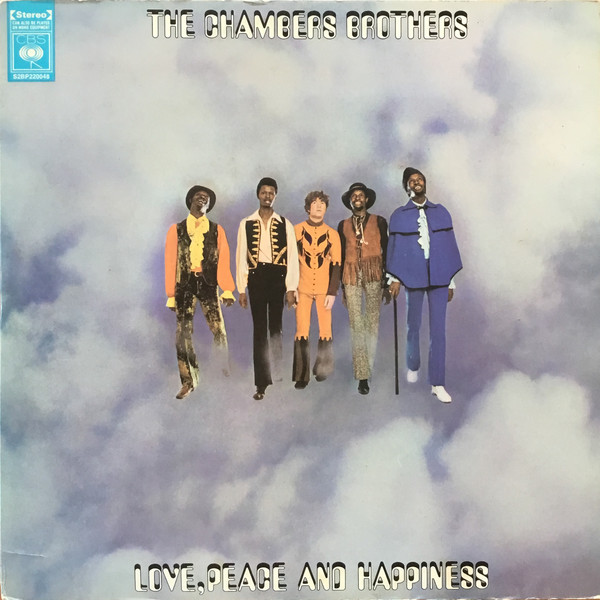
Love Peace and Happiness
After the awful Atomic Rooster and the disappointing Morrison Hotel, it is such a delight to listen to an album for the first time and be blown away. It also allows me room to revisit a hobby horse of mine (hey, it’s my blog, indulge me as I indulge myself!). The album is Love, Peace and Happiness by the Chambers Brothers, released in the US in December 1969 and available in the UK, and reviewed, in February 1970.
I knew, from Rob Chapman’s Psychedelia and Other Colours, that The Chambers Brothers introduced the word ‘psychedelicised’ in Time Has Come Today; what I didn’t expect was this wholly original blend of Gospel, Soul, Blues and Rock that encompasses a fabulous Bee Gees cover and finishes with barbershop r’n’b.

New Musical Express, 28 Feb. 1970 (we need to talk about language)
The album, a double, is half live, half studio and all music. Their cover of Sammy Turner’s If You Want Me Too had me dancing round the kitchen, as did many others. The superb title track is everything white blues-rock groups were striving for and failing to attain, notwithstanding a drum solo.
Fabulous. And all on Spotify, though I’m going to be buying it when the pension next comes in.
Now, to that hobby horse. Back in July 2009 I wrote:
The first time I heard Farther on up the Road was almost certainly when Eric Clapton and The Band played it on The Last Waltz and I thought it was pretty good. Later I heard a really stinging version by Don Preston on a cracking wee album called Sacre Blues (which I heard on an old Alexis Korner show sometime in the very early 1980s) and thought that it was really good. It wasn’t until a lot later that I heard a version by Bobby Bland recorded in 1957 and was completely bowled over.
In comparison to the straight ahead 12-bar with extended guitar solo which we have come to associate with electric blues – and especially that of the British “blues boom” and it’s progeny – the Bobby Bland release is a very different beast and the main thing you notice, aside from the piano and saxes having equal ranking with the guitar, is the loping rhythmic complexity which the British bluesers very rarely ‘got’.
Too much white blues, and for that matter white rock, fetishizes guitar technique. In 1969/70 this was embodied by the technically showy but musically vacuous fretboard masturbation of Alvin Lee and Ten Years After. Love Peace and Happiness is a great example of how to do it properly. You ain’t got the blues if you ain’t got soul; the Chambers Brothers had soul to give away.

Recent Comments