
Love, Death and the Lady
Once again, the folk scene comes up with the goods, but Love, Death and the Lady, released 1 May 1970, is a very different beast to The Garden of Jane Delawney (yesterday, which has been slightly edited since posting). This is an eccentric album; by that I do not mean that it is goofy or weird, I use the definition in my Chambers dictionary:
departing from the centre : not having the same centre as another… out of the usual course : not conforming to the common rules.
There is not the slightest hint of folk-rock here, nor any of the presentational artifice associated with Ewan MacColl; the album wilfully ignores fashion. The aesthetic is an emergent property of Shirley Collins‘s unadorned soprano and her sister Dolly‘s sympathetic arrangments and occasional backing. And the songs are, in the best British tradition, bleak. The album title isn’t a flourish, it’s an exact statement of what lies between the grooves.
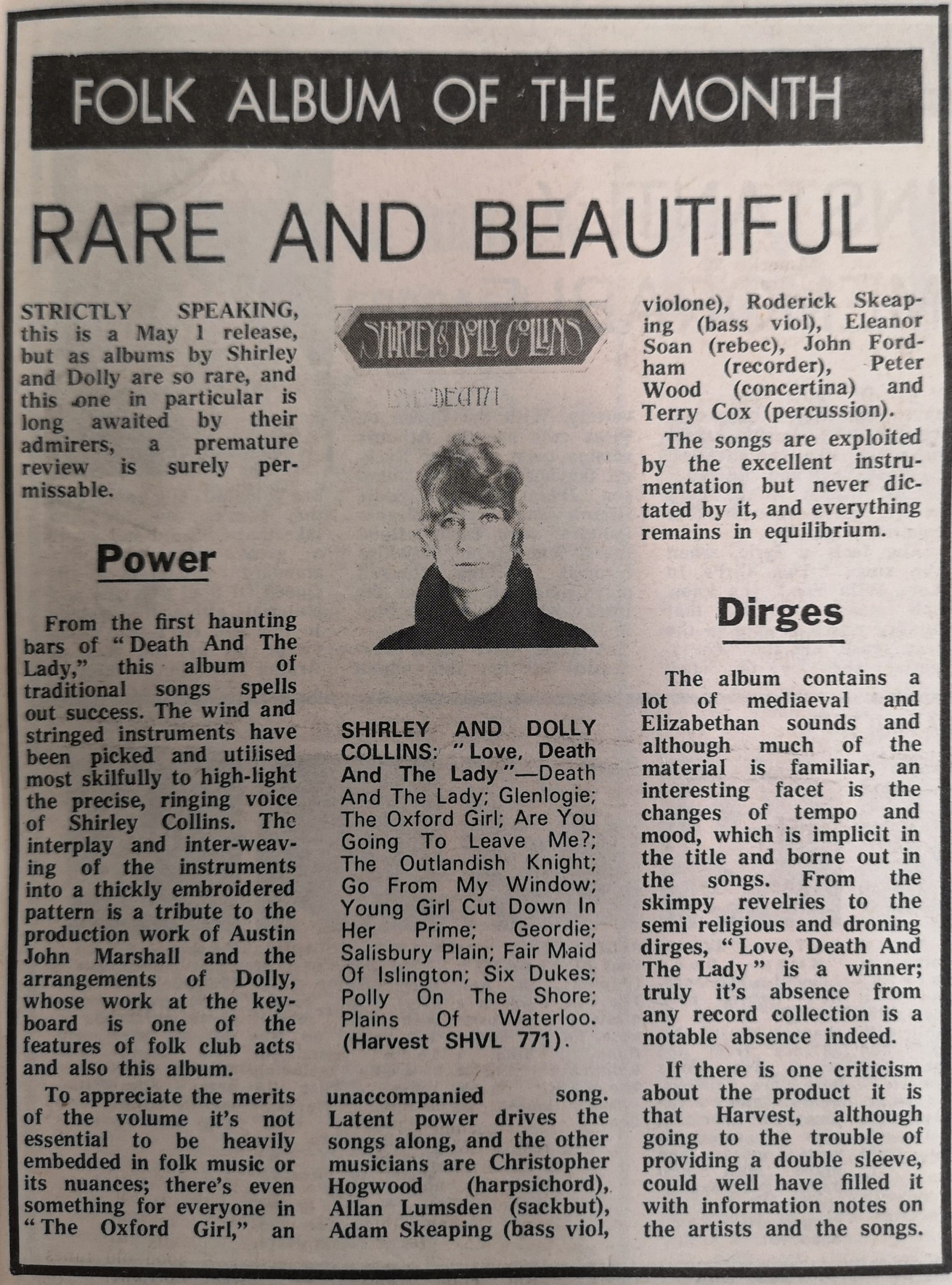
Melody Maker
In The Oxford Girl Shirley sings (unaccompanied):
I took her by the lily-white hand
And I kissed her cheek and chin,
But I had no thoughts of murdering her
Nor in no evil way.
I catched a stick from out the hedge
And I gently knocked her down,
And blood from that poor innocent girl
Came a-trinkling to the ground
I catched fast hold of her curly, curly locks
And I dragged her through the fields,
Until we came to a deep riverside
Where I gently flung her in.
Look how she go, look how she floats,
She’s a-drowning on the tide,
And instead of her having a watery grave
She should have been my bride.
And there’s more where that came from; a lot more.
It is not an easy listen: although there is a deep sophistication in the arrangements, Shirley’s straight, artless delivery makes it raw, and sometimes unsettling given the violence and darkness inherent in these songs.
But that’s exactly why it is a gem.
I listened on Spotify :and the whole album is available as a YouTube playlist

Recent Comments