In yesterday’s post I quoted Richard Williams and those who ‘don’t dig jazz.’ That use of the verb ‘to dig’ was not an isolated example; one of the things that leaps out immediately from reading the Melody Maker of the day was that there were more digs than an archaeologist’s diary. ‘The only heavy band I really dig is the Zeppelin,’ [says Robert Plant]. ‘Apart from that I dig the mellower things.’ (Melody Maker, 28 March 1970). By contrast, I saw very little if any digging in New Musical Express.
So I got to wondering: where does ‘dig’ come from?
One suggested source is saxophonist Lester Young, who died in March 1959. Young notoriously spoke in a language all his own. Eric Frandsen recounts that once upon a time Lester Young walked into a diner and ordered a piece of apple pie. ‘The apple pie is gone,’ said the waitress. ‘Crazy,’ said Lester. ‘Gimme two pieces.’
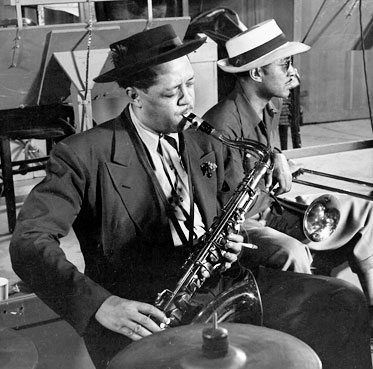
Lester Young 1944
That’s a joke, but it only works because of the legend around Young. One of his pianists said it took him weeks to understand what Young was saying. So did Young originate ‘dig’ as is often asserted? I suspect not. Dig first appears, so far as I can tell, in Cab Calloway’s Hepster’s Dictionary in 1938, with three meanings, the third of which is to comprehend, to understand. Of course Calloway could have got it from Young who was a well-established professional musician then, notably with the Count Basie Orchestra, and who visited New York in 1938, but it could as easily have come from some third source into general speech and been picked up on by both Calloway and Young. (Much, much more speculative is the unevidenced suggestion by Daniel Cassidy in 2007 that ‘dig’ derives from the Irish tuig–to understand, just because it sounds similar).
The best we can say is that to dig was already in circulation amongst musicians in Harlem in 1938.

Cab Calloway
Dig is not the only old hipster word to survive into the 1970 press. Calloway’s dictionary also includes cat: a musician in a swing band; chick: a girl; and groovy: fine (as in I feel groovy). All of those words are in frequent use right through the sixties and into the early seventies, as is ‘bread’ for money (that one probably was coined by Young, though Calloway also has ‘gravy’ for profits).
More interesting, I think, is just how hipster argot from the 30s and 40s came to permeate the discourse of white rock musicians and journalists. That’s thesis level research rather than a short blog post, but it’s easy enough to hypothesise about language transmission between musicians and into a musical community, particularly jazzers: a shared verbal language as well as a shared musical language and identity.
It’s also easy to hypothesise that the ‘in’ language was picked up on by people who weren’t part of a select group but really, really wanted to be, or who at least wanted others to think they were associated with something more interesting than the workaday reality of their lives. That would make the adoption of the slang outside of the circle of musicians as much a matter of pretention and projection of an imagined self as it is appropriation, a means of demonstrating that you weren’t a square like that guy over there.
That same process can be seen with any keen hobbyists adopting professional terms to associate themselves with the in crowd of cognoscenti and distinguish themself from the excluded mundanes.
My guess is that the main vector of transmission generally of dig and related hipsterisms was a combination of fans and liggers and their parallel reading of the Beats, especially Kerouac, whom I dislike but lots of people didn’t, and don’t. All those post-war babies reading Allen Ginsberg, talkin’ civil rights …
And of course, whether you were a muso, a ligger or a wannabe, use of the exclusive lingo on the road might also dangle the possibility, however remote, that maybe, just maybe, you’ll get laid.
We got our own way of walkin’
We got our own way of talkin’, yeah
…
Girl, I’ll show you a real good time
Come on with me and leave your troubles behind
I don’t care where you’ve been
You ain’t been nowhere till you’ve been in
With the in crowd, yeah
Once in circulation it spread as any virus does. I should also observe that the language was pervasive until, suddenly, it wasn’t, You might hear those words used still, though usually only in an ironic, or faux-ironic context, unless you’re Keith Richards.
It’s worth noting that one other term, originating in 1928, survived into the seventies, a term now described by Mirriam Webster as offensive, used as an insulting or contemptuous term for a black person and by dictionary.com as extremely disparaging and offensive. That term is ‘spade’. It appears through the sixties, and as late as 1973 was in the UK top 10 in the original lyric of Mott The Hoople’s All The Way From Memphis. At the time, it appears to have been used, in this context, as a descriptive slang term rather than as a term of abuse or contempt. No one, I hope, would use it today at all, and seeing its casual and unchallenged deployment in a 1969/1970 record review (‘I’ve got this thing about spade chicks’) literally caused me to do a double take in the library.
As an aside, there is probably a thesis, too, in the unironic, casual, use of hipster jargon, including language now percieved as racist, in Blaxploitation movies. It seems to me, incidentally, that the disappearance of a lot of the language from white discourse in the UK correlates to the fading of Blaxploitation as a subgenre.
Still, Isaac Hayes’s mighty soundtrack to the daddy of Blaxploitation movies, Shaft, remains triumphant as the prime example of ‘Dig’ in popular culture

Recent Comments