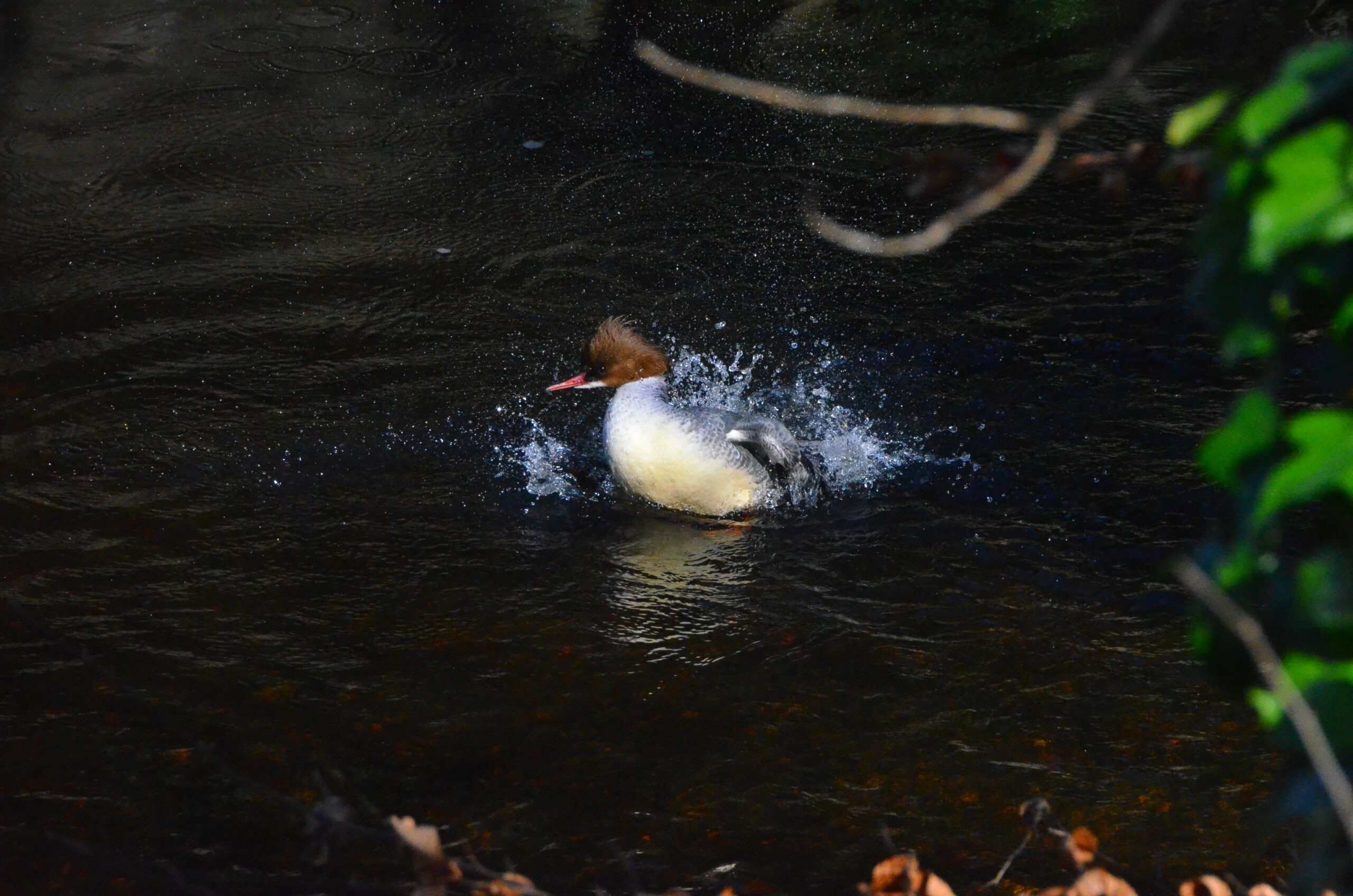
I had intended to go swimming today but felt quite fatigued (the hormone treatment is still active in my system and will be for a few weeks yet) so I decided to go for a walk instead. As it happened I ended up walking 13.3km (8.25 miles) to Dean Village and back along the Water of Leith Walkway. It’s a walk I know well and like very much. I keep my eye open for wildlife, especially dippers and kingfishers and the outside chance of an otter. None of those today though there was an audible but invisible woodpecker. I also let my mind and thoughts wander.
And wander they did.
For some reason it occured to me that 50 years ago, in 1976, I was, or should have been, working towards my Highers at school. At the time I was studying Maths, Physics, Chemistry, Engineering Drawing, Art and English. At the end of that school year I had acceptances from Glasgow and Strathclyde universities for courses including Applied Physics and Mechanical Engineering. In the end, I completely changed my mind and returned for sixth year, initially studying English, Art, French and Latin. I dropped the Art for additional French.
That fifth year in 1975/6 included one of the few things a teacher said that I can remember clearly as if it were only said moments ago. Higher Art and Design included a module on the history and appreciation of art. One day, while we were considering one of the impressionists, I forget which one now, I said, in the way that only 16-year-olds can, that I didn’t like the work of one of them. ‘Laddie,’ said Mr Bennett, ‘ Yer no’ here tae like it, yer here tae appreciate it.’ One of the most profound and long-lasting lessons in all my school life.
I thought too about the post I made the other day about the persistence of quiet faith and remembered something I noticed in China some years ago. Buddhism is generally tolerated rather than encouraged by Chinese authorities, especially in places where tourist income can be generated. But the Buddha is everywhere when you look and become attuned to it, and more often than not small statues become small personal shrines, even in Beijing (which I wrote about here). Memorably, there is a large room in the magnificent National Museum of China on Tiananmen Square devoted to statues and images of the Buddha, and it is noticeable that these usually attract small devotional offerings. Again, faith persists.
It persists too in some of the odd things that are known to appear along the Water of Leith Walkway, workings in wood and string and feathers that may or may not be amateur folk art but also give off a distinct hint of paganism.
***
I have a current YouTube obsession with the channel of Ben Maton, the Salisbury Organist. Ben was an Organ Scholar at St Peter’s College, Oxford and, unlike Anna Lapwood who is known for playing grand organs that respond to the merest touch of the keys, he focuses on playing small instruments in village churches that may or may not have been well-maintained. I hate to use the ‘A’ word but there is an authenticity about Ben’s videos and a gentleness that I really like. I have no idea about Ben’s faith because he never mentions it, but it doesn’t really matter.
I’ve embedded four videos below, one playing Elgar in his birthplace, one playing Vaughn Williams in Down Ampney, one playing a tiny organ in Compton Valance, Dorset, and one in which he is a child in a toyshop at the console of the organ of Wells Cathedral supporting the organ restoration fund (watch out for his smile at 13’39.)
I was in East Kilbride this weekend. I was there to attend a service this morning at the church in which I grew up, St Mark’s Scottish Episcopal Church. Amongst other things, the service was to mark my mum’s ‘retirement’ from active service in and to the congregation. Mum is 93.
I have a complicated relationship with Christianity and the Church; I am not a Christian but, then, neither was Jesus. My memories of St Mark’s in the 1970s are of a large-ish and active congregation. The congregation now is diminished and aging, which is not unique these days whatever the denomination. The appearance this morning of me, my sister and my nieces and nephew with their partners and children pretty much doubled the congregation and halved the average age.
Over the past week I’ve had a number of thoughts about attending the service and the extent to which I would participate without feeling hypocritical. I journaled those thoughts and some of them might appear here one day, but not yet. However, what struck me quite forcibly this morning was that, however ostensibly diminished St Mark’s is, it persists. Every week a group of people meet, share time with each other and participate in a ritual that has meaning for them.
St Mark’s is 70 years old now, a stripling in terms of ecclesiastical architecture but even so a place where people – including Mum and Dad and my family – have gathered and served the community with quiet determination over many years and there is a subtle power in that. And so, despite my non-belief, I was happy to join in with communion this morning not just out of respect for Mum and for the memory of Dad (I wore his cufflinks in my shirt) but because of that quiet persistence.
By happy coincidence, the Gospel reading for today was Matthew’s telling of the expulsion of the money-changers and merchants from the Temple. That (and particularly aspects of Mark’s framing of the stories in his gospel) parallels a lot of my own thinking about personal ethics and organised religion in general, reflecting something older than Messianism or, in Greek, Christ-ism. But that’s a post for another day.
My original plan was to record a version of this post to video and use it to revitalise my dormant YouTube channel. The video would have included me reading Eliot’s The Journey of the Magi to you, however I would have had to record it in the office/shed and it is too cold up there, so you have been spared that.
January sixth is traditionally known in the West as the Feast of the Epiphany but it is a very ancient Christian celebration that predates what we now know as Christmas. In its original form it celebrated several things but the common element in both Eastern and Western Christian traditions is the visit of the Magi to the infant Jesus.
Mark, generally said to be the first of the canonical gospels to be written, has no infancy narrative at all and begins with the man Jesus being baptised by John the Baptist. The Gospel of John, generally said to be the last of the gospels to be written, follows Mark very closely but has as an added bonus a prologue that introduces the whole thing in the light of Greek philosophy.
It is generally thought that Matthew was the second gospel to be written and it is in Matt ch.2 – and only there – that we find the magi – here meaning Zoroastrian priests – who observe the rising star of the King of the Jews and journey westwards to pay their respects (the verb used, προσκυνησαι does not mean ‘worship’ as we now understand the term in a religious sense but is closer to the root Old English meaning of worship as paying respects to something or someone worthy of it.) Luke, who seems to rewrite Matthew for a more Graeco-Roman audience, wants nothing to do with magi and replaces them with shepherds washing their socks by night.
One might wonder, as many have, why Matthew thought it was important to have an infancy narrative at all and why he has Zoroastrian priests come to visit (note that they were neither kings nor, alas, underwear salesmen of Leicester Square.) It could be that they were a symbolic representation of gentiles in general; it could be that, like the gospel writers’ obsession with John the Baptist there is an echo of religious turf wars; it could be something else entirely.
Eliot’s magi, or rather the aging magus who narrates the poem as a memory from his past, is focused on the end of ‘the old dispensation.’ Importantly, the death of the old is presented in conjunction with the birth of the new: the magus says that he thought death and birth were different and Eliot leaves it to us to understand the implicit suggestion that the opposite is true, that they are the same. Eliot and the writer of Matthew have in mind the primacy of Christian mythology no doubt, but Eliot also taps into much older myths of the death of the old and the birth of the new. Death and birth/rebirth are at the heart of festivals everywhere, from solstice to May Day to Harvest.
Eliot’s magus concludes,
We returned to our places, these Kingdoms,
But no longer at ease here, in the old dispensation,
With an alien people clutching their gods.
I should be glad of another death.
The final sentence can bear several readings, and Eliot, the Anglo-Catholic, is perhaps looking at the death of old religions and the birth of Christianity as well as the aging magus himself recognising it is time for him to go and welcoming it. But I do wonder if the final sentence should also carry an implicit echo of rebirth.
A cold coming the magi had of it, at just the worst time of the year but, as Edinburgh temperatures fall to -5C, I reflect that it is now, when the year is at its coldest, that snowdrops emerge.
Boxing Day, and I thought I’d take a trip into town, partly to get some exercise after spending most of yesterday either cooking or eating, but also to see what was happening in the sales.
I got my exercise, but a lot of places were closed so I just wandered around, marvelling at the ‘sale’ prices in the places that were open: even at steep discounts they were more than I would usually spend. Indeed, a lot of my ‘new’ shirts and jackets come from charity or vintage shops at relatively low prices. Given that most of my tastes were formed between 1974-1979, this isn’t a huge hardship.
When my 10,000 steps were nearly ticked off, my knee was protesting so I decided to do what I sometimes do and stop off for 15 minutes peace and rest in St Mary’s Cathedral on Palmerston Place; it was closed. I thought I might instead take the holy drink at a secular temple of the ineffable but Ryrie’s was closed too.
We lost a lot of good’uns in 2025; here’s one of them
As most readers of this blog will know, my first degree was Divinity. I began the degree in October 1977 with the intention of taking the cloth but there’s nothing like a rigorous theological education to make you question your faith – that, indeed, is the point of it. I completed the degree from an academic rather than vocational standpoint and enjoyed it. For a long while I described myself as an atheist; I no longer do. It isn’t that I profess any particular belief, just that I distrust dogmatic unbelief as much as I do dogmatic belief. It’s why I don’t have much time for prominent humanists qua humanists: they’re too dogmatic.
Despite my loss of faith, or maybe precisely because of it, my interest in religion and spirituality remains just as strong as it ever was: one of my favourite novels, and one that I reread often, is Hermann Hesse’s Siddhartha which, if not explicitly tied to a particular world religion (in fact the protagonist rejects the Buddha’s teaching and goes off in search on Enlightenment in his own way) ties into deep themes of Being and Self. Whenever I meet my friend Neil, now retired from parish ministry, we always end up talking about theological themes and topics that usually revolve around the New Testament and what one might call Christian origins and the process of transition from Jewish cult to Roman establishment as well as side ventures into Gnostic thought and the many varieties of Christian faith before canonicity became a thing.
And lurking beneath all that is something else: I was brought up at the bells and smells end of Anglicanism and, like learning to swim or riding a bicycle, it never really leaves you. To this day an old church saturated with living memories of incense and choral music reaches parts of me that even Carlsberg cannot reach.
I mention all of this because I have been dipping into the thought of Owen Barfield. Amongst other things in his long life, Barfield was an Inkling, friend of and fellow pipe smoker with Tolkien and CS Lewis, and influential on both them in both their belief and aspects of their literary output. Barfield took the position that Christianity was a/the true myth, a/the master myth that unlocks all the others (I paraphrase wildly for the sake of a blog post of course). I don’t agree with that; I think that is a form of motivated reasoning from a pre-existent position of Faith rather than profundity, but it did get me musing on aspects of my own belief and lack of it.
To be fair, this is something that I often think about and it undoubtedly feeds through into my fiction, but I generally end up with fairly vague outlines of things that I probably think rather than reaching any conclusions. This time, however, what struck me was that there are aspects of High Anglican ritual that I find deeply attractive even though I do not share the framework of belief that houses it. This relates as much to sung Evensong as to the Eucharist. My sticking point is what the jargon calls Christology: as a minimum, to call oneself a Christian means believing that there was something of universal significance about the man Jesus; I do not believe that. But the act of participating in ritual, in the encounter with the numinous, however you wish to define that, and the sharing of it with other people in a ritual context remains appealing: Reducing some experiences to mere words always involves a degree of loss, but I think we are creatures of symbol, myth and ritual and it is something we should embrace.
Common to all major belief systems whether one of the ‘big’ religions or whether something more diffuse and demotic such as the many strands of paganism are three things,
reflection
behaviour
ritual
I spend a lot of time in reflection and I do my best with ethical behaviour: ritual is the thing that is missing, by which I mean interaction with and participation in Myth. So something I want to focus on now is teasing out aspects of my relationship with the numinous (for want of a better word) and finding appropriate symbols and then working something out for myself. It would be grand to find other like minded people and meet in the sanctuary of a good pub (which means real ale, good whisky, and no TV) or to share a dram or two by an open fire.
A touch of strangeness this evening, listening to Suzanne Vega’s Luka which threw me back to being at work in the 1980s when it was released. Solitude Standing came out in 1987 but the sensation is more generic to that time and place and to younger me.
I remember my colleague Jim saying that the rest of the songs on the album were just as good, though I can’t remember if he’d left to be a full-time academic by then and we were talking in some other venue; I was certainly working in the courts on secondment in 1987. Be that as it may, I had that strange far away but somehow very close feeling tonight.
It was a strange time; in 1987 I was in my twenties with a degree, newly married, trying to find my way while being hopelessly naïve about everything (whereas now I’m in my sixties with two degrees, thirty-nine years married but still trying to find my way and hopelessly naïve about everything.)
I’ve written about these kind of flashbacks before, usually to the seventies and triggered by Joni Mitchell or Focus and I’ve come to enjoy the moments of connection when they come. Is it a block universe, or reverse déjà vu or just random neurons connecting? I don’t know. I do know that in those moments I feel a continuity with young me but also a certain melancholy, especially for people who made the seventies and eighties special for me but who have gone. In those moments of connection I can imagine that they’re still just a phone call away.
Recent Comments