I’ve spent most of the month since I last posted sitting out under a sun umbrella either reading or trying to write. A lot of the reading has been research for the writing, and has included spells in the National Library, Edinburgh Central Library and the National Records. In terms of fiction I’ve been deep diving once more into Dorothy Dunnett; I really enjoyed her second series of historical novels, the House of Niccolo series set in C15 but have always found her earlier series, the Lymond novels (C16) harder to get into and that’s my current task. So far so good.
I thought writing would flow more naturally once the worry about cancer receded but I’m finding it tough to get back into it. My process is to turn up for work every day with notebook or MacBook and trust that sooner or later the Muse will come and join me. I’m getting there but it’s slow going.
***
I have occasional conversations with other men who have been through, or are still in the middle of, the prostate cancer experience. Those of us who have had the hormone treatment tend to gripe about the inexorable weight gain that is common amongst us. One chap said that he had named his moobs Thelma and Louise and I got to thinking about mine – Agnetha and Anna-Frid? Althea and Donna? Suggestions on a postcard, etc.
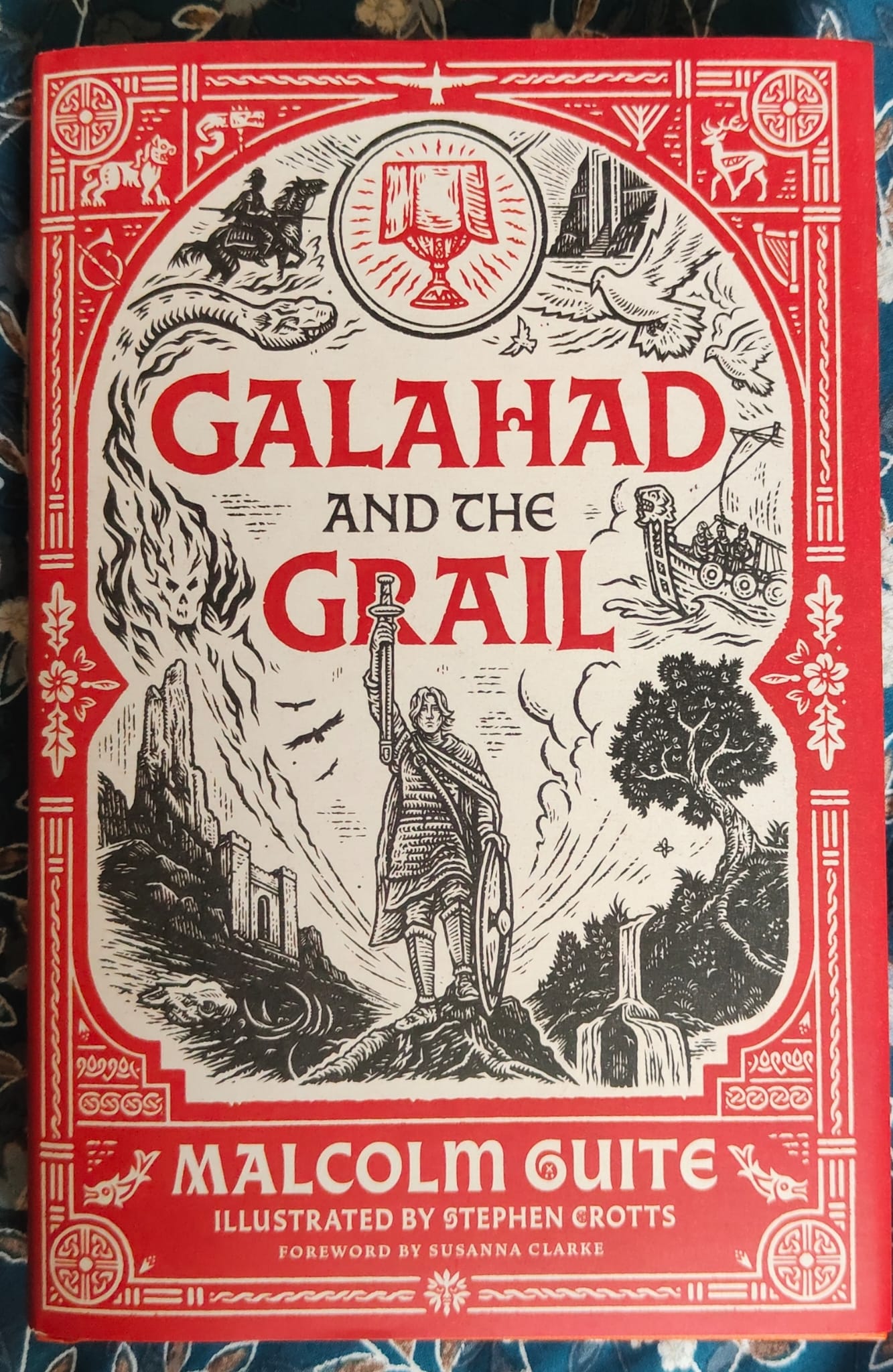
I looked forward to reading Malcolm Guite’s Galahad and the Grail, the first part of his four-volume retelling of the Arthurian corpus, which has the overall title of Merlin’s Isle. The series title comes from Kipling’s Puck’s Song:
She is not any common earth,
Water or wood or air,
But Merlin’s Isle of Gramarye
Where you and I will fair.
Guite has set himself two tasks. The first is to organise the Arthurian corpus and cast it into ballad metre. Like common metre, ballad metre alternates tetrameter and hexameter with an ABCB rhyme scheme. Thus:
When Galahad was still a child
they let him run full free
and roam the castle holds and halls
and hear the minstrelsy (Book one, Stave 1, 1-4)
The form is very flexible and extendable, particularly with the C lines:
The stroke that brought the ruin down
the stroke that maimed the king,
the dreadful stroke that Balyn gave,
that ill-starred knight whom none could save,
who brought his brother to the grave,
as the old minstrels sing. (One, 1, 29-34)
Unlike common metre, ballad metre is more flexible in the number of unstressed syllables in a line, and this is something I’ll come back to as it threw me in places. The rhythmic structure and rhyme scheme mean that a writer of Guite’s skill can tell a story that fairly zips along, and zip along it does, in lively accessible language. Pleasingly, the book is handsomely produced in a cleanly bound and cased hardback printed on notably good quality paper. It also features excellent woodcut illustrations by Stephen Crotts.
I must say now that I was right to look forward to it: I enjoyed Galahad and the Grail and am pleased that I bought it. I have no doubt that I will buy the subsequent volumes. What follows is more by way of thoughts arising from Guite’s approach together with one or two editorial observations.
***
Guite is a Church of England priest and a theologian. His theology is squarely in the tradition of Anglo-Catholic orthodoxy with a leaning towards the ideas of CS Lewis and Owen Barfield. This informs the second task he set himself which is to ‘make a poem that restores the spiritual elements that have been shorn away and renews their deepest meaning’ (p318) and to,
make an epic poem that would … awaken again in the modern world that openness to beauty and mystery that prepares the heart for the coming of Christ.’ (p316)
I knew that going in because I subscribe to his YouTube channel. It remains to be seen how this flows through the rest of the volumes but I think that, in the abstract, it begs several questions.
An important and influential writer in the study of folklore and Arthuriana was Jessie Weston (1850 – 1928). Her best-known book was From Ritual to Romance (1920) which TS Eliot cites as a major influence on his The Wasteland. Weston was concerned to uncover the origins of the Arthur stories but identifies an immediate and important problem. She sets out her stall thus:
The main difficulty of our research lies in the fact that the Grail legend consists of a congeries of widely differing elements—elements which at first sight appear hopelessly incongruous, if not completely contradictory, yet at the same time are present to an extent, and in a form, which no honest critic can afford to ignore.
Thus it has been perfectly possible for one group of scholars, relying upon the undeniably Christian-Legendary elements, preponderant in certain versions, to maintain the thesis that the Grail legend is ab initio a Christian, and ecclesiastical, legend, and to analyse the literature on that basis alone.
Another group, with equal reason, have pointed to the strongly marked Folk-lore features preserved in the tale, to its kinship with other themes, mainly of Celtic provenance, and have argued that, while the later versions of the cycle have been worked over by ecclesiastical writers in the interests of edification, the story itself is non-Christian, and Folk-lore in origin.
Both groups have a basis of truth for their arguments: the features upon which they rely are, in each case, undeniably present, yet at the same time each line of argument is faced with certain insuperable difficulties, fatal to the claims advanced.
Thus, the theory of Christian origin breaks down when faced with the awkward fact that there is no Christian legend concerning Joseph of Arimathea and the Grail. Neither in Legendary, nor in Art, is there any trace of the story; it has no existence outside the Grail literature, it is the creation of romance, and no genuine tradition …
In the same way the advocate of a Folk-lore origin is met with the objection that the section of the cycle for which such a source can be definitely proved, i.e., the Perceval story, has originally nothing whatever to do with the Grail; and that, while parallels can be found for this or that feature of the legend, such parallels are isolated in character and involve the breaking up of the tale into a composite of mutually independent themes. A prototype, containing the main features of the Grail story—the Waste Land, the Fisher King, the Hidden Castle with its solemn Feast, and mysterious Feeding Vessel, the Bleeding Lance and Cup—does not, so far as we know, exist.
Discussing the Wasteland, Guite writes,
I resist Jessie Weston’s reductive, re-paganising reading of [the Grail] and see its full Christian meanings not merely as a Christian gloss on an essentially pagan symbol, but as the full realisation of that pagan symbol’s true meaning. (p352, my emphasis.)
I do not adopt Weston’s reconstruction of the origins of the stories, which have been comprehensively criticised over the past century, but I do think that her identification of the problem of origins is clear and precise, and I don’t think her reading is reductive. Guite is entirely entitled to assert a decisively Christian reading of the text of the Fisher King and Waste Land tales, and goes for it with skill and gusto. However I don’t think it is at all persuasive for the non-Christian reader that he sidesteps her criticism for reasons which do not arise from the tangled texts themselves but simply from an overarching assertion of the truth of Christian belief, adopting Owen Barfield’s formulation that the Christ myth is a master myth that holds the key to the true meaning of all others (something I have commented on previously)
That is to say, I don’t think Guite is on any firmer ground in Christianising than Weston was in paganising, for reasons that Weston herself understood and stated. I think also that he veers perilously close to the same charge of reductionism that he levels at Weston.
I might add that the notion of Christianising the texts tends tacitly to assume a continuity and essential unity of Christian thought and doctrine. I don’t think this is true even in the writings that now constitute the canonical New Testament in the Western tradition (other traditions and views of canonicity are available) let alone over the millennium and a half, give or take, that the elements of the Arthurian corpus have been present and developing. In this sense, although Guite reflects aspects of the sheer weirdness (to the modern eye) of, for example, Gawain and the Green Knight and The Alliterative Morte Arthur, I’m not sure that he fully engages with that weirdness; the earliest forms of Christianity in these isles (or, indeed, in the eastern Mediterranean) were not Anglo-Catholic.
Christianity has a long history of incorporating and syncretising elements of cultures it came to dominate, most notably the incorporation of substantial aspects of Roman worship of gods and Imperial bureaucracy from around the turn of the fourth century onwards. We might note Paul and John incorporating elements of Aristotelianism and Stoicism into their respective letters and gospel. It is no great stretch to posit the incorporation of elements of native cultures into a Christian framework without (reductively) intellectualising it as the revelation of the ‘true meaning.’
I mentioned in my Hangzhou diary that I had bought a copy of Journey to the West in Shanghai. I enjoyed it but think I probably need to find a better translation to do it justice. One of the things which I found intriguing is the character of Buddha who plays an occasional role in the story. Unlike in the Indian tradition, this Buddha is a magical immortal and one of a pantheon, NOT the Siddhartha Gautama who found enlightenment. I found the conception of him in the stories to be surprisingly reminiscent of the “magical” Jesus of some of the the apocryphal gospels and mystery plays. Even more strikingly, the Heavenly Court of the Jade Emperor is very like a manifestation of the earthly Imperial court – just like the structure of Roman Catholicism reflects that of the Imperial court in Rome around the time of the Emperor Constantine.
Finally, the notion of re-sacralising in opposition to Enlightenment rationality and objectivism is not something that can or ought to be confined to a resurgence of Christian thought: it applies equally to any of the major world religions or, indeed, to paganism. I might come back to this in a later post.
***
I mentioned a couple of editorial observations. The first is that casting the verse in ballad rather than common metre led to some jarring moments for me. Guite encourages his audience to read the text aloud in an ‘incantatory’ manner, which is fine until ones accent/dialect reads non-stressed syllables differently. I regularly found myself thrown out of the rhythm by lines that, for me, read as having ‘too many’ syllables. Second, and here I am an old man shouting at clouds, I suppose it is because the primary publisher is American that double rather than single speech marks are used throughout (though spelling is British English.) Third, some stanzas seemed awkward to me and I’m a bit surprised they survived revision. For example
Not far from here, if I am right,
the drear Wasteland begins—
barren and bare, lifeless and drear,
because of human sins. (Three, V, 119-122)
That repetition of ‘drear’ clunks.
For all that, I must stress that I did enjoy the book and look forward to what comes next.
I am on the next stage of recovery, resistance work in the local gym. I am following a set of core exercises suggested by an exercise specialist at Prostate Scotland. Today was my third session.
The core issue is that the hormone implants and radiotherapy tend to reduce muscle mass and the resistance work is intended to restore it and also help create a cancer-suppressive environment in the body. The exercises I have are targeted at the main muscle groups and include deadlifts, a first for me. I’m not a complete stranger to resistance work but in the past it has always been as an adjunct to cardio training, mainly running; this time the resistance work is the main course and any cardio is an adjunct to it, at least for the first few months until things get back into balance.
The target is to find the weight for each exercise where I can manage 8 – 10 repetitions before having to stop, then doing three sets of them. Once I get used to that weight and can do, say, 10 to 15 repetitions, I raise the weight a notch, and so on. I would like to get back to running, but it isn’t a priority at present.
I won’t know how well the hormones and radiotherapy worked until early June when tests are scheduled.
***
I’ve been reading a lot lately. I mentioned Stevie Smith a couple of posts ago but I’ve also been dipping into Thomas Hardy’s poetry (there is a lot of it, of varying quality), Malcolm Guite’s first volume of the Arthurian corpus in epic verse, Galahad and the Grail, and Patricia A McKillip’s Ombria in Shadow. The latter is an object lesson in writing Fantasy to a very high standard and has given me plenty to think about as regards craft and technique in general.
I also read The Hobbit for the first time since the girls were small; it is an odd book. I enjoyed revisiting it but every so often the writing irritated me. Still, I enjoyed it enough to make the mistake of revisiting the first of the Peter Jackson Hobbit films to see if time has improved it; it has not.
At the time of writing I have complete 14 of 20 fractions of radiotherapy; to the best of my knowledge it is going well. The side-effects, principally tiredness, come and go and I just have to go with them. I’ve learned that Bluetooth and earbuds are the solution to TV noise in the waiting room. I have many playlists and sometimes particular songs bring joy. Pet Shop Boys are always a cert, and three others are posted at the end of this. Most days the actual time under the beam is around 90 seconds, although once every week they also do a scan to check everything looks good.
Early in the week I took time to go to a couple of local gyms to check prices and also to ask if instructors were OK to work out a programme focused on recovery from the impact of the hormones and the radiotherapy – primarily addressing potentially reduced muscle mass and possible issues with bone density (although prescription calcium/vitamin D supplements should have helped with that.) As the androgen inhibition impacts of the hormones wears off I can build in cardio, I think. The key is not to be heroic, just to do some focused work. I get a heavily discounted rate with the local authority gym through MacMillan Cancer Care, though the private gym is the nicer (and closer) facility. Probably I’ll use the cheaper options while I can, then reconsider.
One of the books I read in the waiting room and at home was William Gibson’s Neuromancer (pub. 1984) It is justly seen as a formative work in modern SF and you can pretty much see the future being written, although as ever what is a warning about a techno dystopia seems to have been taken as a blueprint and call to action by the tech industry. It functions as a novel by being a fast-paced caper thriller presented in what was then a novel setting (the term cyberspace comes from it) using tech neologisms. I enjoyed it and can understand why it is so well regarded, but it will go back to the charity shop I got it from.
In TV viewing, after a shaky start Star Trek: Star Fleet Academy delivered what I thought were two decent episodes in episodes 4 and 5. I gave up on Star Trek: Discovery during its third season for several reasons, one of which was its tendency to inspiring speeches. The first three episodes of Academy leaned into this with ‘teachable moments’ delivered with that aura of cloying, earnest sentimentality that is uniquely American. Episodes 4 and 5 succeeded by largely dispensing with that and were much the better for it.
In the meantime, I took the opportunity of rewatching all of the TV adaptation of Deborah Harkness’s A Discovery of Witches. I think I’ve mentioned before that I very much prefer the books and had problems with the way the narrative was compressed for TV. In fairness, I enjoyed it more in this binge watch, albeit that I fast-forwarded through some scenes. As I’m avoiding anything particularly intellectually challenging I may read the books again. That isn’t to disrespect the books which I enjoy and are layered, but they’re not Pynchon. Of the five so far published the first three are by far the strongest, however I’ll give Prof Harkness a pass because she too was public about her encounters with cancer.
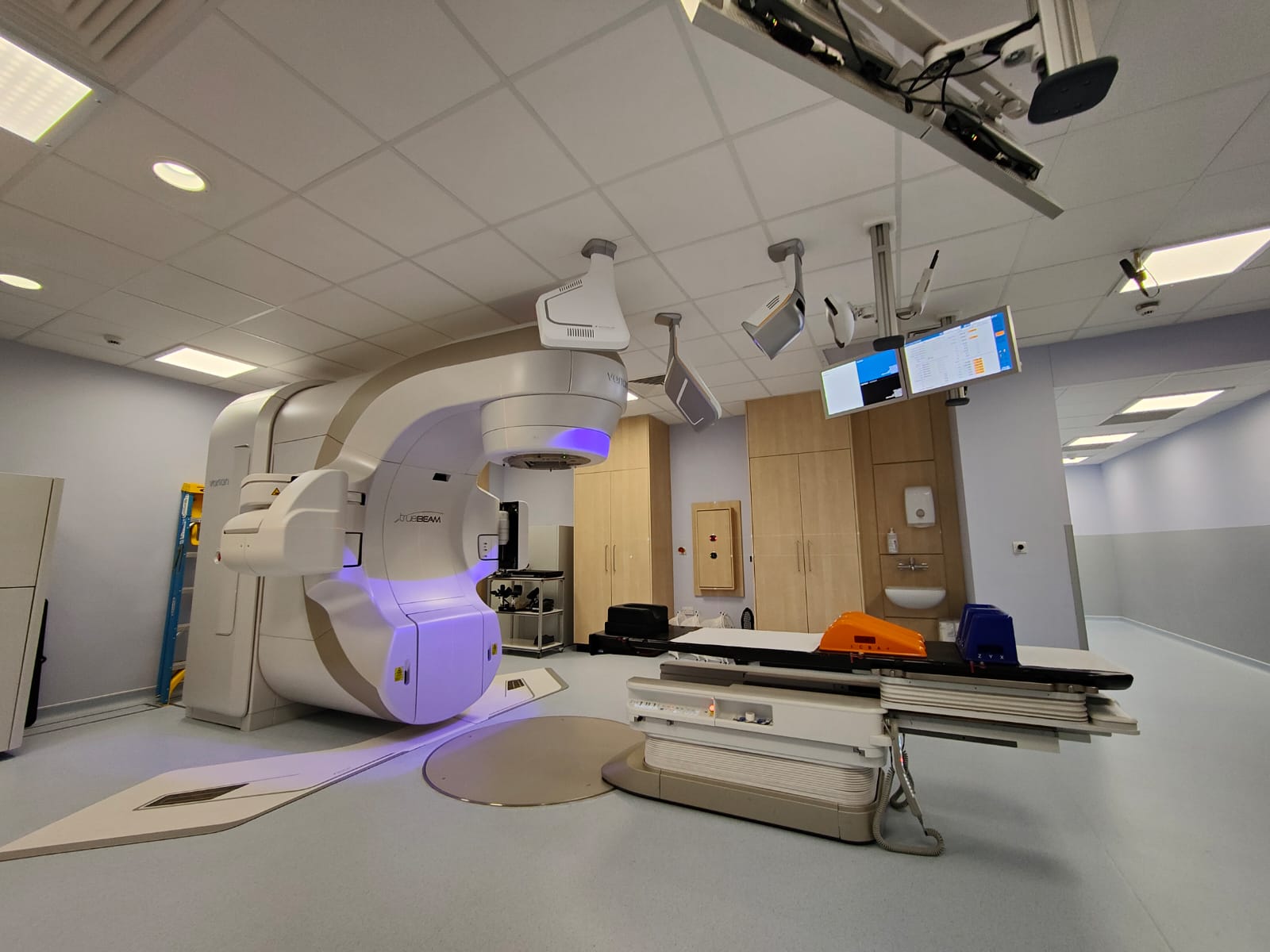
As of today I have had 6 sessions (‘fractions’) of radiotherapy with 14 more to go. The procedure involves removing my shoes and trousers and lying on the machine that you see in the photograph for a few minutes while it rotates around me. So far so good.
I have not yet experienced any direct side effects but I am aware that, even though it is only a couple of hours a day including commuting to the hospital and back, it nevertheless consumes a lot of my emotional energy and I get quite tired (though not yet the fatigue that the radiotherapy can induce.)
I have a list of things I want to do and get on with but it is hard to sustain my focus on, for example, writing. A lot of the time I don’t have my computer turned on at all. I have been fine with reading for the most part although I am not reading anything intellectually taxing over long stretches. I have been enjoying reading poetry before going to sleep (currently Simon Armitage, Magnetic Field: The Marsden Poems.)
I am acutely conscious of things I haven’t done.
My only problem with the radiotherapy is the TV in the waiting room. I don’t mind if it’s tuned to bland radio but more often than not it is showing morning programmes on STV and they are dreadful. I have a book with me usually (I’ve just finished The Man in the High Castle and am moving on to Neuromancer) but it is hard to concentrate and there is no quiet area. According to the radiologist this morning, the TV was introduced because people complained about the atmosphere in the waiting room without it. Bluetooth headphones and ambient electronica tomorrow. I think.
***
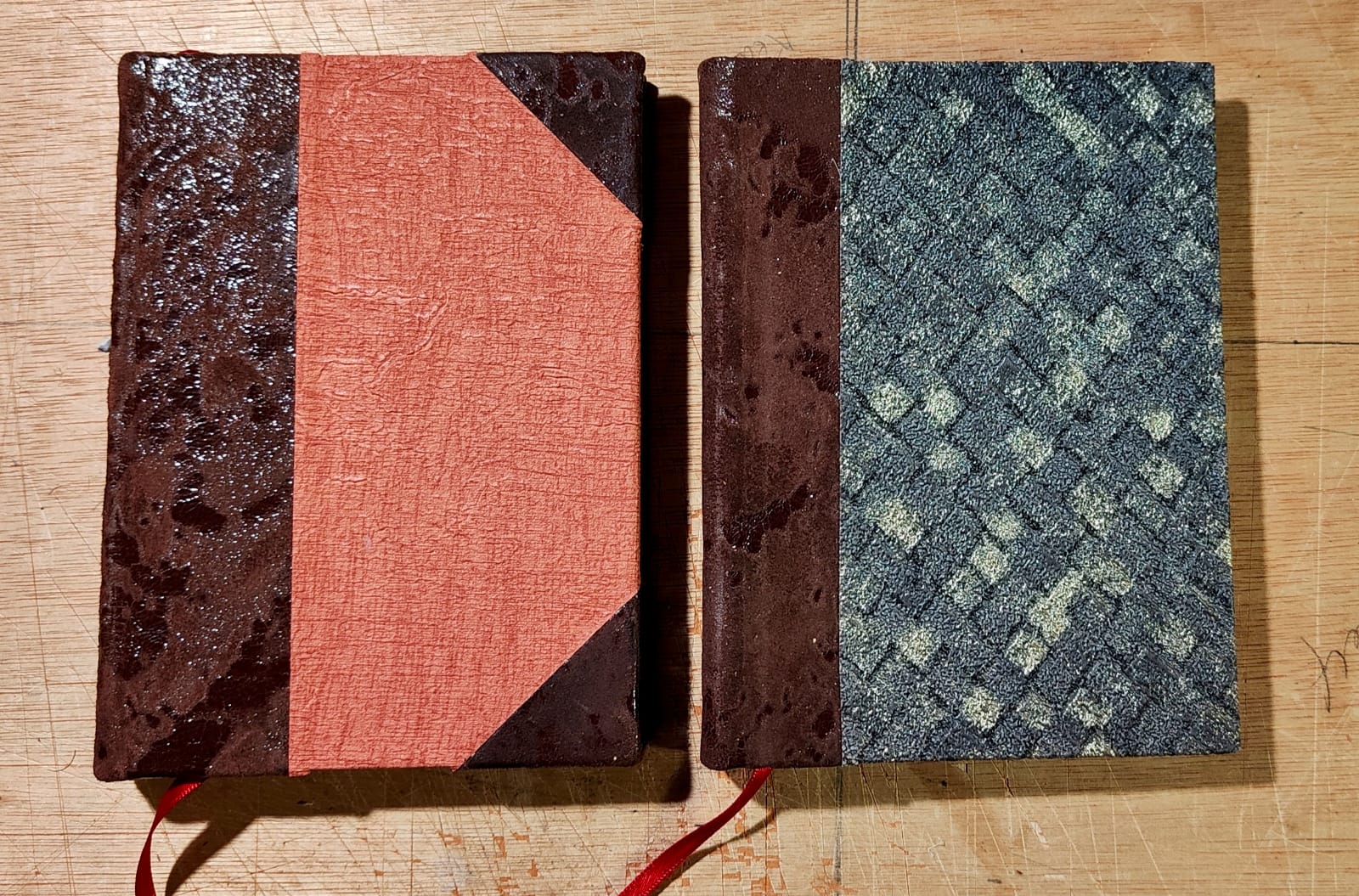
Non-identical twins
The one thing I have managed is to make a couple more notebooks. I like both of those photographed even though their cosmetic attractiveness masks ‘beginner’s’ issues in their construction, although they are functional. The one on the right in the photo is the better realised of the two.
There’s a ‘Zen’ quality to the repetitiveness of the steps taken to come up with something tangible and useful – stitching the signatures together and measuring and making the case and gluing it on. It is a very different kind of focus to that needed to come up with a thousand words of fiction. It is also, by definition, an analogue task done with hands without the use of modern technologies.
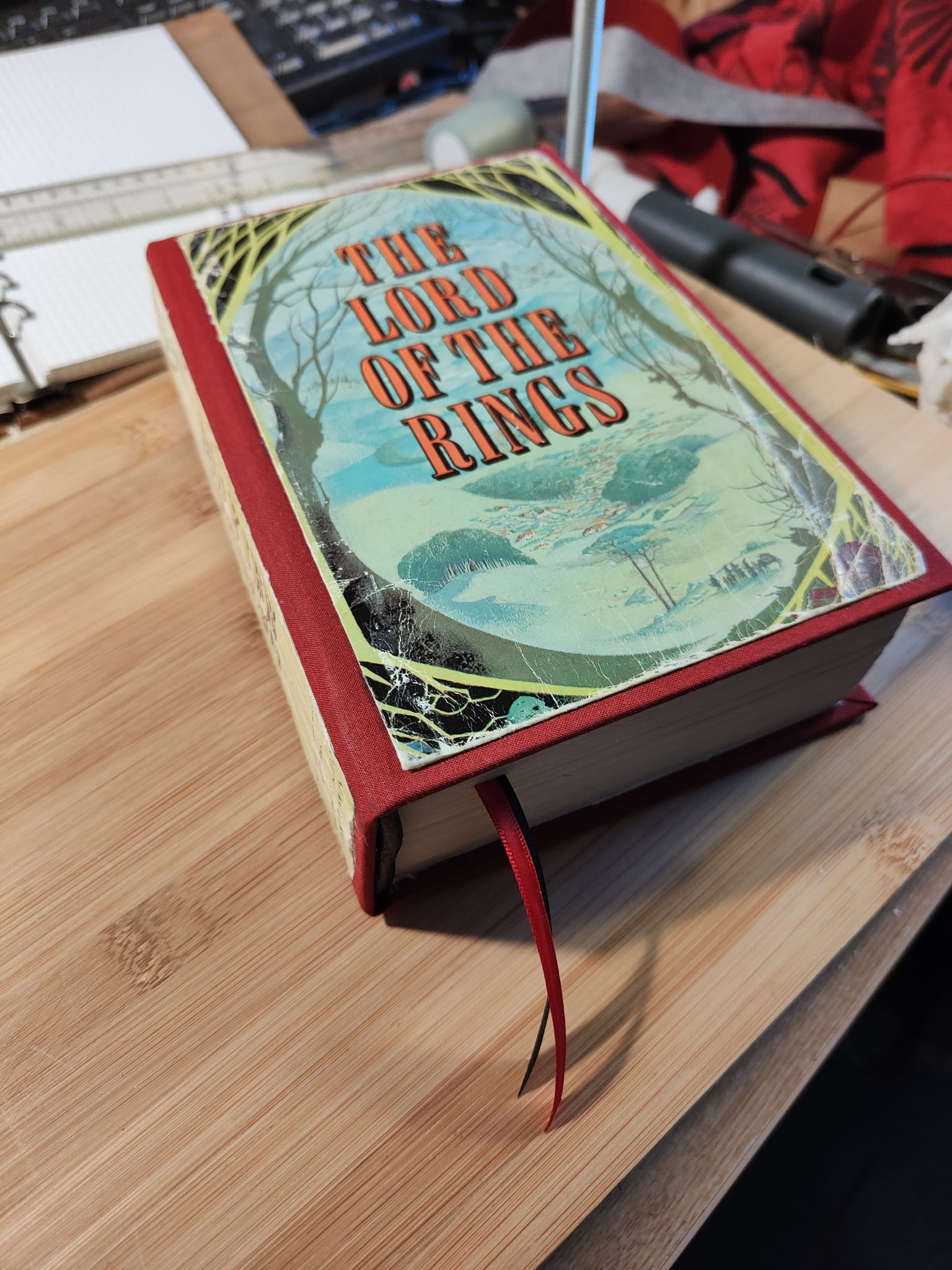
A bigger project, completed before the radiotherapy began, was to rebind of my teenage copy of The Lord of the Rings. I have the 8th impression of the Unwin paperback which was the first of the impressions published in 1971 and so was probably a birthday present. In the intervening 55 years it was read and reread and was the one I read to my daughters as a bedtime story before the Peter Jackson films. The cover was sellotaped on and the text block was split and also held together with sellotape.
One does not simply let one’s LotR disintegrate
In good condition those editions have some value, largely because most of them are not in good condition and had a name for falling apart. However it does have a lot of sentimental value to me, so I decide to repair it. I carefully removed all the old sellotape, repaired the text block and reinforced the spine, then cased it as a hardback, retaining the covers with the Pauline Baynes illustrations. It should be good now for another 55 years even if I am not.
I note that the Unwin editions were published in a clear font on Indian paper while modern paperbacks bought since the films have cheaper acidic paper that is already browning.
There may be other survivors of childhood worthy of the same treatment, but they can wait until the radiotherapy is over and I’m more inclined to take on projects for myself.
***
Allan Massie, RIP. I enjoyed several of his novels over the years, particularly Augustus.
I use a lot of notebooks and have opinions about what I like, opinions that boil down to squared paper that will take fountain pen without the ink bleeding through to the other side. I use various notebooks in varying sizes – A4, A5 and B5 mainly but my pocket notebooks are A6, more or less, and after an initial flirtation with the ubiquitous Moleskine I now use cheap ones made in China that are at least as good as Moleskines and considerably cheaper.
For some time I’ve toyed with the notion of making notebooks for myself, forming and stitching the paper signatures and case binding them. The photos are of my first effort, made over the last couple of days using materials I had in the shed, although I bought needles and linen thread. The finished article is a bit rough but I’m pleased with how it turned out. More to the point, now that I’ve made one I know that I can make more and make them better, with various papers in various sizes and with various covers. The one in the photos is covered in what looks like leather but is in fact a wallpaper sample that I’ll rub with beeswax tomorrow when the glue is dry.
outside
There is something pleasingly analogue about it, something homespun, even if all the constituent materials were made elsewhere.
Next up will likely be several A5 notebooks in various covers: I have a piece of thin leather that will do the job and I plan to experiment with making my own book cloth, as well as finding creative uses for other wallpaper samples.
There is a point to this besides the inherent pleasure in making the notebooks. I had my second hormone implant today and have a CT scan tomorrow preparatory to radiotherapy in a couple of weeks. I’ve mentioned before that one of the effects of the hormones is low-level fatigue and energy loss. This impacts in various ways but one of them is that I’m not always sufficiently with it to do anything that requires focus and creative imagination like writing fiction. This fatigue will become more pronounced as the radiotherapy progresses. Making notebooks is a handy way to keep myself active and occupied without having to think too hard about anything more than making the signatures, kettle stitching them together, making the cover and putting it all together.


Recent Comments