I am on the next stage of recovery, resistance work in the local gym. I am following a set of core exercises suggested by an exercise specialist at Prostate Scotland. Today was my third session.
The core issue is that the hormone implants and radiotherapy tend to reduce muscle mass and the resistance work is intended to restore it and also help create a cancer-suppressive environment in the body. The exercises I have are targeted at the main muscle groups and include deadlifts, a first for me. I’m not a complete stranger to resistance work but in the past it has always been as an adjunct to cardio training, mainly running; this time the resistance work is the main course and any cardio is an adjunct to it, at least for the first few months until things get back into balance.
The target is to find the weight for each exercise where I can manage 8 – 10 repetitions before having to stop, then doing three sets of them. Once I get used to that weight and can do, say, 10 to 15 repetitions, I raise the weight a notch, and so on. I would like to get back to running, but it isn’t a priority at present.
I won’t know how well the hormones and radiotherapy worked until early June when tests are scheduled.
***
I’ve been reading a lot lately. I mentioned Stevie Smith a couple of posts ago but I’ve also been dipping into Thomas Hardy’s poetry (there is a lot of it, of varying quality), Malcolm Guite’s first volume of the Arthurian corpus in epic verse, Galahad and the Grail, and Patricia A McKillip’s Ombria in Shadow. The latter is an object lesson in writing Fantasy to a very high standard and has given me plenty to think about as regards craft and technique in general.
I also read The Hobbit for the first time since the girls were small; it is an odd book. I enjoyed revisiting it but every so often the writing irritated me. Still, I enjoyed it enough to make the mistake of revisiting the first of the Peter Jackson Hobbit films to see if time has improved it; it has not.
It has been a tiring and expensive week. Expensive because Kirstin and I have booked to go away for the first time in a couple of years save for two city breaks in York. We’ll be in Italy for seven days in May and I dare say that you’ll read more about that in due course. It marks the end to the cancer uncertainty, a significant birthday for Kirstin and also, later in the year, our 40th wedding anniversary.
More expense: I was at the opticians and bought new glasses with a new prescription. Even using the various promotional deals on offer, new varifocal glasses are not cheap.
And finally I bought a new sports watch. I have previously owned two Garmin Forerunner 235 watches that I used primarily for running though they can also be used for swimming. I bought both of them second-hand and very cheap on eBay 3 years ago. One of them gave up the ghost but the other works well enough although the battery is going and it gets cranky sometimes; I’ll keep it as a backup. I bought a new one, albeit one model back from the current and as discounted ‘new old stock,’ because it has more functions that directly relate to the work I need to do for cancer recovery in the gym, and also for recording assorted metabolic functions that the Forerunner does not include. The new one is another Garmin, a Vivoactive 5 bought at substantially less than its old retail price and much less than the current Vivoactive 6.
Keeping it Understated
I’m tired mainly because I made a start on getting back into the exercise this week. On Monday I was swimming, pootling up and down the local 25m and feeling better about it than I expected. Tuesday was a brisk/vigorous 5k walk. On Wednesday I thought I’d go round our local hill, an old favourite route of mine; I aimed to alternate walking and light jogging with the emphasis on the walking but in fact I jogged most of it. For both the swimming and the jogging the aim was not to attempt anything heroic but simply to do the activity as best as I could to get my body back into an exercise frame of mind. I’ve also been doing some light resistance work in the house. I can report that I am feeling aches in all the right places and plan more of the same for the coming weeks and months, building in focus and intensity.
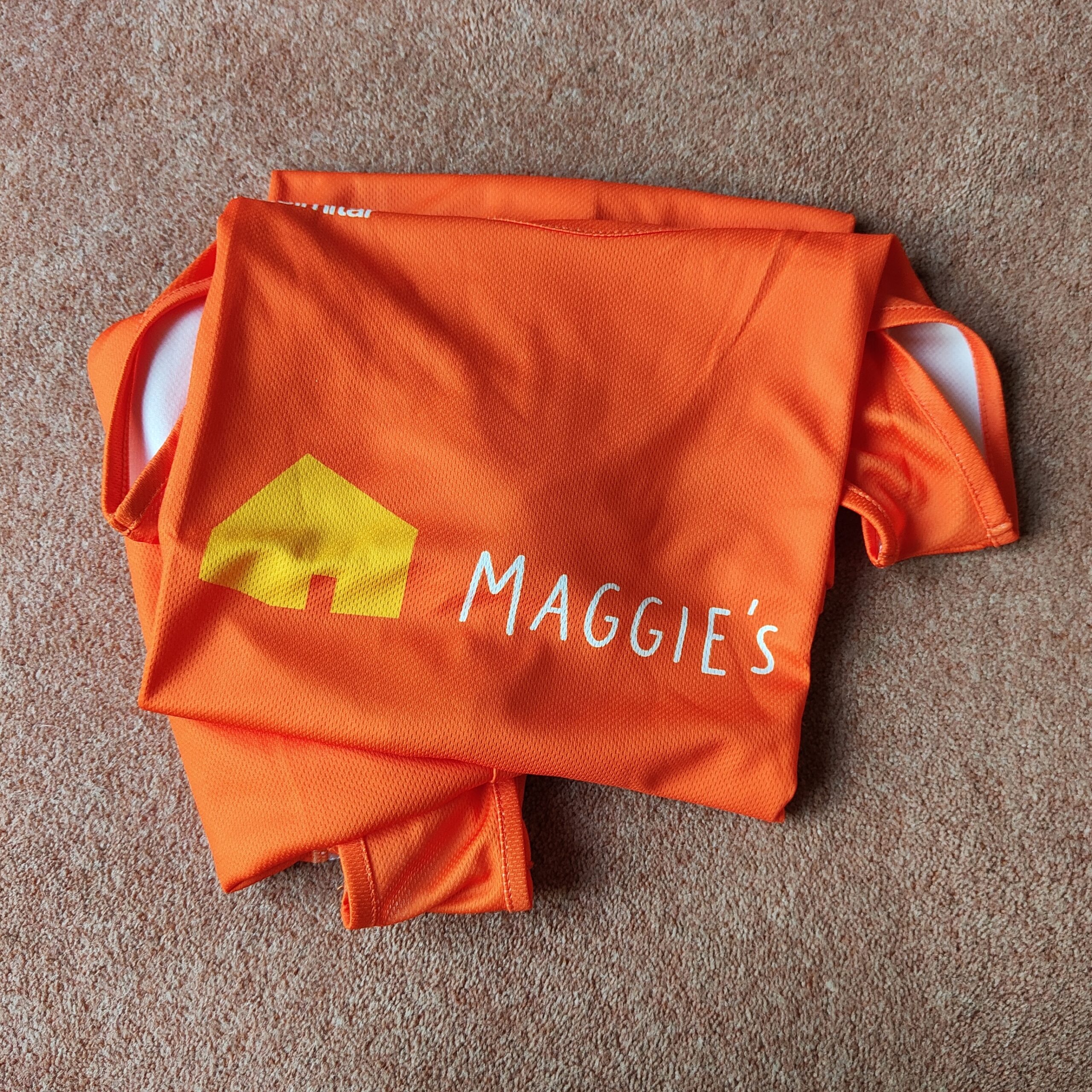
On the same theme, I had a phone call yesterday from Lisa, a prostate cancer specialist at Maggie’s. We had a very good chat about my stage in process (still in treatment because hormones are still in circulation in my body and the radiotherapy is still doing its work even though the daily sessions have stopped) and about my approach to exercise for the remainder of the treatment period and for recovery thereafter. I’ll write more about this once I’ve worked things through, however by the time she phoned I had already made a donation to Maggie’s in return for two running/gym vests. I’m happy to promote Maggie’s and happy to wear the shirts in the hope that they might prompt questions and discussion.
I have had nothing but praise for the care I have received since the diagnosis of my prostate cancer, however there was one area of the preparation and recovery process where advice and guidance was scarce: exercise.
I only became attuned to the importance of exercise late in the treatment process when I watched a presentation by Prof Robert Newton (also embedded below.) The only guidance I received was to ‘listen to my body’ and keep things moderate and ‘not to overdo it.’ On checking, there are one or two sentences about exercise and hormone therapy in a booklet produced by Prostate Scotland provided in my information pack, but it was not front and centre in the medical advice I was given by clinical nurse specialists, the oncologist or the radiographers.
The Basics
Hormone treatment and radiotherapy have side effects, though they differ between patients. Some are visible such as weight gain because of the hormones, some are not. In the case of the hormones, the invisible ones are loss of muscle mass and loss of bone density. The bone issue is addressed in part by the prescription of a calcium carbonate/vitamin D daily tablet; the muscle mass loss is a bigger issue. In my case, the hormone therapy is for six months (from October 2025) and not long-term; all being well, the hormone payload should diminish from around April this year.
Exercise does not cure cancer, but there is considerable evidence from Australia and elsewhere that exercise is important to the treatment process and plays a key role in resilience against both recurrence of the cancer as well as other health benefits. As it happens, I have been active with walking and also with some limited work with dumbbells, but I haven’t really focused on it. I now think that not focusing on it was a mistake.
Rather as happened with putting my type-2 diabetes into remission in 2021/22, I have concluded that I’m going to have to take ownership of using exercise for recovery and for building resilience against recurrence for myself.
Why is physical activity important in prostate cancer?
Physical activity is very important for maintaining or even improving your physical and psychological health. Even though at times you may not feel like it, it’s a good idea to do some physical activity most days, if not every day.
Exercise is a planned, structured type of physical activity. It can address specific health issues and prevent other chronic diseases, such as heart disease, stroke, diabetes, high blood pressure and other cancers. There is extensive evidence that targeted exercise is very beneficial and safe when you have prostate cancer.
Current Australian recommendations state that all men should perform some exercise each week, no matter the stage of their prostate cancer or whether they are undergoing difficult treatments. Exercise is now recognised as a medicine because it’s a powerful way to improve your health before, during and after prostate cancer treatments. If you are on hormone therapy, targeted exercise is vitally important for you.
What are the most effective types of exercise?
Any physical activity you can do will be beneficial. However, the most effective forms of exercise are:
Cardiorespiratory exercise, such as fast walking, jogging, cycling and swimming
Resistance training exercises, such as lifting weights, stair climbing and high intensity resistance workouts
It’s a good idea to do a combination of both forms of these exercises regularly (cardiovascular and resistance). You can also include sports such as golf and bowling or try some gentle exercise, such as walking each day, yoga, Pilates or Tai Chi. Any movement that raises your heart rate, makes you breathe faster and deeper, and contracts your muscles forcefully is beneficial.
Regular exercise, in any form, is better than none. It can give you more energy and a positive outlook to help you cope with your prostate cancer treatments and enhance you recovery.
How often should you exercise?
It is best to do some form of physical activity every day if you can. If you are relatively healthy, then you can also aim to do:
120 to 150 minutes of moderate to vigorous exercise each week
At least 2 resistance training sessions per week
The good news is that I have at least crossed the threshold: I was fit before the treatment started (I ran 5k less than a week after my biopsy last summer); the bad news is that I followed the general advice to take it easy and let my gym membership lapse for the duration.
What Now?
As I see it there are two stages to what I need to do The first, which with startling originality I’ll call Stage One, is to regain fitness. Aside from what I can do at home and in my neighbourhood, MacMillan Cancer Care have me on a scheme with Edinburgh Leisure for cheap access for a few months to council-run gyms and swimming pools. I don’t trust my knees to go proper running outside but I can go swimming and reacquaint myself with resistance equipment in the gym. I can pick up my walking pace from amble to brisk, and use a gym treadmill.
Stage Two is to work out a more developed programme for myself. I have Prof Newton’s book on order to help me shape that, but I think it entails going to the gym and speaking to an instructor about creating a routine focusing on core muscle mass.
Were I to formalise my thinking I would put it as,
Outcomes: fitness, recovery, resilience
Strategy: structured and phased approach to fitness, targeting problem areas
Tactics: building and executing routines and putting social markers around them, such as sponsored walks, runs etc. Journal the activities and my progress (and setbacks) and make the journey public here and on social media.
It’s been an odd few weeks. I hadn’t done much in the way of exercise since early June, first because of the time demands of a family wedding and second because, as soon as the wedding was celebrated, Kirstin and I both came down with colds that lingered. I’ve been around the block enough times to know that exercising before the body has recovered is a bad idea, so it was only last week that I went into the swimming pool a couple of times and, yesterday, into the gym.
The gym was busy so I didn’t do my full routine, but I did enough to find out the hard way that I’ve lost a bit of strength on the free weights. The plus side is that my previous efforts with free weights and upper body work made the return to the pool less difficult than it might have been. Anyway, I took a turn on a treadmill yesterday – set at an incline and a decent walking pace. On a whim, I also did some light jogging, basically the equivalent of 1km, my first attempt at jogging since the knee problem emerged in February. Happily, I had no reaction in my knee when on the treadmill and haven’t had any today.
I am well aware that I am not ready to go back to running, but I am pleased that I appear to be in a better place than I was five months ago.
Plenty of walking today, and a nap this afternoon. My knee may not have reacted, but the rest of me did.
***
Recent reading
Two new novels formed my reading this week, both quite different.
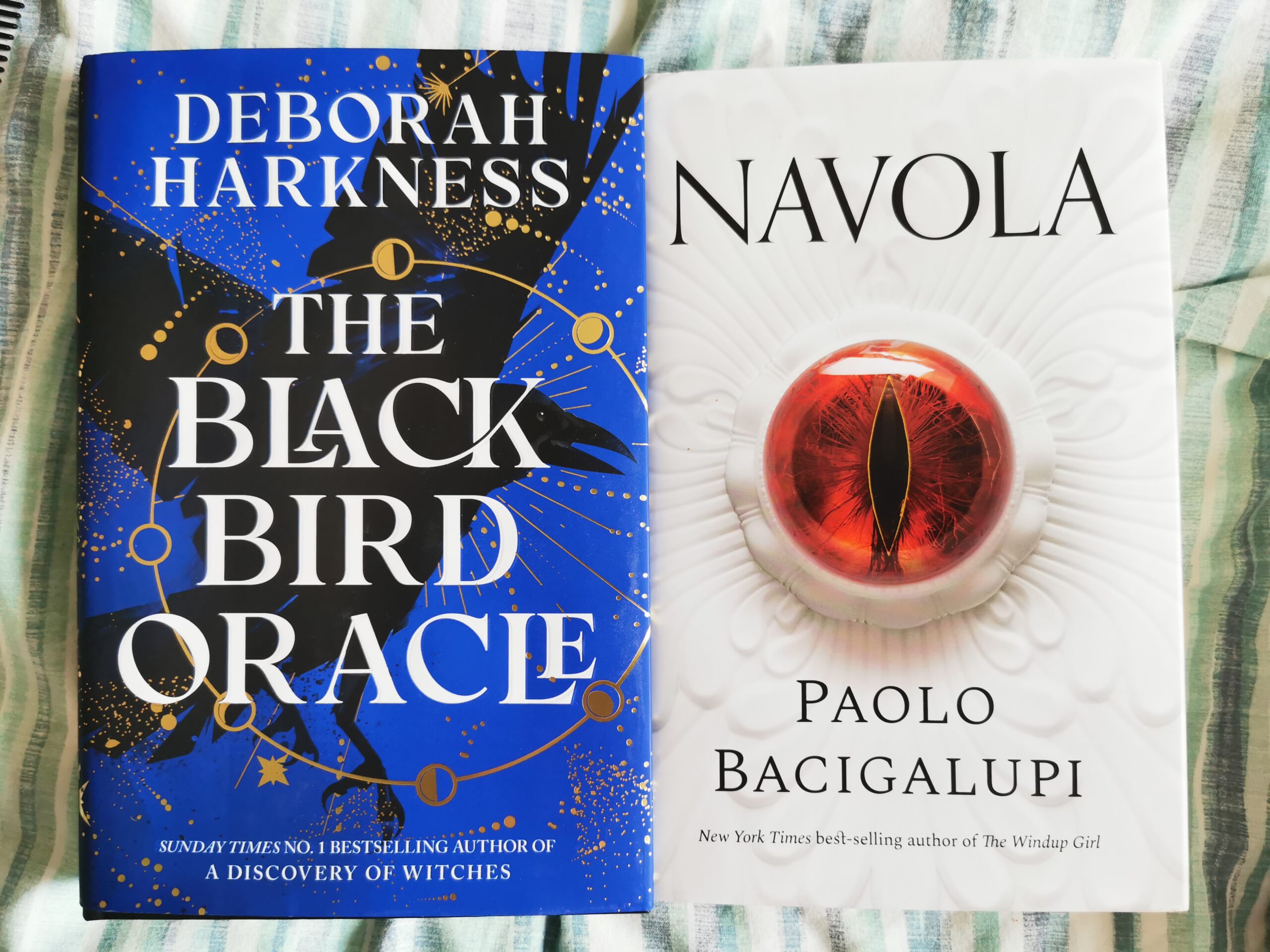
Paulo Bacigalupi’s Navola is a dark fantasy, grimdark even, that requires close attention. It’s a mashup of renaissance banking and trade, Rome and The Godfather. I enjoyed it a lot and look forward to the sequel in due course.
Deborah Harkness’s The Black Bird Oracle is nowhere near as deep or subtle, but it is an enjoyable page-turner. It doesn’t have the historical depth of the first two books in the sequence (A Discovery of Witches and The Shadow of Night) but that’s OK. I’m not being slighting – it was an enjoyable read after the more hardcore Navola.
Both books are waystations as I finish the current story collection and the back of my mind turns to the next novel or two. More on that later.
A trip to a sports physiotherapist has established what seems to be going on with my left knee. After a systematic assessment and rejection of possible causes of the problem, he reckons it’s down to wear and tear on the meniscus, possibly just because of aging. The upshot is that I can go back into the gym when I want, do as much upper-body resistance as I feel inclined, and also any cardio work except any running on the treadmill. In addition, I have some specific exercises designed to strengthen the knee. The downside is that, particularly at my age, it may be some time before I can consider running again, although he is reasonably confident that the time will come when I can.
Cheese:
Although I haven’t had my annual check yet, the general news is that my HbA1c remains in the normal range and therefore my diabetes remains in remission. This is despite my weight going up by around 2.5 kilograms based on this time last year. A period of weight-loss is called for, something that might be helped by getting back into the gym and/or swimming or possibly also by foregoing my taste for Stilton for a while. A more considered comment is in my latest Substack post linked here:
Progress continues to be made in working through some family lines, though the C19 Nottinghamshire family continues to be awkward. One of the problems is the divergence between social history and apparent genetic history and this is compounded by the way Ancestry suggests genetic matches.
The theory is that Ancestry (a) finds a genetic match (b) compares family trees to find common ancestors and (c) suggests a match. In principal this should work well, and a lot of the time it does. Where it gets less helpful is when either there is an error in one of the family trees it compares or where there is a problem with the underlying records from which people derive family trees – for example if a family are lying to officialdom or otherwise covering over the traces of illegitimacy or other shenanigans – which is what I continually encounter.
On this point, it is worth saying that the myth of ‘Victorian morality’ does not survive first contact with family history research. What is far more interesting to me are the many accepted ways that families would formally or informally absorb issues – for example an older couple might declare an illegitimate grandchild as one of their own children to census enumerators. We cannot know for sure in many (or most) cases the circumstances in which illegitimate (a term I dislike) children might be conceived – it might be teenage passion, it might be false promises from a bloke who then runs away. As the great Lizzie Higgins sang (What AVoice),
When my apron it hung low
My true love followed through frost and snow.
But now my apron is tae ma chin;
He passes me by and he’ll ne’er speir in.
It’s up and doon yon white hoose brae,
He’s called a strange girlie to his knee
An he’s telt her a tale that he’s once told me.
Oh I wish, I wish, oh I wish in vain,
I wish I was a maid again.
But a maid again I will never be
’Til a apple it grows on a orange tree.
However, the child might also come from rape or other coercion or incest. In the latter case, family shame and trauma would also lead to disguising the truth. Two centuries later, after the individuals are long gone, DNA technology throws up discrepancies in the established narrative.
It’s also worth noting that women in urban areas noted for poverty, such as Nottingham, might well (and often did if offical reports are to be believed) turn to sex work to make ends meet. I’m not saying that this was the case for any of my ancestors, simply that it would be wrong to dismiss the possibility.
I note with pleasure that people sharing the same name as my forebears (Faulks/Fawkes) in a small village in Nottinghamshire were noted for their skill in making Stilton, which explains a lot.
An odd thing has happened. I had a listen to Taylor Swift’s latest album, The Tortured Poets Department (Anthology edition). I thought it was OK and listened to it again. The second time through I enjoyed it. Can you guess where this is going? I’ve since bought Folklore and Evermore and rather like them. I am not a Swifty in the sense that I don’t connect with everything she does, but I do like some of it quite a lot.
Jeez, a Deadhead and Swifty-adjacent: who’da thunk it?
In other news, I haven’t run since February thanks to a knee problem that I’ve been resting. My gym membership starts up again in two weeks and I’ll get a clearer idea of how things, er, stand then. I think it’s a muscle problem rather than a knee problem as such, so aside from not running I’ve also been stretching quads a lot. It mainly impacts if I’m going down hill so my first tentative steps will be on a treadmill followed by a flat surface. I still have time to get back to 10K fitness by autumn, though maybe not as confidently as last year.
My time generally has been spent either revising the work in progress, a more substantial job than I expected, or digging into my family tree. On the latter, from a position of scepticism I’ve become more enthusiastic about the contribution of genealogy DNA as a means of confirming or refuting possible ancestral lines. Finding a DNA match with a sibling of a conjectured 5xgreat grandmother is, if not 100% cast-iron, about as good evidence as you can get that the conjecture is correct.
Meantime, I really like this, because I was a 17-year old boy once too.
Recent Comments