At the time of writing I have complete 14 of 20 fractions of radiotherapy; to the best of my knowledge it is going well. The side-effects, principally tiredness, come and go and I just have to go with them. I’ve learned that Bluetooth and earbuds are the solution to TV noise in the waiting room. I have many playlists and sometimes particular songs bring joy. Pet Shop Boys are always a cert, and three others are posted at the end of this. Most days the actual time under the beam is around 90 seconds, although once every week they also do a scan to check everything looks good.
Early in the week I took time to go to a couple of local gyms to check prices and also to ask if instructors were OK to work out a programme focused on recovery from the impact of the hormones and the radiotherapy – primarily addressing potentially reduced muscle mass and possible issues with bone density (although prescription calcium/vitamin D supplements should have helped with that.) As the androgen inhibition impacts of the hormones wears off I can build in cardio, I think. The key is not to be heroic, just to do some focused work. I get a heavily discounted rate with the local authority gym through MacMillan Cancer Care, though the private gym is the nicer (and closer) facility. Probably I’ll use the cheaper options while I can, then reconsider.
One of the books I read in the waiting room and at home was William Gibson’s Neuromancer (pub. 1984) It is justly seen as a formative work in modern SF and you can pretty much see the future being written, although as ever what is a warning about a techno dystopia seems to have been taken as a blueprint and call to action by the tech industry. It functions as a novel by being a fast-paced caper thriller presented in what was then a novel setting (the term cyberspace comes from it) using tech neologisms. I enjoyed it and can understand why it is so well regarded, but it will go back to the charity shop I got it from.
In TV viewing, after a shaky start Star Trek: Star Fleet Academy delivered what I thought were two decent episodes in episodes 4 and 5. I gave up on Star Trek: Discovery during its third season for several reasons, one of which was its tendency to inspiring speeches. The first three episodes of Academy leaned into this with ‘teachable moments’ delivered with that aura of cloying, earnest sentimentality that is uniquely American. Episodes 4 and 5 succeeded by largely dispensing with that and were much the better for it.
In the meantime, I took the opportunity of rewatching all of the TV adaptation of Deborah Harkness’s A Discovery of Witches. I think I’ve mentioned before that I very much prefer the books and had problems with the way the narrative was compressed for TV. In fairness, I enjoyed it more in this binge watch, albeit that I fast-forwarded through some scenes. As I’m avoiding anything particularly intellectually challenging I may read the books again. That isn’t to disrespect the books which I enjoy and are layered, but they’re not Pynchon. Of the five so far published the first three are by far the strongest, however I’ll give Prof Harkness a pass because she too was public about her encounters with cancer.
It isn’t quite a month since my first hormone implant and I’m beginning to feel its impact now in two ways. The first is that I find myself getting tired by late afternoon. I keep active, but a weariness descends; I do pick up again after supper though: the second is that it is changing trips to the bathroom – I’m peeing a bit more often and with greater urgency. I’m due another implant in January and I’m told that further and increasing weariness is an expected side-effect of the radiotherapy, which starts at the end of January and runs through February.
The idea, by the way, is that the hormones block testosterone which starves the cancer (and shrinks the prostate) and, under radiotherapy, cells are damaged but healthy ones grow back whereas cancerous ones don’t.
***
I continue to write despite tiredness and make a point of writing at least a paragraph a day. In practice I find I have two or three productive days of several hundred words followed by a couple of days off during which I read. I’m quite happy with the direction the new novel is taking, albeit that it is in first draft and it will need a lot of kicking into shape when the first draft is done, especially around pacing and structure. How to fix both of those becomes clearer when the whole story is told and I can take a big-picture view. I don’t expect to get to that stage until later in 2026 once the radiotherapy is over and I get back to my normal routines.
***
Meanwhile, I’ve been watching assorted programmes (online) including a spy series produced by Yorkshire Television in the late 1970s: The Sandbaggers. Unusually for a spy series, and possibly taking its cue from Len Deighton, it spends a lot of time on inter-Whitehall rivalry and manoeuvring, only occasionally venturing into action sequences and cynical brutality. It is undoubtedly ‘of its time’ in production values, stuffed full of tobacco products and, of course, rotary telephones with never a mobile or laptop computer in sight. Enjoyable.
Andor season 2 has taken up residence in my head in a way that few TV shows do and none have since Sense8. This post is an attempt to articulate some of the reasons why I like it, given that it is, from a certain point of view, just Star Wars.
This post is spoiler-free.
I’ve been watching Star Wars since I first saw it in East Kilbride cinema on UK release in 1978. Over the past half century I have followed the films and TV series, including the animated series, and dipped into the novels. Much as I have, for the most part, enjoyed the recent TV shows as casual viewing, they don’t do anything new with the base material; I’ve seen them described as dramatised fan fiction and that has a ring of truth. A major problem raised by Andor is that it implicitly highlights issues with those other Star Wars shows (and films) and the two principal issues it spotlights are their circumscribed writing and constrained imagination.
The thing is, the other shows and films all focus one way or another on the fantasy/sword and sorcery elements of the Force, the Jedi and the Sith. Andor dispenses with those elements almost completely, although it does touch on the Force, recognising that the Force is diagnostic of Star Wars.
Andor also presents the brutality of the Empire in ways rarely seen since we saw the smouldering skeletons of Lars and Beru in Star Wars (1977). The cruelty is much more tangible than pantomime villains such as Darth Vader or Emperor Palpatine. The rebellion here is not about abstract struggles between the light and dark sides of the Force, it arises from Imperial oppression.
Star Wars has been political since its inception; it is other things as well, but there is a political core. The genius of Lucas was to wrap so many contemporary elements and resonances in a fairy-tale package, though, over time, the fairy-tale wrapping has been mistaken for the packaged goods. The way the stories have developed over the past half century has often obscured the metaphorical payload or treated the struggle against the Empire as simply part of the mise-en-scene and/or simplified it into Robin Hood terms (Robin good, Sheriff of Nottingham bad.) Andor takes the politics seriously and is written by a very talented writer who knows his history. Tony Gilroy rips away the fancy wrapping and exposes what’s in the box.
(Some readers might object that aspects of this have been explored in the Expanded Universe of books and comics, and no doubt that is correct. However, I have only dipped into the books and, I have to say, haven’t really enjoyed most of those I’ve read, so can’t really comment on that.)
The premise of Andor is simple: what happened to create the rebellion that Luke Skywalker parachutes into? Who were the rebels? What did they rebel against? What shaped them as people? This premise is extended also to two of the principal antagonists, Syril Karn and Dedra Meero, who are also two of the most compelling characters in the show.
At the core is the titular protagonist Cassian Andor who features in Rogue One. We follow his journey from small-time thief looking for his sister to the hardened revolutionary of Rogue One, but he is only one player in a larger movement. We also see the radicalisation of Senator Mon Mothma, the role of social and political elites, and multiple squabbling factions who may or may not be the People’s Popular Front of Judea. We get cynical manoeuvring by Imperial security forces and revolutionary masterminds alike. None of the main characters are cyphers, most are morally complex. Storylines echo and mirror each other as they intertwine: we condemn the actions and attitudes of Imperial characters without necessarily noticing that the radicals are doing and thinking exactly the same things. There are no gratuitous redemption arcs; bad things happen to good people. All is brought to life by actors and actresses allowed to be at the very top of their game.
The result is that episodes 2.07, 2.08 and 2.09, which deal with the build up to the Ghorman Massacre, the massacre itself and its immediate aftermath have been hailed as three of the best executed episodes in recent TV, not simply in the Star Wars universe. The final three episodes, 2.10, 2.11 and 2.12, are perfect.
Andor implicitly questions the focus on militarised mysticism of the rest of Star Wars. It isn’t that other aspects of that universe have not previously featured, more that Andor shifts the core paradigm away from fights between samurai in space to the lives of everyone else in that universe.
Andor forces us to conclude that exploring the Star Wars galaxy solely through the Jedi and Sith is like exploring the course of World War 2 solely through internal doctrinal arguments in the Vatican and factional infighting in the Swiss Guard.
That isn’t to say that the Force is something to be ignored, just that there are other ways to explore and engage with it, much as the machinations of the Culture are only suggested fleetingly at the close of Iain M Banks’s Inversions.
Andor has often been described as Star Wars for grown-ups, but there’s more to it than that: to date, in broad terms, Star Wars as a ‘franchise’ (I dislike that term) has devolved into space opera and fantasy; Andor returns it to science fiction by engaging with the central metaphors of the original, as did The Last Jedi.
From the moment the Star Wars universe began to expand with the release of The Empire Strikes Back and the early novelisations, it has been a very flexible palette with scope for many different stories and tonalities. I do not think that from now on every new release should be a gritty political drama, but I do think that we can hope that everything now should be seen creatively as before and after Andor: Andor has raised the bar of what we should hope, and rebellions are built on hope.
Until recently, I was looking forward to collecting my State Pension later this year as a great way to gain more disposable income and make the lifestyle a bit more comfortable. As the markets now stand, I’m watching my private pension fund diminish at a disturbing rate; we’re not yet in Truss/Kwarteng territory, but turmoil in the markets mean squeaky-bum time until the markets finally stabilise, whenever that might be. I also have a Civil Service pension and find that this year’s index-linked increase is *less* than our annual Council Tax rise. Anyway, six months to State Pension day and it suddenly looks a lot more like a safety net than a comfort blanket.
***
The Butcher Bird has been out for a month now. I am delighted to say that I have sold some copies, but not many copies. So it goes, as Billy Pilgrim said, poo-tee-weet. I don’t write for sales, but it is always nice when I see that a book has sold or someone says something kind on social media. And as I write this I see that someone, somewhere in the UK, has bought a hardback copy; I got quite the endorphin rush.
***
One of my TV memories from the early 1970s was watching Clochemerle on BBC2, a satire that revolves around a proposal to erect a public urinal near the church in a small wine-growing town in Beaujolais. I have it on a DVD and should watch it again, not least because the luminous Cyd Hayman is in it, an early crush of mine. A lot later I read the book by Gabriel Chevallier and at least one of its sequels (I have all three of them but I have no memory of reading the third, Clochemerle les Bains.) I also have one of his other novels in an old paperback, TheAffairs of Flavie, but didn’t get along with it. They’re quite old translations and could do with an update. What I didn’t know until recently was that he wrote a semi-autobiographical novel, La Peur, based on his experiences in the trenches in WW1, a novel that was effectively suppressed when WW2 came along. It was eventually released in English as Fear in 2011. I’m reading it at present and enjoying it: the modern translation helps.
***
A trailer is out for Star trek: Strange New Worlds season 3 is out and I’ve embedded it below. It drove me to watch my three favourite episodes of season two – Tomorrow and Tomorrow and Tomorrow, Those Old Scientists and Subspace Rhapsody. Easily the best Star Trek show since Deep Space 9.
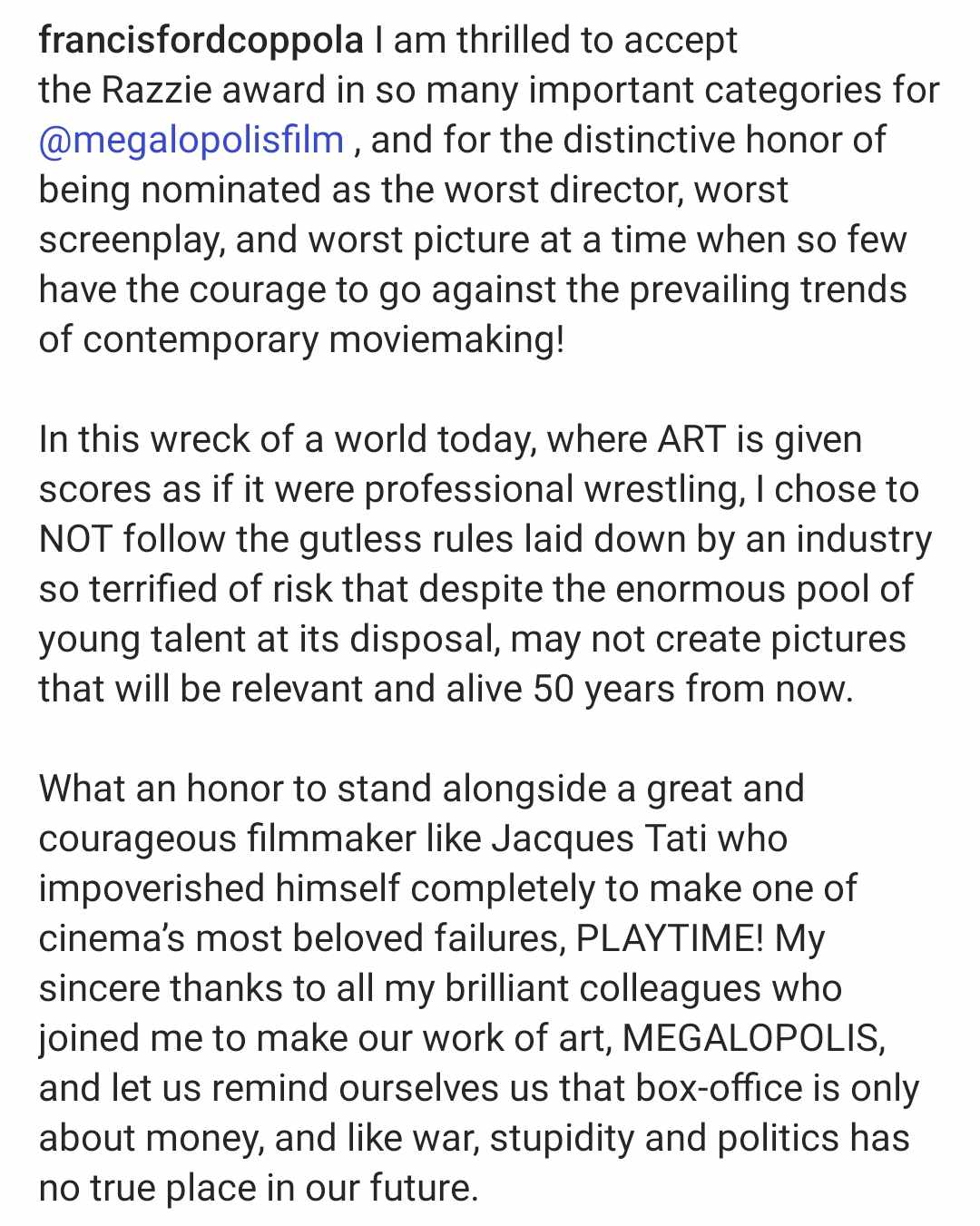
Last year, Francis Ford Coppola released his long-term passion project, Megalopolis. The film was largely panned by the critics using terms including sloppy and self-indulgent. Mark Kermode delivered a lengthy rant about how much he disliked it. The film was nominated in 6 categories in the Golden Raspberries and won two of them – worst supporting actor (Jon Voigt) and worst director. Coppola’s remarks at the Rassies are copied in below.
That surprised and disappointed me because I had been looking forward to seeing it when the trailer was released. I didn’t see it in the cinema but I did watch it this afternoon on the small screen.
You may not be surprised to learn that I enjoyed it.
Coppola’s Comments
It is definitely an auteur piece and it is heavily stylised, much as One From the Heart was several years ago. It is also something of a manifesto and an assertive rejection of what has become the Hollywood norm. It is not a superhero film. It does not follow the strictures of the Hero’s Journey. You will not find 15 Save-the-Cat beats. It is much more structured around classical theatre – for Greek and Roman values of classical.
More than anything, it looks at contemporary cinema and shouts from the rooftops that it doesn’t have to be like this, that there is more to the human imagination and to art than is encompassed in the spreadsheets of Hollywood producers, accountants and executives. It is, in a sense, a call back to a much earlier age of cinema when anything was possible. I don’t think it is too much of a stretch to suggest that the title is itself a nod to Lang’s Metropolis, a classic of German Expressionist art. (It’s worth remembering that Metropolis was also panned by critics on its release, as, of course, was Blade Runner.) In the context of modern films, Megalopolis induces culture shock, like reading young-adult fan fiction then picking up a novel by Thomas Pynchon.
It also, by a happy coincidence of timing, can be read as a grand satire on the gilded toilet pedestal that sits at the heart of the oval throne room of Trump.
Is it perfect? By no means. Do I plan to rewatch it soon? Yes.
Lindsay and I were at Barrowland this week to see Public Service Broadcasting on the opening night of their latest tour. This was the third time I’ve seen them at Barrowland (the sixth time I’ve seen them overall since 2017) and, in a sign of changing times, this show was sold out, and tickets went fast. It goes without saying that it was a great gig – I don’t recall ever seeing a bad one from them. The first time I saw them, playing The Race For Space in it’s entirety at the Usher Hall as part of the Edinburgh Science Festival, was excellent and they manage to get better with every tour. They spent an hour and forty-five minutes on a selection from across their history, all played with skill, confidence and energy, and bolstered by a ‘lively’ crowd.
The inestimable Peter Ross, author of the excellent Steeple Chasing and A Tomb with a View amongst many other things (and a fellow devotee of Half Man Half Biscuit) was there too: his Guardian review is here:
I’ve embedded the video for Night Mail, which Peter mentions, at the foot of this post. It’s one of PSB’s earliest recordings and remains a setlist staple. I’ve also embedded ‘Progress’, by turns ironic and optimistic (the voice over is from a film about progress in the UK mining industry.)
***
I watched David Olusoga’s new A House Through Time: Two Cities At War, rapt. I saw the first episode on telly (for which I often need my hearing aids these days) and the other three episodes on iPlayer with noise-cancelling headphones. The hyperlink is to iPlayer which you might not be able to access outside of the UK. This series was narrowly focused on two apartment blocks, one in London the other in Berlin, and deftly used the central conceit of researching the lives of the residents to follow a broader social history, in this case roughly 1930 to 1945. In the best traditions of public service broadcasting, it informed, educated and entertained, and packed a powerful emotional punch, especially episode three. Highly recommended.
I’m still watching the latest from Marvel, Agatha All Along, and I’m still really not sure what to make of it. As I wrote last time, it has a distinctly American sensibility for, I now realise, American values of pantomime: the acting is not – and is not supposed to be – naturalistic. It also sits in a line of witchcraft narratives that owe a lot to the Brothers Grimm as filtered through Disney, and the Wicked Witch of the West of The Wizard of Oz – and not in an ironic or critical way. I think I’m enjoying it, but I’m not as enthusiastic as the mass of fans on social media.
***
I’ve been spending time reading The Scotsman from 1933 and 1939 as background preparation for the next novel(s) and it has been fascinating. My initial aim was to get background colour and detail for the stories and I’m getting that, but I’m also struck by the differences between then and now. By that I do not just mean a world where the listings are for Radio not TV and international travel is by sea not air, I also mean the way in which the paper is written and edited. Grammar and syntax are spot on even if the vocabulary is now dated, but, more than that, there are no bylines and no opinion columnists: the focus is on the verities of who, what, when, where and how. The reporting of Hitler’s appointment as Chancellor in late January of 1933 is exemplary: concise, sharp, analytical and objective.
There is also that thing of watching events play out in real time when I know the outcome and it doesn’t end well (something that is strong in A House Through Time as well.)
Working through the papers (and I plan to read through 1936 too) is quite time consuming but worth it. As I mentioned last time, I intend also to work through the Edinburgh Evening News and Edinburgh Evening Dispatch for the same years for a different tone and a different assumed audience. It has since occurred to me that for many people of the time the primary news source would not have been the papers but Pathé newsreels in the cinema. happily, these have been digitised and are freely available online.


Recent Comments