I have had nothing but praise for the care I have received since the diagnosis of my prostate cancer, however there was one area of the preparation and recovery process where advice and guidance was scarce: exercise.
I only became attuned to the importance of exercise late in the treatment process when I watched a presentation by Prof Robert Newton (also embedded below.) The only guidance I received was to ‘listen to my body’ and keep things moderate and ‘not to overdo it.’ On checking, there are one or two sentences about exercise and hormone therapy in a booklet produced by Prostate Scotland provided in my information pack, but it was not front and centre in the medical advice I was given by clinical nurse specialists, the oncologist or the radiographers.
The Basics
Hormone treatment and radiotherapy have side effects, though they differ between patients. Some are visible such as weight gain because of the hormones, some are not. In the case of the hormones, the invisible ones are loss of muscle mass and loss of bone density. The bone issue is addressed in part by the prescription of a calcium carbonate/vitamin D daily tablet; the muscle mass loss is a bigger issue. In my case, the hormone therapy is for six months (from October 2025) and not long-term; all being well, the hormone payload should diminish from around April this year.
Exercise does not cure cancer, but there is considerable evidence from Australia and elsewhere that exercise is important to the treatment process and plays a key role in resilience against both recurrence of the cancer as well as other health benefits. As it happens, I have been active with walking and also with some limited work with dumbbells, but I haven’t really focused on it. I now think that not focusing on it was a mistake.
Rather as happened with putting my type-2 diabetes into remission in 2021/22, I have concluded that I’m going to have to take ownership of using exercise for recovery and for building resilience against recurrence for myself.
Why is physical activity important in prostate cancer?
Physical activity is very important for maintaining or even improving your physical and psychological health. Even though at times you may not feel like it, it’s a good idea to do some physical activity most days, if not every day.
Exercise is a planned, structured type of physical activity. It can address specific health issues and prevent other chronic diseases, such as heart disease, stroke, diabetes, high blood pressure and other cancers. There is extensive evidence that targeted exercise is very beneficial and safe when you have prostate cancer.
Current Australian recommendations state that all men should perform some exercise each week, no matter the stage of their prostate cancer or whether they are undergoing difficult treatments. Exercise is now recognised as a medicine because it’s a powerful way to improve your health before, during and after prostate cancer treatments. If you are on hormone therapy, targeted exercise is vitally important for you.
What are the most effective types of exercise?
Any physical activity you can do will be beneficial. However, the most effective forms of exercise are:
Cardiorespiratory exercise, such as fast walking, jogging, cycling and swimming
Resistance training exercises, such as lifting weights, stair climbing and high intensity resistance workouts
It’s a good idea to do a combination of both forms of these exercises regularly (cardiovascular and resistance). You can also include sports such as golf and bowling or try some gentle exercise, such as walking each day, yoga, Pilates or Tai Chi. Any movement that raises your heart rate, makes you breathe faster and deeper, and contracts your muscles forcefully is beneficial.
Regular exercise, in any form, is better than none. It can give you more energy and a positive outlook to help you cope with your prostate cancer treatments and enhance you recovery.
How often should you exercise?
It is best to do some form of physical activity every day if you can. If you are relatively healthy, then you can also aim to do:
120 to 150 minutes of moderate to vigorous exercise each week
At least 2 resistance training sessions per week
The good news is that I have at least crossed the threshold: I was fit before the treatment started (I ran 5k less than a week after my biopsy last summer); the bad news is that I followed the general advice to take it easy and let my gym membership lapse for the duration.
What Now?
As I see it there are two stages to what I need to do The first, which with startling originality I’ll call Stage One, is to regain fitness. Aside from what I can do at home and in my neighbourhood, MacMillan Cancer Care have me on a scheme with Edinburgh Leisure for cheap access for a few months to council-run gyms and swimming pools. I don’t trust my knees to go proper running outside but I can go swimming and reacquaint myself with resistance equipment in the gym. I can pick up my walking pace from amble to brisk, and use a gym treadmill.
Stage Two is to work out a more developed programme for myself. I have Prof Newton’s book on order to help me shape that, but I think it entails going to the gym and speaking to an instructor about creating a routine focusing on core muscle mass.
Were I to formalise my thinking I would put it as,
Outcomes: fitness, recovery, resilience
Strategy: structured and phased approach to fitness, targeting problem areas
Tactics: building and executing routines and putting social markers around them, such as sponsored walks, runs etc. Journal the activities and my progress (and setbacks) and make the journey public here and on social media.
I completed my course of radiotherapy today. No doubt I’ll have more to say about it as the results become clearer in time and when I’ve had some time to reflect, but it’s worth recording the date.
I have been lucky. The radiographers treat anywhere between 180 and 240 people per day using 6 machines. and I know from chatting to people in the waiting room that some of those people have much more significant and life-changing cancers than me and face more intense side effects. Cancer, and the waiting rooms, are great levellers.
***
Team Doolally
Late to the party, I caught up with Dept Q, scandi-noir transplanted to Edinburgh with a magnificently sweary Matthew Goode taking the lead in a very strong cast. I binged it over two nights and am looking forward to the next series when it finally appears. Also, I enjoyed playing the game of spotting Edinburgh locations and noting when they did not match geographically.
At a loose end, I revisited Matrix : Resurrections which I thought I’d written about here previously but seemingly not. The first part of the film is funny and clever; unfortunately the second half is a boring retread of stuff we’ve seen before. It was a good earner for most of the Sense8 cast who appear in it, cast adrift when that series was cancelled, but not a particularly good film overall. I suspect that had a lot to do with it being the work of only one Wachowski: Lana.
In other news, Jon Anderson, erstwhile lead singer of Yes, is touring this year. He is 81. Touring with the Band Geeks, the show will be dominated by Yes classics played at their original tempo. I have, of course, already bought a ticket.
This is something I posted at the weekend over on Substack and thought worth cross-posting here. I’ve edited it lightly and also added a link to the song from which the title comes.
In the newfound reverie Of quiet peace I found Freedom comes from being unafraid Of the heartache that can plague a man
===
I haven’t posted here for a while; I have been caught up with treatment for early stage prostate cancer and my focus has meandered. Some initial reflections on that are what I want to sketch here, fully conscious that these are neither well-formed musings nor decided positions.
When I was coming to terms with the diagnosis, before I knew details of the staging and treatment, I had plenty of time to consider personal mortality and also to determine, firmly, that creativity is resistance. That conviction remained, and remains, even after it was determined that my cancer (bog-standard, no funky stuff, per the Clinical Nurse Specialist) is eminently treatable. What has changed over time are the ways that creativity has manifested as my treatment has progressed.
A key impact has been on my ability to focus on my novel-in-progress – that focus has come and gone; in parallel my reading has shifted back and forth between books that require concentrated attention and books that don’t. For a while I had that sense of guilt usually expressed as hashtag I should be writing. I was conscious of every day that passed without my putting forth a thousand words or so. I still am. On the other hand, somewhere along the way I have worked out how the novel will end and how that ties to what I’ve already written and thus how my existing draft should flex to accommodate it.
And I have generated a load of running notes of ideas and scenes to write, plus I’ve had plenty of time to consider (and reconsider) the overall shape of the book and the ineffable something that I’m searching for in the first draft, the ghost in the story that animates it.
Even though I expected it, I have been surprised by the extent to which my reactions to treatment have affected my focus and stamina for fiction; it is as though concentrating on the realities of life has got in the way of my ability to live in a fictional world of my own devising. Conversely, I also think that sharp focus on the mundane is shaping my approach to the prosaic, and that this will be manifest in my writing once I have a first draft and can get down to the hard work of turning words into writing.
In the meantime I have channelled creativity into other activities: I tried my hand at verse that occasionally aspired to poetry (and in the process read a lot of poetry); I learned to stitch and bind my own hardcover notebooks; I began the process of remembering how to play guitar; and, as sales of my existing books have fallen to zero, I have pondered what that means for the one I am writing, the scattered short stories sitting unpolished in folders and the stories I hope to write when the current one is done.
Somewhere along the way my mindset shifted. Or perhaps something that has always been there crystallised and the title of this piece frames it: although the realities of treatment get in the way of some aspects of creativity, they will pass. I have reached an uneasy détente with mortality that frees me to articulate to myself the things that are important to me.
The renewed story I tell myself of who I am is shaping the fictional worlds I create.
At the time of writing I have complete 14 of 20 fractions of radiotherapy; to the best of my knowledge it is going well. The side-effects, principally tiredness, come and go and I just have to go with them. I’ve learned that Bluetooth and earbuds are the solution to TV noise in the waiting room. I have many playlists and sometimes particular songs bring joy. Pet Shop Boys are always a cert, and three others are posted at the end of this. Most days the actual time under the beam is around 90 seconds, although once every week they also do a scan to check everything looks good.
Early in the week I took time to go to a couple of local gyms to check prices and also to ask if instructors were OK to work out a programme focused on recovery from the impact of the hormones and the radiotherapy – primarily addressing potentially reduced muscle mass and possible issues with bone density (although prescription calcium/vitamin D supplements should have helped with that.) As the androgen inhibition impacts of the hormones wears off I can build in cardio, I think. The key is not to be heroic, just to do some focused work. I get a heavily discounted rate with the local authority gym through MacMillan Cancer Care, though the private gym is the nicer (and closer) facility. Probably I’ll use the cheaper options while I can, then reconsider.
One of the books I read in the waiting room and at home was William Gibson’s Neuromancer (pub. 1984) It is justly seen as a formative work in modern SF and you can pretty much see the future being written, although as ever what is a warning about a techno dystopia seems to have been taken as a blueprint and call to action by the tech industry. It functions as a novel by being a fast-paced caper thriller presented in what was then a novel setting (the term cyberspace comes from it) using tech neologisms. I enjoyed it and can understand why it is so well regarded, but it will go back to the charity shop I got it from.
In TV viewing, after a shaky start Star Trek: Star Fleet Academy delivered what I thought were two decent episodes in episodes 4 and 5. I gave up on Star Trek: Discovery during its third season for several reasons, one of which was its tendency to inspiring speeches. The first three episodes of Academy leaned into this with ‘teachable moments’ delivered with that aura of cloying, earnest sentimentality that is uniquely American. Episodes 4 and 5 succeeded by largely dispensing with that and were much the better for it.
In the meantime, I took the opportunity of rewatching all of the TV adaptation of Deborah Harkness’s A Discovery of Witches. I think I’ve mentioned before that I very much prefer the books and had problems with the way the narrative was compressed for TV. In fairness, I enjoyed it more in this binge watch, albeit that I fast-forwarded through some scenes. As I’m avoiding anything particularly intellectually challenging I may read the books again. That isn’t to disrespect the books which I enjoy and are layered, but they’re not Pynchon. Of the five so far published the first three are by far the strongest, however I’ll give Prof Harkness a pass because she too was public about her encounters with cancer.
Today marked the halfway point in my planned radiotherapy. As ever it was quick and easy and the radiology team at the Edinburgh Cancer Centre were a cheerful, professional delight. Significantly, it also marks the point at which I no longer have to self-administer an enema to ensure the bowel is empty before the daily dose of radiation. That may not sound like much but it is.
At my preliminary meeting with the oncologist in September he said that there would be side effects but no one can predict in advance what those side effects will be or how severe. In my case I have had weight gain from the hormones (because testosterone production is effectively shut down) and I am now beginning to experience regular fatigue caused at least in part by my body’s defences trying to repair the impact of the radiation. Less obvious is that both the radiation and the daily enemas disrupt the normal daily digestive process, and that is why the end of that particular routine is a relief in more ways than one.
On the subject of enemas two cautions:
enemas and white underwear make a dubious combination, though I got through it largely unscathed and unstained, and
as my neighbour Sandy who has also been through this said, ‘never trust a fart.’
The trick is to keep as active as possible. I try to walk my 10,000 steps every couple of days (I know the target is arbitrary but it is a decent rule of thumb, and also includes Kaimes Road as a touch of cardio.) and I have some dumbbells here, mainly used for bicep curls.
It occurred to me earlier this evening that, although I have tried to be as open as sensible here there is one topic I have hinted at but have not written about at any length, and that is the long nights of the soul that followed the original suggestion that I might have cancer. It is a big subject and one that I do want to write about because it is foundational to how we as individuals react to a potential diagnosis and intimations of mortality, but haven’t yet found the words. A year on from the original discovery is quite some time to wait before finding the words, but I have private journals and notes to remind me. What I remember very clearly, though, is that there was a distinct ‘before’ and ‘after’ sensation when I got the ‘phone call from my doctor.
***
The road goes ever on
In amongst all this stuff I have managed the occasional paragraph or two of the novel-in-progress and have also compiled an expanding set of notes on to work on once I feel more focused. I do not for a moment compare myself to JRRT but I find this extract from a letter to Auden reassuring as a first draft slowly reveals itself to me.
I’ve mentioned JRRT a few times recently. I am not an uncritical admirer: I enjoyed The Hobbit, and LotR astonishes every time I dip into it. I never got on with The Silmarillion. I enjoyed his translation of Gawain and the Green Knight and am currently working through his unfinished The Fall of Arthur which is fine but was abandoned and is thus neither finished nor polished. Even so, I think he has a stature that goes well beyond the confines of the genre he inspired but of which he was not himself a part.
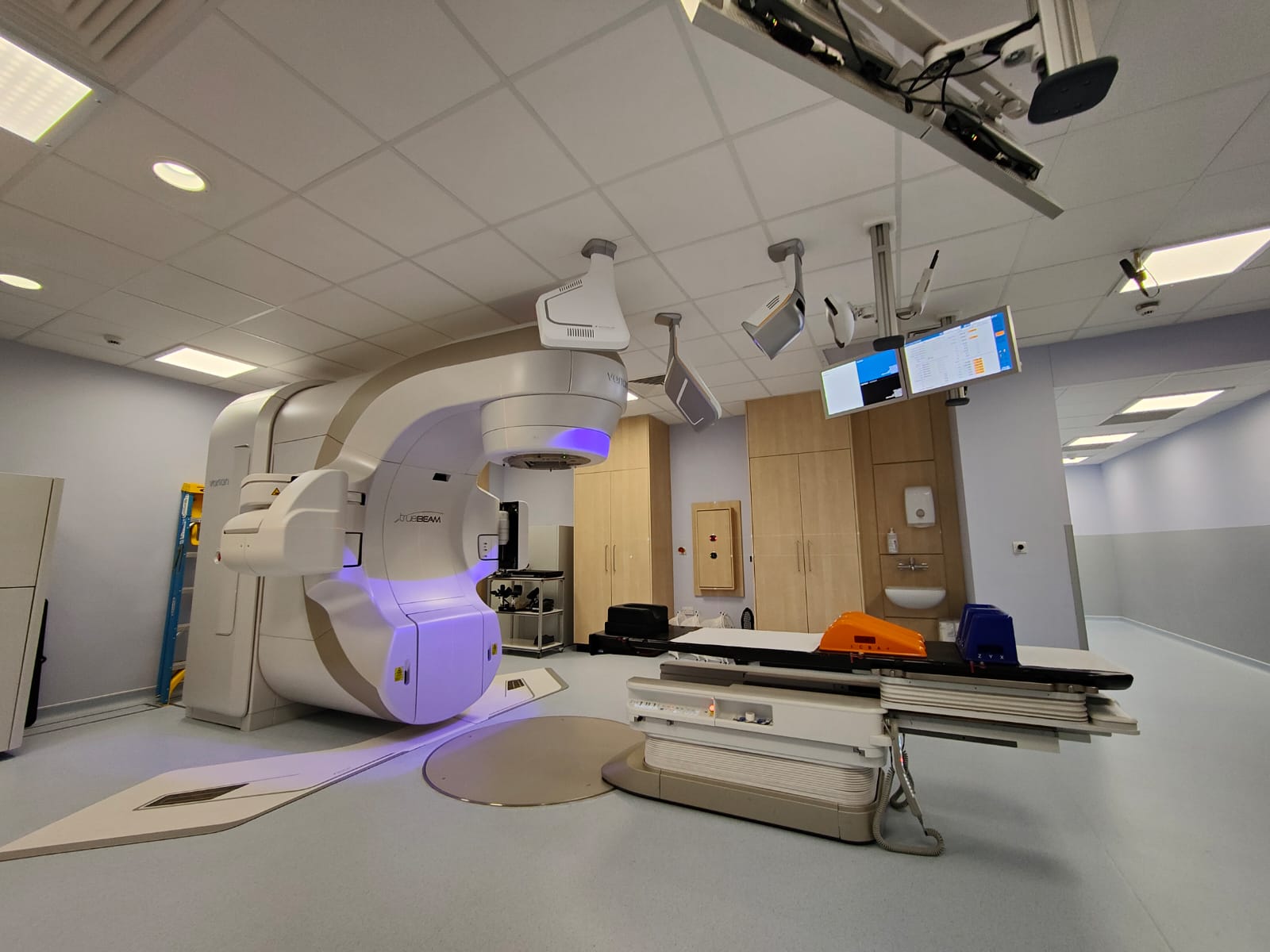
As of today I have had 6 sessions (‘fractions’) of radiotherapy with 14 more to go. The procedure involves removing my shoes and trousers and lying on the machine that you see in the photograph for a few minutes while it rotates around me. So far so good.
I have not yet experienced any direct side effects but I am aware that, even though it is only a couple of hours a day including commuting to the hospital and back, it nevertheless consumes a lot of my emotional energy and I get quite tired (though not yet the fatigue that the radiotherapy can induce.)
I have a list of things I want to do and get on with but it is hard to sustain my focus on, for example, writing. A lot of the time I don’t have my computer turned on at all. I have been fine with reading for the most part although I am not reading anything intellectually taxing over long stretches. I have been enjoying reading poetry before going to sleep (currently Simon Armitage, Magnetic Field: The Marsden Poems.)
I am acutely conscious of things I haven’t done.
My only problem with the radiotherapy is the TV in the waiting room. I don’t mind if it’s tuned to bland radio but more often than not it is showing morning programmes on STV and they are dreadful. I have a book with me usually (I’ve just finished The Man in the High Castle and am moving on to Neuromancer) but it is hard to concentrate and there is no quiet area. According to the radiologist this morning, the TV was introduced because people complained about the atmosphere in the waiting room without it. Bluetooth headphones and ambient electronica tomorrow. I think.
***
Non-identical twins
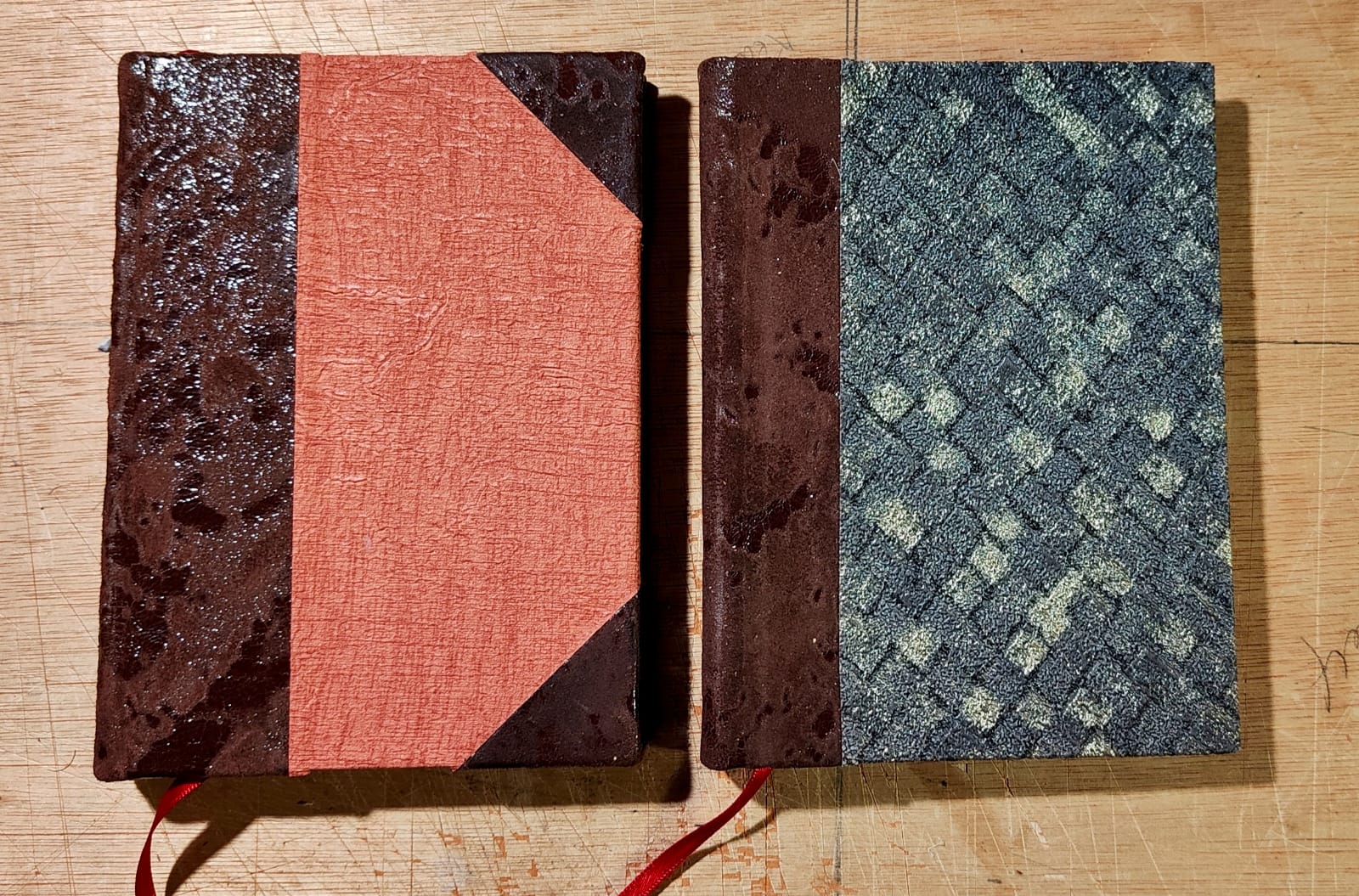
The one thing I have managed is to make a couple more notebooks. I like both of those photographed even though their cosmetic attractiveness masks ‘beginner’s’ issues in their construction, although they are functional. The one on the right in the photo is the better realised of the two.
There’s a ‘Zen’ quality to the repetitiveness of the steps taken to come up with something tangible and useful – stitching the signatures together and measuring and making the case and gluing it on. It is a very different kind of focus to that needed to come up with a thousand words of fiction. It is also, by definition, an analogue task done with hands without the use of modern technologies.
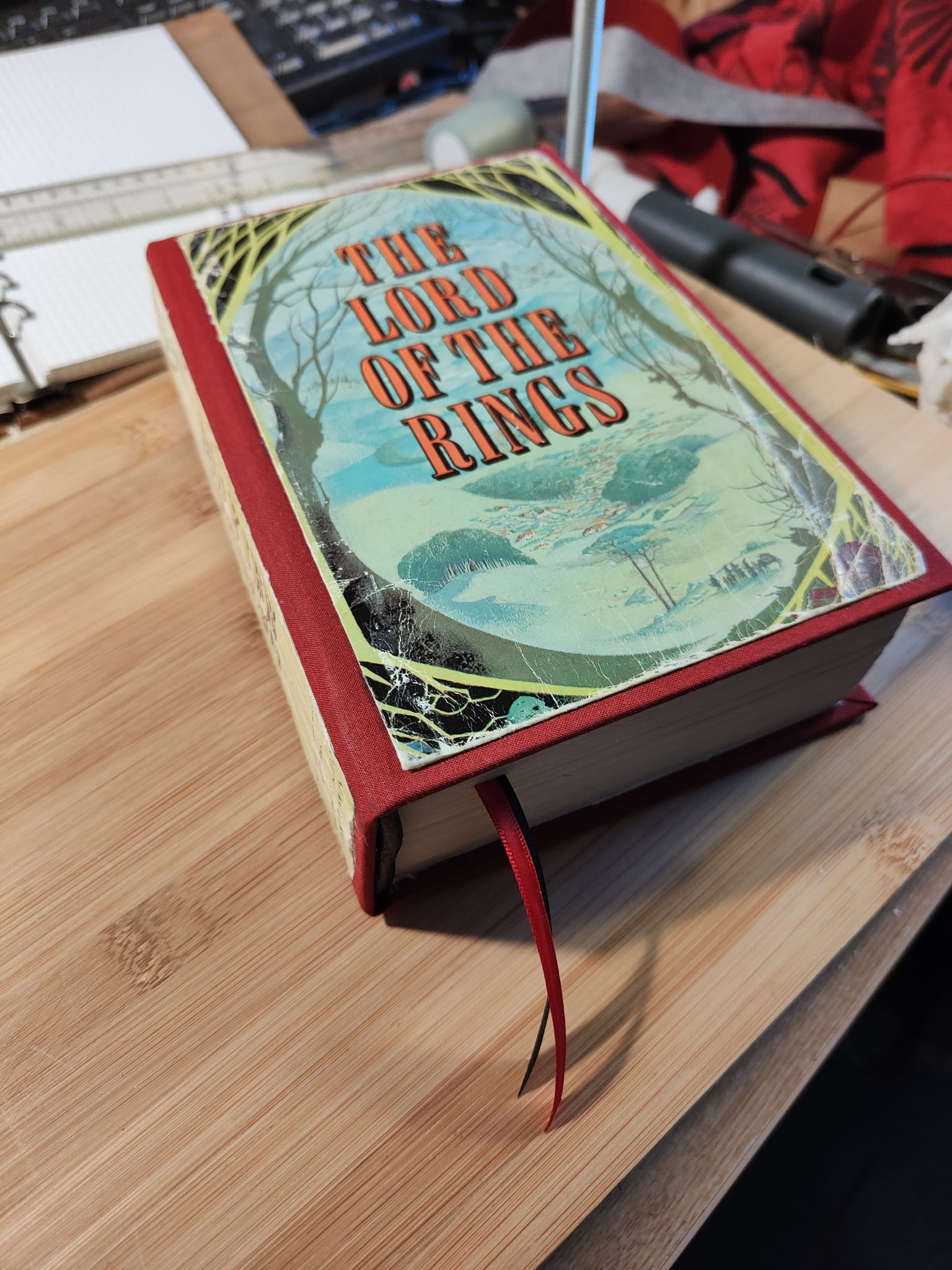
A bigger project, completed before the radiotherapy began, was to rebind of my teenage copy of The Lord of the Rings. I have the 8th impression of the Unwin paperback which was the first of the impressions published in 1971 and so was probably a birthday present. In the intervening 55 years it was read and reread and was the one I read to my daughters as a bedtime story before the Peter Jackson films. The cover was sellotaped on and the text block was split and also held together with sellotape.
One does not simply let one’s LotR disintegrate
In good condition those editions have some value, largely because most of them are not in good condition and had a name for falling apart. However it does have a lot of sentimental value to me, so I decide to repair it. I carefully removed all the old sellotape, repaired the text block and reinforced the spine, then cased it as a hardback, retaining the covers with the Pauline Baynes illustrations. It should be good now for another 55 years even if I am not.
I note that the Unwin editions were published in a clear font on Indian paper while modern paperbacks bought since the films have cheaper acidic paper that is already browning.
There may be other survivors of childhood worthy of the same treatment, but they can wait until the radiotherapy is over and I’m more inclined to take on projects for myself.
***
Allan Massie, RIP. I enjoyed several of his novels over the years, particularly Augustus.


Recent Comments