May 30, 2025 | Dead Water
Nearly half a century ago, I left home to come to university here in Edinburgh. It was my eighteenth birthday. Like many eighteen-year olds, I was in that odd space between too old for school and too young for adulthood. Memories fade but, for better or for worse, 1977-82 shaped my life in often unexpected ways.

New College, 1978-79
I wasn’t a particularly good student for the first two and a half years of my degree. I dare say that there are several reasons for that, but immaturity was certainly one of them. Universities are less forgiving now, I suspect, but in the late 1970s they were still relatively safe spaces to work through an extended adolescence until one chanced upon subjects that captured ones attention and imagination and brought everything else into focus. In my case it was two conjoined half courses, Logic and Philosophy of Science, that became the fulcrum on which my thinking turned. I ended up as a reasonably good student for the second half of my degree.
Ironically enough for a Divinity student, that ‘improvement’ coincided with a loss of faith and a decision to complete the degree as an academic exercise. To call oneself Christian is to assert that there is some metaphysical significance attaching to the person of Jesus of Nazareth (I use the words metaphysical significance loosely: this is a blog post not a monograph and you know what I mean.) How one develops this is generally called Christology because one believes that the man is somehow Messiah (in Jewish terms) or Christ (in Greek terms), which is to say annointed. I neither assert nor believe any such thing. That realisation, somewhere in 1978/79-ish, was freeing for studying theology and belief.
I continue not to profess any faith or belief, though neither do I have a lot of time for the dogmatic certainties of modern Humanism. However clichéd it may be, I remain interested in belief as a phenomenon and what one might loosely call spirituality in all the ways that it manifests. And one never quite shakes off the comfort blanket of an Anglican childhood steeped in high church flummery. I am always ready to ease into an old church blessed by centuries of piety and incense.
Some of you might have noticed that aspects of my latter-day rereading of the Gospel of Mark found their way into the disillusioned priest who is the protagonist of my novel The Raven and the Hart as she struggled to rekindle her faith, though her thoughts are not necessarily my thoughts in an autobiographical way, she being a fictional character in ways that I, for the most part, am not.

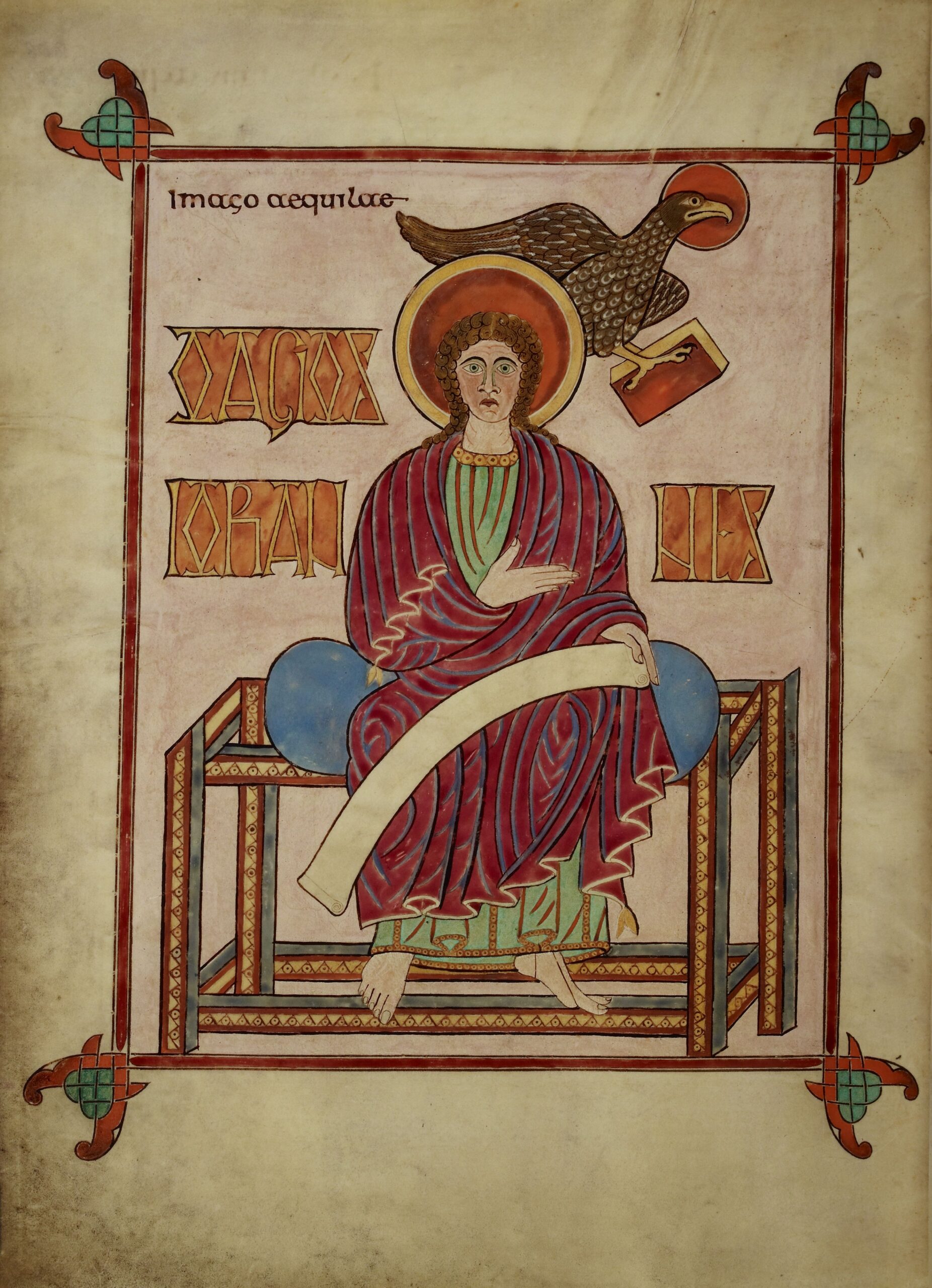
St John the Evangelist in the Lindisfarne Gospels (London, British Library, MS Cotton Nero D IV, f. 209v).
Be that as it may, these current thoughts were prompted because I recently looked at the Fourth Gospel, conventionally attributed to John, for the first time in decades. I was struck by just how deeply weird it is as a piece of literature. It features a developed and in some ways idiosyncratic Christology that intrigued me, and seems to preserve evidence of ideological turf wars between Nazarenes and followers of John the Baptist (who is also an intriguing figure.) On the back of that I renewed my University library membership and borrowed a commentary on/overview of the Fourth Gospel recommended by a current professor at New College whom I emailed.
When I sat New Testament 2, the lectures (and seminars) on the Fourth Gospel were taken by David Mealand whom I wish now I had taken time to know better. Unfortunately my handouts and lecture notes do not survive. I should like now properly to revisit the many strangenesses of the fourth gospel and how it fits into Christian origins. I should also like to explore the non-Pauline/Petrine traditions of early Christianity, such as Thomas in India, for pretty much the same reasons that, as I recently wrote here, I would read History were I to have my time again. Not that I could afford the fees these days, and neither do I have the necessary languages to do it properly.
My experience on my second degree, when I was older, was that if you pay attention and do the work and reading you get a lot more out of the courses, and better marks/grades too. I wonder how much more I would get now out of some of the subjects in my first degree if I took them again out of real interest rather than because they were prescribed elements of the degree.
May 14, 2025 | Goggle-eyes, Star Wars
Andor season 2 has taken up residence in my head in a way that few TV shows do and none have since Sense8. This post is an attempt to articulate some of the reasons why I like it, given that it is, from a certain point of view, just Star Wars.
This post is spoiler-free.
I’ve been watching Star Wars since I first saw it in East Kilbride cinema on UK release in 1978. Over the past half century I have followed the films and TV series, including the animated series, and dipped into the novels. Much as I have, for the most part, enjoyed the recent TV shows as casual viewing, they don’t do anything new with the base material; I’ve seen them described as dramatised fan fiction and that has a ring of truth. A major problem raised by Andor is that it implicitly highlights issues with those other Star Wars shows (and films) and the two principal issues it spotlights are their circumscribed writing and constrained imagination.
The thing is, the other shows and films all focus one way or another on the fantasy/sword and sorcery elements of the Force, the Jedi and the Sith. Andor dispenses with those elements almost completely, although it does touch on the Force, recognising that the Force is diagnostic of Star Wars.
Andor also presents the brutality of the Empire in ways rarely seen since we saw the smouldering skeletons of Lars and Beru in Star Wars (1977). The cruelty is much more tangible than pantomime villains such as Darth Vader or Emperor Palpatine. The rebellion here is not about abstract struggles between the light and dark sides of the Force, it arises from Imperial oppression.
Star Wars has been political since its inception; it is other things as well, but there is a political core. The genius of Lucas was to wrap so many contemporary elements and resonances in a fairy-tale package, though, over time, the fairy-tale wrapping has been mistaken for the packaged goods. The way the stories have developed over the past half century has often obscured the metaphorical payload or treated the struggle against the Empire as simply part of the mise-en-scene and/or simplified it into Robin Hood terms (Robin good, Sheriff of Nottingham bad.) Andor takes the politics seriously and is written by a very talented writer who knows his history. Tony Gilroy rips away the fancy wrapping and exposes what’s in the box.
(Some readers might object that aspects of this have been explored in the Expanded Universe of books and comics, and no doubt that is correct. However, I have only dipped into the books and, I have to say, haven’t really enjoyed most of those I’ve read, so can’t really comment on that.)
The premise of Andor is simple: what happened to create the rebellion that Luke Skywalker parachutes into? Who were the rebels? What did they rebel against? What shaped them as people? This premise is extended also to two of the principal antagonists, Syril Karn and Dedra Meero, who are also two of the most compelling characters in the show.
At the core is the titular protagonist Cassian Andor who features in Rogue One. We follow his journey from small-time thief looking for his sister to the hardened revolutionary of Rogue One, but he is only one player in a larger movement. We also see the radicalisation of Senator Mon Mothma, the role of social and political elites, and multiple squabbling factions who may or may not be the People’s Popular Front of Judea. We get cynical manoeuvring by Imperial security forces and revolutionary masterminds alike. None of the main characters are cyphers, most are morally complex. Storylines echo and mirror each other as they intertwine: we condemn the actions and attitudes of Imperial characters without necessarily noticing that the radicals are doing and thinking exactly the same things. There are no gratuitous redemption arcs; bad things happen to good people. All is brought to life by actors and actresses allowed to be at the very top of their game.
The result is that episodes 2.07, 2.08 and 2.09, which deal with the build up to the Ghorman Massacre, the massacre itself and its immediate aftermath have been hailed as three of the best executed episodes in recent TV, not simply in the Star Wars universe. The final three episodes, 2.10, 2.11 and 2.12, are perfect.
Andor implicitly questions the focus on militarised mysticism of the rest of Star Wars. It isn’t that other aspects of that universe have not previously featured, more that Andor shifts the core paradigm away from fights between samurai in space to the lives of everyone else in that universe.
Andor forces us to conclude that exploring the Star Wars galaxy solely through the Jedi and Sith is like exploring the course of World War 2 solely through internal doctrinal arguments in the Vatican and factional infighting in the Swiss Guard.
That isn’t to say that the Force is something to be ignored, just that there are other ways to explore and engage with it, much as the machinations of the Culture are only suggested fleetingly at the close of Iain M Banks’s Inversions.
Andor has often been described as Star Wars for grown-ups, but there’s more to it than that: to date, in broad terms, Star Wars as a ‘franchise’ (I dislike that term) has devolved into space opera and fantasy; Andor returns it to science fiction by engaging with the central metaphors of the original, as did The Last Jedi.
From the moment the Star Wars universe began to expand with the release of The Empire Strikes Back and the early novelisations, it has been a very flexible palette with scope for many different stories and tonalities. I do not think that from now on every new release should be a gritty political drama, but I do think that we can hope that everything now should be seen creatively as before and after Andor: Andor has raised the bar of what we should hope, and rebellions are built on hope.

Recent Comments