Nearly half a century ago, I left home to come to university here in Edinburgh. It was my eighteenth birthday. Like many eighteen-year olds, I was in that odd space between too old for school and too young for adulthood. Memories fade but, for better or for worse, 1977-82 shaped my life in often unexpected ways.
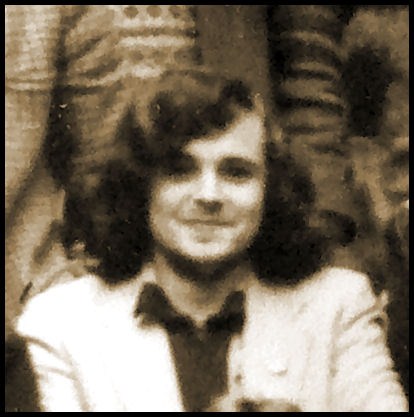
New College, 1978-79
I wasn’t a particularly good student for the first two and a half years of my degree. I dare say that there are several reasons for that, but immaturity was certainly one of them. Universities are less forgiving now, I suspect, but in the late 1970s they were still relatively safe spaces to work through an extended adolescence until one chanced upon subjects that captured ones attention and imagination and brought everything else into focus. In my case it was two conjoined half courses, Logic and Philosophy of Science, that became the fulcrum on which my thinking turned. I ended up as a reasonably good student for the second half of my degree.
Ironically enough for a Divinity student, that ‘improvement’ coincided with a loss of faith and a decision to complete the degree as an academic exercise. To call oneself Christian is to assert that there is some metaphysical significance attaching to the person of Jesus of Nazareth (I use the words metaphysical significance loosely: this is a blog post not a monograph and you know what I mean.) How one develops this is generally called Christology because one believes that the man is somehow Messiah (in Jewish terms) or Christ (in Greek terms), which is to say annointed. I neither assert nor believe any such thing. That realisation, somewhere in 1978/79-ish, was freeing for studying theology and belief.
I continue not to profess any faith or belief, though neither do I have a lot of time for the dogmatic certainties of modern Humanism. However clichéd it may be, I remain interested in belief as a phenomenon and what one might loosely call spirituality in all the ways that it manifests. And one never quite shakes off the comfort blanket of an Anglican childhood steeped in high church flummery. I am always ready to ease into an old church blessed by centuries of piety and incense.
Some of you might have noticed that aspects of my latter-day rereading of the Gospel of Mark found their way into the disillusioned priest who is the protagonist of my novel The Raven and the Hart as she struggled to rekindle her faith, though her thoughts are not necessarily my thoughts in an autobiographical way, she being a fictional character in ways that I, for the most part, am not.
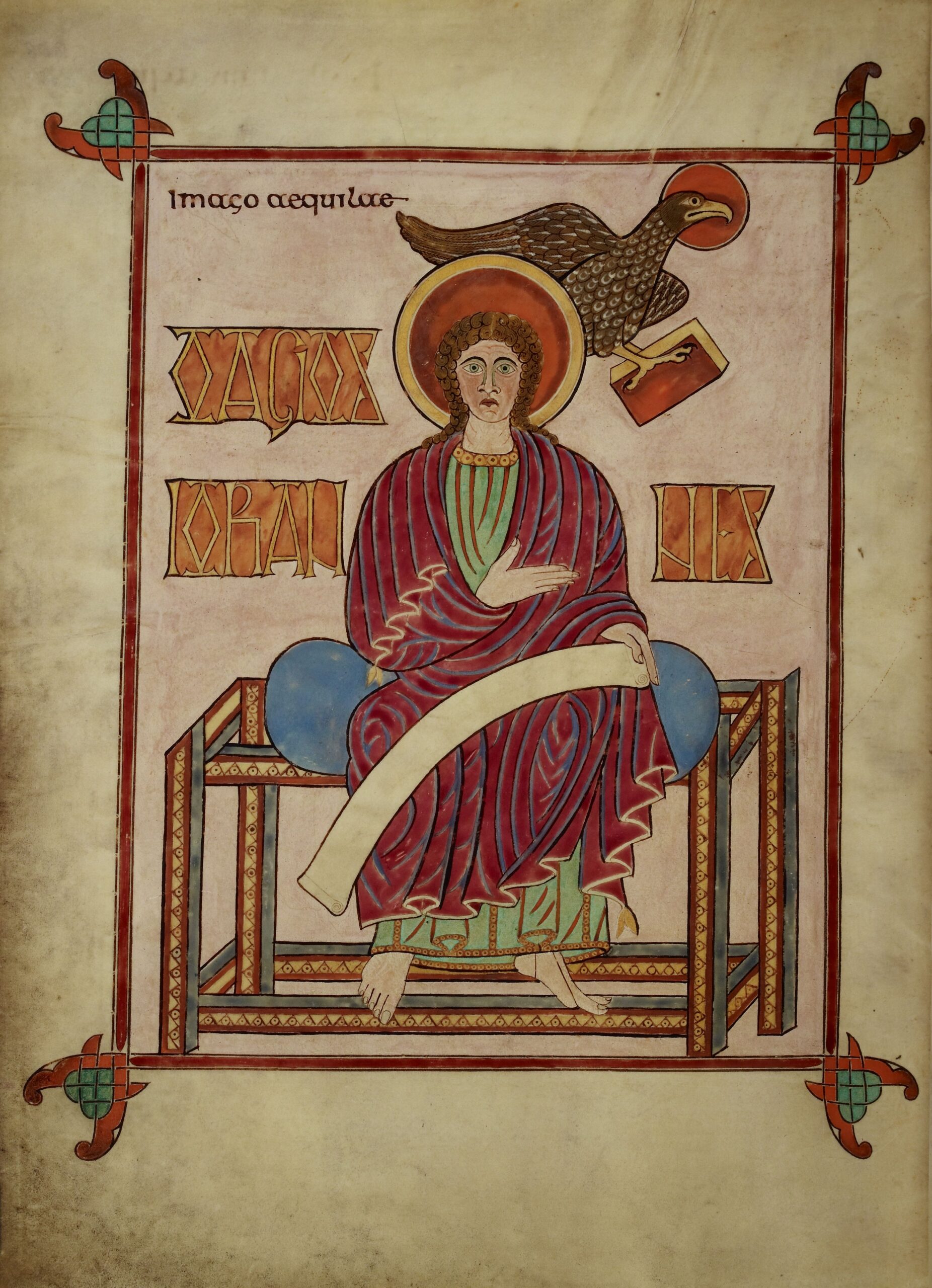
St John the Evangelist in the Lindisfarne Gospels (London, British Library, MS Cotton Nero D IV, f. 209v).
Be that as it may, these current thoughts were prompted because I recently looked at the Fourth Gospel, conventionally attributed to John, for the first time in decades. I was struck by just how deeply weird it is as a piece of literature. It features a developed and in some ways idiosyncratic Christology that intrigued me, and seems to preserve evidence of ideological turf wars between Nazarenes and followers of John the Baptist (who is also an intriguing figure.) On the back of that I renewed my University library membership and borrowed a commentary on/overview of the Fourth Gospel recommended by a current professor at New College whom I emailed.
When I sat New Testament 2, the lectures (and seminars) on the Fourth Gospel were taken by David Mealand whom I wish now I had taken time to know better. Unfortunately my handouts and lecture notes do not survive. I should like now properly to revisit the many strangenesses of the fourth gospel and how it fits into Christian origins. I should also like to explore the non-Pauline/Petrine traditions of early Christianity, such as Thomas in India, for pretty much the same reasons that, as I recently wrote here, I would read History were I to have my time again. Not that I could afford the fees these days, and neither do I have the necessary languages to do it properly.
My experience on my second degree, when I was older, was that if you pay attention and do the work and reading you get a lot more out of the courses, and better marks/grades too. I wonder how much more I would get now out of some of the subjects in my first degree if I took them again out of real interest rather than because they were prescribed elements of the degree.
Has someone already said university is wasted on the young? I was there just because I had jumped, successfully, through all the hoops. I had no idea what I wanted to do , other than “get a good job” Whatever that meant. Fortunately , I chose a reasonably useful course. And here we all are 5o years later!
By the way , that’s a cracking photo. Quite a cheeky expression, and so much hair! Is that a white jacket? I was never brave enough for one of those.
I think it began as white, or white adjacent, but deteriorated over time.
Interesting, Ian. My journey with Christianity is a road with many twists and turns of Methodist, Church of Scotland, Baptist, and C of E. I’ve been an evangelical teenager and almost atheist in my 20s. Where I am now, I hardly know but having played the organ for three funerals this week, I’m not sure I believe any of it.