In quiet moments at home or when I’m out for a walk, I sometimes think of roads not taken, decisions that would have had a significant impact in my life had I picked a different option. These are not, for the most part, regrets, more reflections on what might have been.
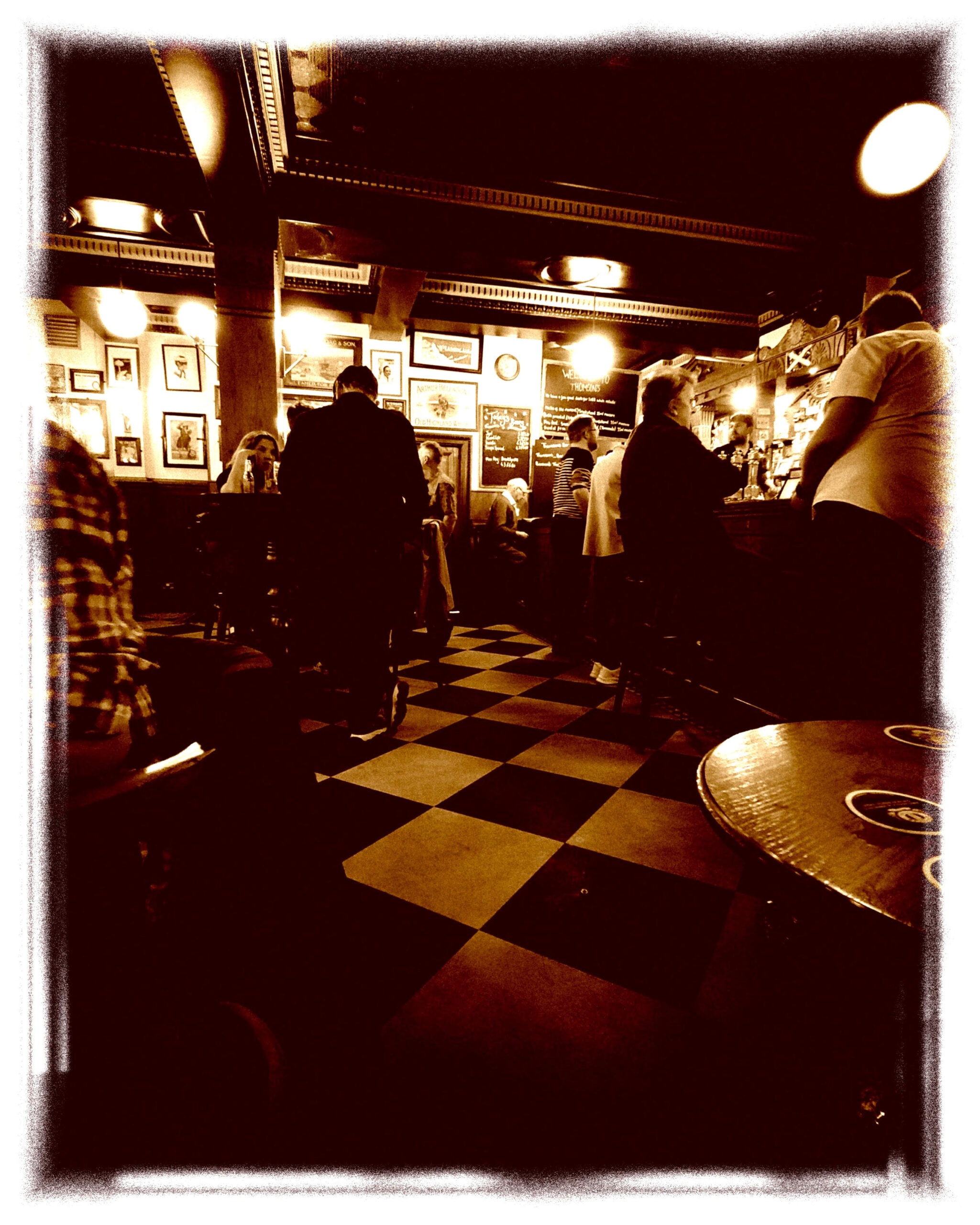
Thomson’s Bar, Haymarket
I was out on Friday evening (11th) with friends who are all amateur or professional historians. Whenever we meet, we drink good beer in a pub with no TV and natter about whatever interests us. When politics is discussed, it is usually of the 17th and 18th century variety.
I enjoy these nights out despite a general sense of imposter syndrome: they trigger that same reflection on what might have been, and ‘what might have been’ is the decision I made at High School not to study History to ‘O’ level or above, a decision made, if I remember correctly, for the pragmatic reason that History clashed with Physics on the timetable. I enjoyed the historical elements of my first degree (1977-82) but it wasn’t until my second time at university (1991-94) that the consequences of that pragmatic decision hit home.
In 1993/94, bored out of my skull on the post-graduate Diploma in Legal Practice, I took a half course from the main LLB degree programme to fill my time with something that interested me. The course, Scots Law and the Western Legal Tradition, was led by John Cairns, Hector MacQueen and David Sellar and was I think, the best single course of my second time at University (despite stiff competition) and something of a personal revelation.

Humblebrag
I’d had hints of something when I worked at the Lands Tribunal for Scotland which at the time shared a building with the Scottish Land Court. While there, I came across some scrapbooks in the attic collecting together all the contemporary press coverage of the Napier Commission that led to the Crofters Holdings (Scotland) Act 1886 and the establishment of the Scottish Land Court and realised that there was something there I would like to investigate further. However it was Scots Law and the Western Legal Tradition which convinced me that, had I my time again, History is the discipline I should most like to commit to, my principal interest being early-modern Scotland. It’s why I later did an evening course in Scottish palaeography and why I looked into undertaking further University study of History on a part-time basis (the fees stopped that notion dead in its tracks.)
One of my interests, and something I should like to look at in much greater depth, are the so-called witch trials. This is a well-ploughed field and something of a cliché, but that is precisely why it interests me – what has become received academic wisdom does not ring true to me.
I chatted about this some time ago with Stuart MacDonald, author of The Witches of Fife who these days also takes a critical view of how the same field is developing. In chatting with Stuart, I outlined my core problems with received wisdom and wrote the following (lightly edited for this post):
Thinking about it (off the cuff over a coffee), I have problems with
- the idea of a ‘hunt,’ which is a value-laden term. I think it is equally plausible, with one or two exceptions, to view accusations and prosecutions as arising out of a heightened awareness of supposed transgressions of scriptural or natural law norms.
- the act(s) of categorising and systematising features of the records locks the structures and the assumptions of those categories and systems into place as an analytical paradigm that is difficult to break out of where evidence is lacking, or ambiguous, or capable of other interpretations. In essence, an analytical tool transforms into the interpretative norm.
- prosecution bias in the records and the inherent presumption of both guilt and the nature of the offence.
- the idea of clustering of trials in certain years needs to be alert for random clustering of events leading to spurious statistical artefacts being given a false significance.
- the general ignoring of elite activities that veer into similar territory, particularly alchemy and divination unless, as with the Earl of Bothwell, there was political cause.
- other factors outside the paradigm, for example the treatment of the case of Thomas Weir ignores political and personal animus in the prosecution on the part of the Lord Advocate (Nisbet, later Lord Dirleton).
Since jotting that down a year ago, other concerns, or elaborations of the same concerns, have occurred to me. My core interest lies in the phenomenology of changing responses to the imposition of Reformed Calvinist ideology on rural and urban cultures over the period from around 1530 to 1700. I believe it is against that background that we should consider the prosecution of all crimes against scriptural and natural law.
The upshot is I reckon that, sooner or later and probably sooner, there’ll be a paradigm shift in our interpretation of the witch trials. Part of me should have liked to be involved in that had younger me made different decisions and were time and resource to research things properly available to me now.
I was at school with Ian and was able to study history and physics at O grade and H grade. I was obliged to drop chemistry in order to study geography, and I felt the absence as physics became more demanding. I remember others saying the same.
My best subject was English, and I was in the top class, where the very competent and rather glamorous Mrs Towndrow taught us about John Donne and Edwin Muir. The second class were taught by a steely-eyed spinster whose name Ian will remember, who left her charges with a cast-iron knowledge of English language and grammar. I wouldn’t like to say which class got the better education.
I read the first sixty pages of The Butcher Bird this morning, and one of the luckless commune-dwellers was named Joan Somerville. That might have been the name of the English teacher.
Thanks for the mention Ian. I generally agree. What I think we also need to take seriously is the reality that the driving engine in the clusters of cases in the mid-seventeenth century, the ones that read really responsible for Scotland’s notoriety, was the presence of professional witch-finders. This requires more thorough investigation. It’s when we move around the normal processes of the law for whatever reason or supposed crisis, that we end up with consequences that are very troubling.