Trainblog
(Written Friday 20 November)
I haven’t written a train blog for quite some time, but I find myself once more zipping down the East Coast mainline en route to a Jake Thackray/Georges Brassens gig in Kent.
Despite yesterday being – it is said – the wettest day in the UK this century with Cumbria and parts of Scotland experiencing devastating floods, the East coast has blue skies and a bright, if wintry, sun. There was, though, the usual flooding north of York where a grey heron, quite unconcerned by the passing train, was busy looking for new territories in which to hunt. As always Northumbria was particularly attractive.
Musically the journey has been enlivened by an eclectic selection of artists in my headphones. Porcupine Tree went Up the Down Stair, Warren Zevon was an Excitable Boy, Yes made a Drama, Fever Ray was, well, Fever Ray.
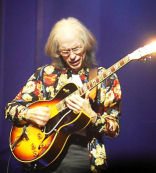 I went to see Yes last night at the Usher Hall and really enjoyed it. I had expected that it would probably be at least entertaining but I had not expected Chris Squire and particularly Steve Howe to be quite so energised and rejuvenated and playing very well indeed. Some relatively recent and controversial line-up changes in the band have scraped away some of the accumulated crust of the years and uncovered the great rock’n’roll band which lurks beneath the “Prog Rock” veneer. It was pretty much the same material as usual but with a real kick to it. All they need to do now is to put out a new album containing decent new material and that would be the icing on the cake.
I have been reading the first volume of Timothy Neat’s biography of Hamish Henderson. It is interesting reading and yet I am getting irritated by it. I will comment more on this later but for now it is enough to remark that after reading an account of Henderson’s relationship with Ewan MacColl, the MP3 player served up Dick Gaughan, Tony Capstick and Dave Burland singing some of MacColl’s songs. These are, make no mistake, great songs well performed and yet there is an air of the synthetic about them – a whiff of artifice. I much prefer the songs in which MacColl indulges no barely disguised political subtext, a habit of his which, after a while, becomes wearisome (much in the same way as I prefer Henderson when he was not acting as a self-consciously political agent). Of the songs on the album my favourites are probably Dick Gaughan’s rendering of Jamie Foyers (which does, indeed, have a political subtext but is also very human and superbly performed) and Dave Burland’s magnificent “Sweet Thames Flow Softly”.
For the gig tomorrow I am reverting to steel strung guitar and bringing my self-built instrument. I have hardly played my Martins recently – although a quick strum earlier this morning reminded me of the gulf in build quality between them and mine. I’m looking forward to giving the guitar a decent run out tomorrow. The change in string gauge from 12-54 to 11-52 has sorted almost all of any –slight- residual intonation issues although I may yet have to shave a tiny bit of compensation onto the saddle for the bass E-string.
(Sunday 22 November)
I am tired, heading north on a noisy train with uncomfortable seats. We’ve just pulled into Durham and I am reflecting on an entertaining night last night. The noisy carriage is being drowned out, in my ears at least, by Banco de Gaia, Neu! and, currently, early Grateful Dead – “Box of Rain” seems appropriate for today’s weather.
The gig last night was about half and half Jake Thackray and Georges Brassens material with one self penned song by Alan Franks (“Martin at the Mitre” played on a stunning Stefan Sobell acoustic). In the course of the evening we also had some Jake translated into French by Michel Ameline and some Brassens in English by various translators including me.
The crowd was limited on a wet and blustery night but they all stayed to the end and were kind and genuine in their comments after the gig. Many were people who were not familiar with either Jake or Georges and were accepting even of a second half which was largely in French. A large part of this acceptance was the excellence of Goun and his reinterpretations of Brassens classics which caught all of our attentions. He is a nice bloke too – He and I were, along with Didier Agid and Michel Ameline staying with Terry and Juliet Grant and Goun and I spent an entertaining hour or so after breakfast fingerpicking blues and other tunes.
We also found out that Michel is a keen cider maker in his native Normandy and he had brought samples. The dry cider made from Normandy apples was superb and I have brought home with me a bottle of another dry cider (with apples from Brittany) and one of sweet cider.
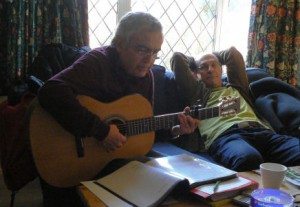
Goun and Didier (playing my guitar)
I used my home-made guitar for the gig and was very pleased by the experience. There were two professionally luthiered guitars at the gig, Alan Franks’ Sobell and Goun’s Favino: these were expertly handcrafted instruments built by masters and not kits put together on a kitchen table. Nonetheless there is something very satisfying about performing with an instrument which one has built one’s self and which seemed to impress those who took the chance to play it. I was particularly taken by surprise when Goun played some licks on it and something of its potential was revealed to me.
Goun and I are very different players. Aside from the small issue of his professional skill and my amateur hackery, there is a confident aggression to his playing whereas he commented that I tend more to caress the strings and encourage the sound to emerge of its own accord. Perhaps I should shift further in his direction, if only a little, to put a different dynamic into my playing. Certainly I have found myself playing with slightly more fluency of late as I have got more at home with this instrument.
I really ought, though, to have some on-board electrics, something which I have been avoiding for some time now, preferring to play entirely acoustically into a microphone. I have always had a concern about the quality of sound which pickups often give to an acoustic guitar, particularly piezzo pickups under the saddle. I am now of the view that it would be useful to make another guitar, exactly the same as this one, but with a built in swan-neck microphone feeding into a small belt-worn pre-amp. We shall see.
I mentioned earlier that I was getting irritated by the first volume of Neat’s biography of Hamish Henderson. It is, let me be clear, a readable book but it has been reading by one who was a friend of Henderson’s for many years and it shows. One can argue about the extent to which a biography should narrate the facts of a life with, or without, also incorporating some element of critical analysis, but I would prefer there to be at least some critical analysis and not to be as uncritical as this one is. I am here using critical in the sense of objectively based consideration rather than negatively criticising.
One effect of the book has been to leave me with a clear view that the young Henderson was an odd creature whom I probably would have come to dislike had I met him, especially had he come round for tea and stayed for a month, as was his wont. Possibly a more critical or rounded biography would leave me feeling differently; however many of the elements of his life which the biographer notes with apparent approval (or at least no visible disapproval) leave me cold and give the impression of an intellectual romanticism which borders on the delusional. There are occasions also when the biography seems formally weak – for example in the narration of Henderson’s expulsion from Italy and lengthy “persona non grata” status there, there is little or no evidence that Neat has put in the research to get a clearer understanding of what the authorities’ reasons were. While these might be guessed at, the account as it stands is deficient.
Similarly, although the volume is about the emergence of Henderson as a poet, there is little evidence of a sustained output, after the publication of his Elegies for the Dead in Cyrenaica in 1948, to justify his place as other than a footnote in recent Scottish literary history.
I still look forward to Volume 2, however, which deals with his emergence as a song collector of major importance.
Recent Comments