The Butcher Bird is now out and available in paperback, hardback and kindle editions. Currently it is exclusive to Amazon, though I plan to change that later in the year.
The link to buy is HERE. (link to UK site, just change .co.uk to your local suffix, such as .com or .ca)
As I wrote in my previous post, The Butcher Bird is finished. Since then, I’ve been through the proof and found all the silly things I thought I’d already found, and have just about agreed the final cover. There are some technical things I need to do and decisions to make, but I also have to think about marketing and sales.
I was impressed by the efforts of the late David Lynch to avoid describing or explaining any of his work. Similarly, Alex Garland declined to go into much detail about Civil War (1) suggesting instead that people should just watch the film and react to it without prior knowledge. You can do that if you’re David Lynch or Alex Garland but not if you’re an unknown struggling to be seen in the surf of all of the other unknowns.
The cover, with the title, is the start of the process. Whether you are in a bookshop or scrolling on the internet, it is the cover that catches your eye. Ideally, it should be an arresting image that gives some information to the potential reader of the broad genre of the book. You then pick it up and, hopefully, are hooked by the short descriptive text (‘the blurb’) which might be written by a marketing professional or, in my case, is written by me. If the reader is intrigued in the shop, they might read the first page; online they might look at the preview. At that point they decide whether or not to buy the book.
So if I’m happy with the title and cover, as I am, and am confident in the writing of the first few pages, which I am, it is the blurb that is the missing link, the hook into the text. It needs to be short and memorable, 20-odd words to entice a potential reader into, in this case, the remaining 107,000 words.
Orwell, in grumpy mode, commented on this in 1936 (In Defence of the Novel) in respect of blurbs written by professional publicists.
Question any thinking person as to why he ‘never reads novels’, and you will usually find that, at bottom, it is because of the disgusting tripe that is written by the blurb-reviewers. There is no need to multiply examples. Here is just one specimen, from last week’s Sunday Times: ‘If you can read this book and not shriek with delight, your soul is dead.’ That or something like it is now being written about every novel published, as you can see by studying the quotes on the blurbs. For anyone who takes the Sunday Times seriously, life must be one long struggle to catch up. Novels are being shot at you at the rate of fifteen a day, and every one of them an unforgettable masterpiece which you imperil your soul by missing.
I was tempted to use part of that as part of the blurb, but I suspect Amazon wouldn’t let me.
The key thing is not to attempt obsessively to describe or summarise the book’s contents. Interview With A Vampire (Anne Rice, 1976) has, ‘In a darkened room a young man sits telling the macabre and eerie story of his life – the story of a vampire, gifted with eternal life, cursed with an exquisite craving for human blood.’ I like that: it doesn’t actually tell you anything of the detail of the contents but tells you all you need to know about what to expect. A Discovery of Witches (Deborah Harkness, 2011) had ‘It begins with absence and desire. It begins with blood and fear. It begins with a discovery of witches,’ although it then elaborated detail, possibly unnecessarily.
All that I have to do is figure out something similar, distilling the essence of the book in a way that entices, bearing in mind that what I think and what a potential reader might think are not the same at all.
(1) I enjoyed Civil War very much, but it was somewhat on the nose in the current political climate in the US.
The manuscript of The Butcher Bird went off to be typeset yesterday, and work should soon begin on a cover. In theory I could do both of those using online tools for free, but I decided long ago that it was worth having a professional job done to produce a professional end result. As I’ve probably said before, writing and revising the book is, for me, the (relatively) easy bit; the hard bits are thinking up a descriptive blurb and a marketing approach. I’ve thought quite deeply about both of these previously, but so far nothing has worked.
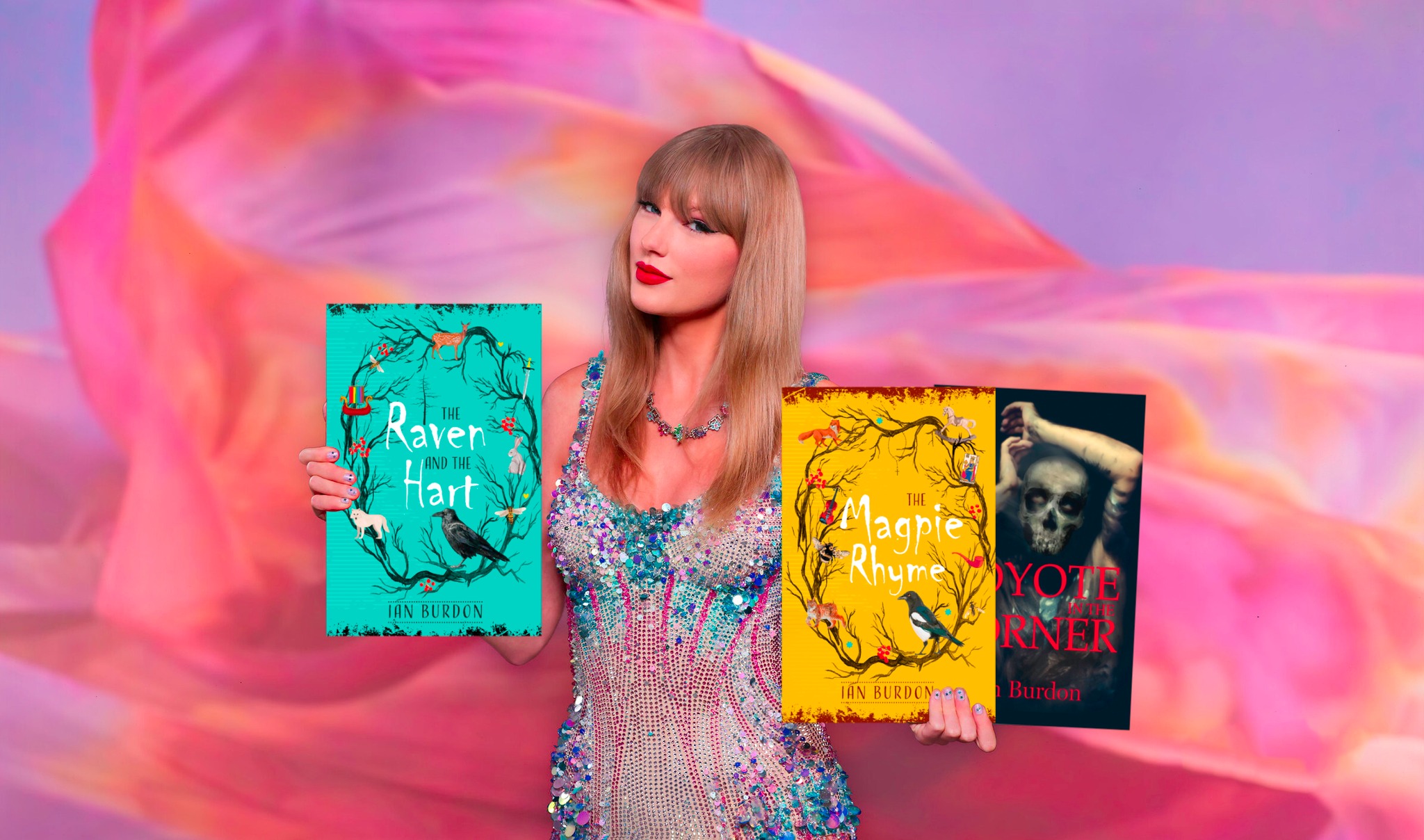
Fake Taylor.
I mentioned on Facebook that the only thing almost guaranteed to make sales is to have Taylor Swift photographed reading one of my books, and that led my friend Joe to fake up the inset photo. Yes, of course it is fake and, apart from putting here for amusement value, it cannot ever be used, alas.
Some time ago, I had the idea that there must be an organic way to exploit the network effects of social media for viral marketing. I still think that must be possible, but it is hard to make happen and, probably, getting harder as algorithms shift towards commercialising engagement. While social media has certainly led to some sales for me, it hasn’t led to any great volume of sales and, as I approach publication of my fourth book, my costs far outweigh my revenue. For The Butcher Bird I intend to be more proactive in promoting the book, though there is always something I find inherently distasteful about that. I’m more of a Sgt. Wilson than a Pvt. Walker on this (one for the kids there.)
Also, there is something interesting about the advice available online: it contains an inherent logical fallacy. It is,
commercially successful writers do x, y and z. Therefore
if you do x, y and z you will be a commercially successful writer.
After mention of Malcolm Guite in my last post, it occurred to me that I could spend some time making short videos of me reading from my own writing – both the new book and previously published things. I would likely post them to my YouTube account and embed them here also. This is to do with marketing, of course, but might be interesting anyway seeing as I haven’t had the budget to do audiobooks of my stuff and I refuse to use AI.
I’ve spent a lot of time recently polishing the next book, The Butcher Bird. Aside from a final read through, I think it is finished and I’m about to kick off the production process. More news here when it is available.
Before New Year, I did a lot of preparatory work on the next book after The Butcher Bird and now need to get back into the world waiting to be created, from which I have so far only received teasing postcards. It looks like 1930s Edinburgh, but not quite. A lot of my preparation has been dumping ideas into notebooks and sifting through them for what works and what doesn’t, trying to mindmap the elements and how they relate to each other. I’ve been through this process once and need to repeat it to get to the essence of the story. At present I’m in the happy position of having too much material but, less happily, it doesn’t entirely cohere. Some may eventually become other stories, but first things first.
More smoke, vicar?
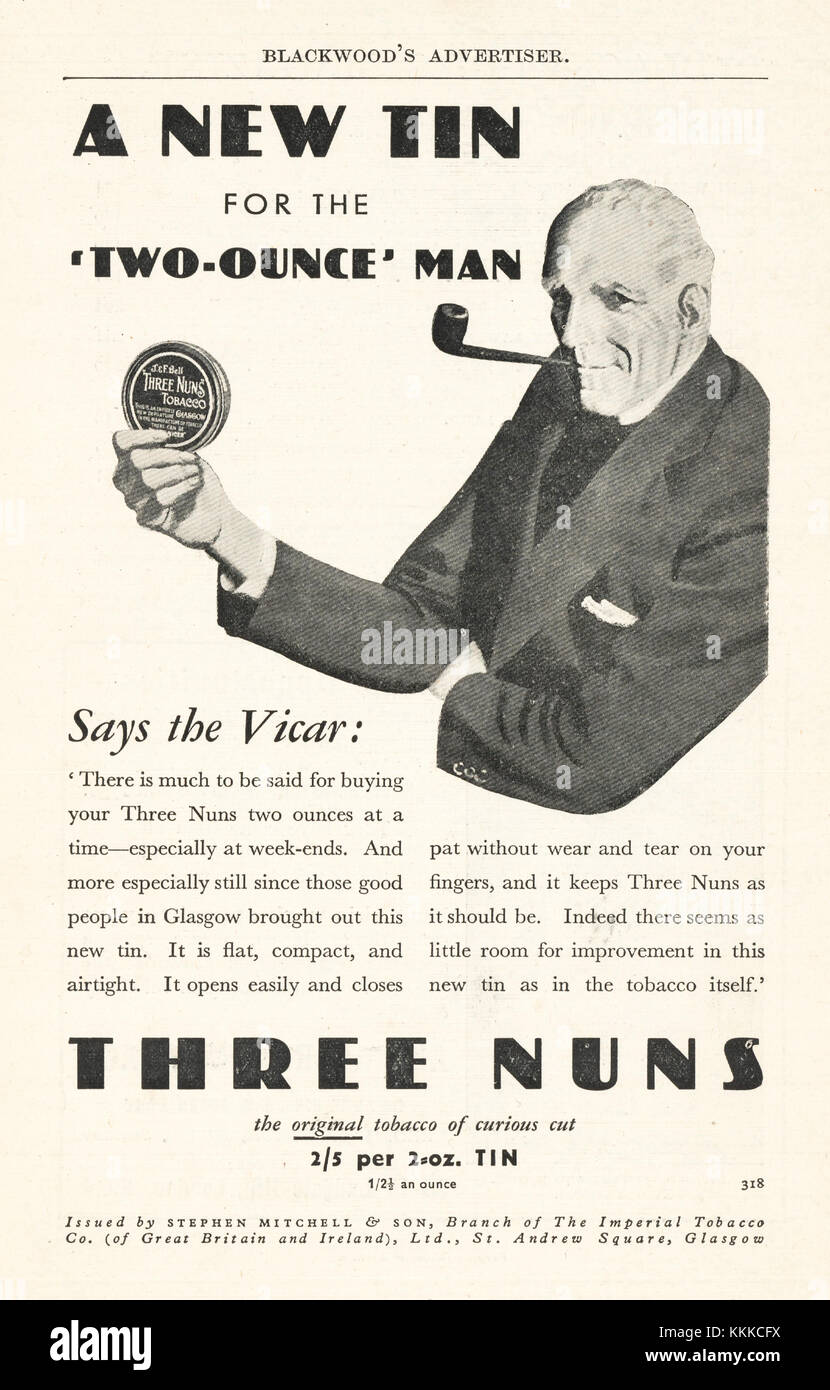
Being the 1930s, there is a lot of tobacco about. I decided some time ago that my protagonist would be a pipe smoker and, in a nod to JRR Tolkien and CS Lewis, would likely smoke Three Nuns (“None Nicer”). This led me down an enjoyable rabbit hole of investigating pipes, tobacco and tobacciana, including the differences between the two versions of Three Nuns available in the 1930s. However it also led me into the strange, niche subculture of pipe smokers on YouTube, and this has been a delight, albeit and admittedly an eccentric delight.
The pipe-smoking world of YouTube has many facets. There are men (always men) discussing and reviewing the essentials of their passion in knowing terms, often with the barely-suppressed intensity of the obsessed. There are also lengthy videos on the restoration of old pipes and the making of new ones and a number of people growing and blending their own tobacco. There are discussions of storing and cellaring tobacco to allow it to mature. Very often, though not inevitably, these men are wearing waistcoats (vests to Americans) and I have observed one or two elaborate moustaches.
There is a tendency amongst some of the American YouTubers towards a faux Britishness, an affectation not shared by the British creators who seem often to be in their shed musing on St Bruno (ready rubbed or flake? There’s a question) and the Condor moments of their yesterdays. And there is one to whom I have subscribed, Rev. Dr. Malcolm Guite, a poet and retired clergyman, who often posts videos of himself, rumpled like an unshaken duvet, reading from his own or others’ writing – notably Tolkien – while sipping malt whisky and puffing on one of his impressive collection of Peterson pipes, pausing from time to time to wheeze. I have embedded a link to him reading Tolkien on Ents and Entwives below.
Childhood
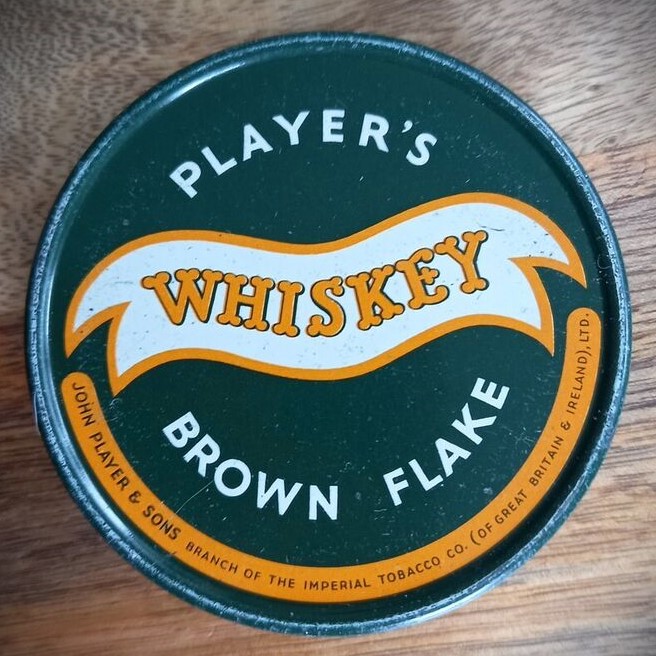
Guite triggered a flashback of our house in 1960’s Derby. Dad smoked a pipe then and I remember loads of empty Player’s Whiskey Flake tins around the house along with Benson and Hedges Mellow Virginia. Dad had two bent-stem pipes, one smooth, one rusticated, and I suspect they were Petersons. I have no idea what happened to them, though I do have one of his other pipes in a box in the shed – a small Westgate Standard, made in France, the stem bitten through. I have a notion now to find some old pipes and attempt to restore them, then place them on my desk while writing to put me into the world of my protagonist. I daresay eBay would be the only source now (unless you know differently.)
***
One thing that I like to do when preparing to write is to read good writers and good books in the hope that something will rub off on me by some kind of literary osmosis. I have just begun a reread of Susanna Clarke’s Jonathan Strange & Mr Norrell, which I haven’t read since it was published. It beguiled me then and it is working its magic again now. The BBC adaptation is good but barely scratches the surface of the stories told in the novel, including those told in the footnotes that run parallel to the main text. Aside from technical virtuosity, Clarke is very dark and very funny, her mordant, deadpan humour shining through.
As a self-publishing writer living and working in Edinburgh West, an opt-out approach seems to me to be the precise opposite of what is required: an explicit opt-in together with measures to enforce compliance by tech companies is the most ethical option both in general and as a means of protecting my rights as a creator. This is because the proposal,
puts the burden of seeking a remedy on the individual being stolen from: it should not be my responsibility to dig through every single company’s website, app or customer support to tell them that I do not want to have my work used to train something that will replace my meagre royalty stream even if I trusted them to honour my wishes (which I do not);
does not, as far as I can see, protect me from someone else reposting my work and AI then being trained on the infringing copy;
assumes trustworthy behaviour in an asymmetric relationship; nothing that I have seen justifies granting that trust.
Chris Bryant is reported as saying that the proposed opt-in approach is a ‘win-win.’ It plainly is not; there are very obvious winners and losers and, as a creator, I would be amongst the losers.
I appreciate that this is a complex issue in an international environment, but that does not seem to me to be an excuse for letting creators twist in the wind.
Recent Comments