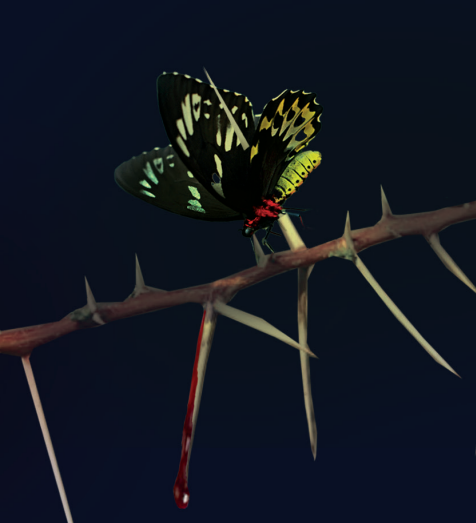
The Butcher Bird: detail from cover.
As I wrote in my previous post, The Butcher Bird is finished. Since then, I’ve been through the proof and found all the silly things I thought I’d already found, and have just about agreed the final cover. There are some technical things I need to do and decisions to make, but I also have to think about marketing and sales.
I was impressed by the efforts of the late David Lynch to avoid describing or explaining any of his work. Similarly, Alex Garland declined to go into much detail about Civil War (1) suggesting instead that people should just watch the film and react to it without prior knowledge. You can do that if you’re David Lynch or Alex Garland but not if you’re an unknown struggling to be seen in the surf of all of the other unknowns.
The cover, with the title, is the start of the process. Whether you are in a bookshop or scrolling on the internet, it is the cover that catches your eye. Ideally, it should be an arresting image that gives some information to the potential reader of the broad genre of the book. You then pick it up and, hopefully, are hooked by the short descriptive text (‘the blurb’) which might be written by a marketing professional or, in my case, is written by me. If the reader is intrigued in the shop, they might read the first page; online they might look at the preview. At that point they decide whether or not to buy the book.
So if I’m happy with the title and cover, as I am, and am confident in the writing of the first few pages, which I am, it is the blurb that is the missing link, the hook into the text. It needs to be short and memorable, 20-odd words to entice a potential reader into, in this case, the remaining 107,000 words.
Orwell, in grumpy mode, commented on this in 1936 (In Defence of the Novel) in respect of blurbs written by professional publicists.
Question any thinking person as to why he ‘never reads novels’, and you will usually find that, at bottom, it is because of the disgusting tripe that is written by the blurb-reviewers. There is no need to multiply examples. Here is just one specimen, from last week’s Sunday Times: ‘If you can read this book and not shriek with delight, your soul is dead.’ That or something like it is now being written about every novel published, as you can see by studying the quotes on the blurbs. For anyone who takes the Sunday Times seriously, life must be one long struggle to catch up. Novels are being shot at you at the rate of fifteen a day, and every one of them an unforgettable masterpiece which you imperil your soul by missing.
I was tempted to use part of that as part of the blurb, but I suspect Amazon wouldn’t let me.
The key thing is not to attempt obsessively to describe or summarise the book’s contents. Interview With A Vampire (Anne Rice, 1976) has, ‘In a darkened room a young man sits telling the macabre and eerie story of his life – the story of a vampire, gifted with eternal life, cursed with an exquisite craving for human blood.’ I like that: it doesn’t actually tell you anything of the detail of the contents but tells you all you need to know about what to expect. A Discovery of Witches (Deborah Harkness, 2011) had ‘It begins with absence and desire. It begins with blood and fear. It begins with a discovery of witches,’ although it then elaborated detail, possibly unnecessarily.
All that I have to do is figure out something similar, distilling the essence of the book in a way that entices, bearing in mind that what I think and what a potential reader might think are not the same at all.
(1) I enjoyed Civil War very much, but it was somewhat on the nose in the current political climate in the US.
A good title bypasses the blurb, and I think The Butcher Bird is a good title. You want to know more.
The best book title I can think of is Why Didn’t They Ask Evans?, by Agatha Christie. Well, why didn’t they?