Feb 10, 2024 | Books
A week ago, the death was announced of Christopher Priest, who I’ve mentioned several times over the years here. I think I have more books by him than any other writer excepting only Patrick O’Brian. I’ve been meaning to write something about him here all week but haven’t come up with anything adequate yet, although I shall.
I did put a couple of things on social media, though, as follows:
There are writers whom one reads with awe, constantly wondering how they did it, hoping that in reading them one might absorb just a little bit of their talent by osmosis or sympathetic magic. Christopher Priest was one of them.
The first of his novels that came my way when I was a teenager was Fugue For a Darkening Island. When it came out, it was criticised for being too left wing; these days it tends to be criticised for being too right wing: that says more about the shifting currents of opinion than it does about the book. That was an early work: his mature work is staggering. I particularly enjoyed The Adjacent, which is sustained weirdness hiding a love story, and many of you might have seen Christopher Nolan’s The Prestige which was an adaptation of Priest’s novel of the same name.
Reading through obituaries and reminiscences of Chris Priest, I’m struck that formal reaction from outside the UK, particularly from France, is more widespread than at home, as if there’s greater recognition of his talent and importance outside the UK literary establishment. Quelle surprise.
I still intend to write something more substantial, but in the meantime, John Klute’s fine obituary in the Guardian is worth a read.
Oct 5, 2023 | Books
My adventures on Tiktok continue. Essentially my presence there is about marketing (though not direct sales promotion) so I’m trying to come up with a stream of interesting content. The problem is figuring out what interesting content is. Here’s a recent example which at least one regular viewer of this site will know about right away 🙂
Tiktok is a weird place. It is algorithmically driven and learns relatively quickly what content you are likely to want, although if it can’t serve any up it will present all sorts of nonsense to see if any sticks. And once it gets an idea it is hard for it to let go. I watched one video of someone camping in heavy rain and all of a sudden my feed is full of people camping in heavy rain. You can block users or say that you’re not interested in something, but it doesn’t always pay attention.
In the big picture, I have to say that the main thing that keeps me on most social media sites these days is some form of marketing. It’s why I went back to Facebook and maintain a presence elsewhere. I can’t say it’s had much impact but it has had some impact so I reckon better to be there than not, if only to have some kind of audience for when I next come to publish something – which won’t be for quite some time yet..
May 17, 2023 | Books, Dead Water, Legs!, Writing
For those interested in these things, I put a post up in my writing pages.
4 Random Musings
***
I had a strange day. I had a dentist appointment this afternoon at which I expected to have some work done underneath a deep, old filling – a shadow showed up on an x-ray at my last check up. I’m normally OK at the dentist, but I’d got myself apprehensive about this one, expecting it to be tough going. In fact, after the dentist had very thoroughly numbed me up, she decided that the x-ray was misleading and the work didn’t have to be done at all. Relief all round. I’m drinking through a straw, though, until the anaesthetic wears off.
***
At the beginning of April, I put up a post on my Diabetes and Me pages about an eight-week experiment I’m conducting on myself. The post is here:
1. Brave New World
I’m still in week six of the experiment, but so far I’ve lost more than 3.4 kilograms (about 7.5lbs) and my average blood pressure is markedly down. It’s been an interesting experience, especially tracking blood pressure. Even though the average is clearly down, there are still days (or even couples of days) where my BP is elevated for no obvious reason. This has got me thinking, and those thoughts will probably turn up in a Substack post at some point. A teaser is to say that I see now why UK doctors look at average BP not at absolute numbers.
I would say that the benefits have come about 75-80% from diet and 20-25% from exercise. A 30 to 45 minute swim (which I do twice a week) has an obvious impact, and, despite what I said at the beginning of the experiment, I’m starting up a couch-to-5k programme again. I dare say the muscle memory will kick back in, but so far my short jog sessions have been more pachyderm than gazelle. I may yet find a happy distance of around 3.5k around our hill, but I’m not back to that stage yet – 2.8km yesterday was hard, slow going and included about 3.5 minutes of walking (in 30-second bursts).
***
In November 2020, I mentioned here that I was reading and enjoying Peter Ross’s A Tomb With A View, his tour of graveyards. His latest is Steeple Chasing: Around Britain by Church. It is beautifully written with his trademark eye for the telling metaphor or simile, insight, and sentences that catch you off guard. Highly recommended.
Jan 26, 2023 | Books, Dead Water

Incense in the Air
As some of you know, I used to be a candidate for ordination in the Scottish Episcopal Church. Sometime around 1979, I shifted my ground and completed my first degree (Divinity) as an academic subject. Since then have put quite some distance between the church and me. I retain an interest in what you might broadly call spiritual and religious matters, but do not profess any faith. I have at times called myself an atheist but that isn’t something that I do any more, not because of any belief but because I distrust dogmatism in all its forms.
Religious themes run through the fiction that I write in one way or another, from the protagonist of The Raven and the Hart who is a priest questioning her vocation, to Ba Ren the Buddhist monk alone in a wasteland in Soft Sings the River, a story in Coyote in the Corner.)
Last weekend, I dropped into Old St Paul’s Episcopal Church here in Edinburgh for a short time. This was partly because it crops up as a location in a draft novel that I’ve been working on for too long and I wanted to check some details, but also because I remember it from long ago as a space I enjoyed being in. Walking in, I was immediately embraced by the heavy scent of that morning’s incense and the quietness of the church even though it is in the heart of Edinburgh; I was happy to sit for a while and take it in.

South window, Old St Paul’s
I’ve done this before. When researching elements of Raven I spent some time sitting in St Mary’s Episcopal Cathedral on Palmerston Place, a Victorian edifice that dominates the west of the city. Long ago, I went up as far as you can get in the bell tower where I should have had a fine view of the city, although in my memory it was raining. That visit gave me some elements of the setting for Canty’s final sermon, but it was also evocative of a sense of scale and something implicit in places given over to devotions. I felt something similar in some Buddhist temples in China.
Unsurprisingly, my short time in Old St Paul’s led me to reflect on why I liked being there and the possibilities of returning, albeit to enjoy the atmosphere rather than as a member of the congregation. I came away with a certainty that, should I ever return to the church, unlikely as that might be, it is to the High Anglican tradition that I would turn.
In another story in Coyote – Lighten Our Darkness – the vampire Margaret muses on her liking for High Church Anglicanism, musings that, if not exactly autobiographical, do represent something of my own instincts. She says,
I’m attracted to the High Church – none of that primacy of the Word nonsense beloved by those dour Reformers with their endless exegesis of minutiae. There is a splendour in ritual, in the old liturgical soft-shoe shuffle, a splendour that transports. I think it’s to do with the use of all five primary senses to produce something greater than the sum of the parts, that ineffable sixth sense of apprehension of the numinous, of the immanent, the encounter with the divine.
Does it surprise you that I speak of the divine? I don’t know why it should. We have been on this earth a long time and have long memories. We have seen many things that are difficult to explain without invoking the idea of other realms, other realities. That’s another reason I like ritual, treading the boards to play my walk-on part in the Divine comedy. It’s why I like the flummeries and fripperies of the high churches, the scripted choreography of the costumed pierrots in their sanctuaries, chasing the spectrum of the liturgical seasons, mining silver at the rainbow’s end for their chalices and patens, and gold for the embroidery on their chasubles.
I took this a bit further in Raven and again had Canty say something that is close to my own view both as a matter of principle but also as a matter of inclination. Canty comments in passing on the difference between ritual as participation and ritual as performance.
My liking for High Church ritual at its best (and it was the tradition in which I was brought up) is precisely because of the participatory element, of interacting with symbol and myth and community. I decline to participate now because I am not a believer in the core myths of Christianity or any other religion, but it’s where I would find a home if my views changed.
***

UK Hardback 1st edition
In the late 1970s/ early 1980s, Doris Lessing wrote five science fiction novels – or at least they were marketed as such – under the overarching title of Canopus in Argos: Archives. This drew murmurings from the literary establishment about why she had lowered herself into genre, and mutterings from the SF crowd about this literary interloper. Ursula K LeGuin wrote a snippy review of the first of the novels, Shikasta.
I read all of the novels as they came out in paperback and rather enjoyed them, albeit that my clear favourites were the fifth in the series (Documents Relating to The Sentimental Agents in the Volyen Empire, 1983) which is very funny, and the second – The Marriages Between Zones Three, Four and Five (1980). The latter was by far the best of the series, in my opinion, but in the 40 years since I first read it I have never revisited it. Until now.
I’m delighted to say that it holds up wonderfully and I’m more than happy to be immersed in its charms again. I won’t try to retell the plot as it makes no sense outside the context of the book (and for goodness sake don’t rely on the po-faced nonsenses of Wikipedia to get a head start.)
I have a huge to be read pile by my bed and do not need any more, but a reread of the rest of the Canopus in Argos sequence is now on my list.
Sep 21, 2022 | Books, Holidays
This is my final post from our trip to America. Most of the visit was based around family, so this is a bit ‘freeform.’
*

Diego Rivera room, Detroit Institute of Art
The Detroit Institute of Art is an interesting place: I enjoyed the visit, and we didn’t have time to see it all, but there were some odd curatorial decisions. The section on the Americas at least had maps. By contrast, ‘Africa’ was presented as an essentially homogenous entity, as, to a lesser extent, was Asia. I got that the link between the exhibits was thematic rather than geographic, but I thought the presentation of diverse cultures was missing context. I also noticed that the majority of the art, where the artist was identified, was by men.
Similarly, the Gerald Ford Museum in Grand Rapids had a good collection of material about Ford’s life and presidency, albeit somewhat sanitised, but accompanied by a strange exhibition of Michelangelo’s art from the Sistine Chapel, with no good reason for it being there.
*
Our time in America coincided with both the death of the Queen and 9/11. I’ve written in earlier posts about the Queen, but the reaction in the US was interesting. At first, my only exposure was on NPR in Amy’s car, where the news was reported fairly alongside other major stories, notably the heat in California. As I always do in the US, I avoided TV, but did notice several people watching the network coverage over breakfast in the hotel with rapt attention.

911 Commemoration, W Illinois St.
Our second hotel in Chicago was next to a fire station, from which tenders and trucks would issue at all hours of the day and night, sirens wailing like werewolves. Early in the morning of 9.11 I watched as a solemn commemoration was enacted in the rain. Part way through, I dropped down to the hotel breakfast room for a coffee and noticed that no one was paying any attention at all to the memorial taking place outside the large window.
Our final day was spent with friends, Bruce and Arlene, who took the time to drive us around parts of the city, talking about the history and the architecture and taking us to a favourite bar for lunch before dropping us off at the airport.
There isn’t much to say about the journey back except to say that I finally found a benefit of Brexit – I got a reasonable duty-free price on a bottle of Irish whiskey at Dublin airport. We landed at Edinburgh about an hour before the cortege carrying the Queen’s funeral arrived at the back gates – the RAF transport was waiting as we taxied to our stand.
*
Even if we hadn’t been visiting family, I would have enjoyed this visit, notwithstanding the £:$ exchange rate. I really liked the places we went and the people we were with. We were almost entirely in ‘blue’ areas and I made a point of not initiating any discussion of politics, but, that said, it was a relaxed time without drama. When I did get chatting, it was always civil and pleasant and polite with an undertow of good humour.
The centre of Chicago is great – if expensive – even though it smells everywhere of strong weed thanks to the legalisation of cannabis. Indeed, one of the jarring things over the near-40 years since I first visited the US has been the rapid expansion of availability of good beer followed by the ready availability and ubiquitous advertising of weed. Personally, I prefer the beer – and the excellent red wine served by family in Grand Rapids.
There are other elements that are noticeable, of course, just as they are here in the UK. A meme was doing the rounds on social media that was a photo of a commemorative notice about the Queen juxtaposed with someone homeless on the street. The point is valid, but it was mainly posted (that I saw) by Americans. I mention it because I saw it in Chicago even as I passed many unfortunates, some clearly physically and/or mentally unwell, asking for dollars, dimes or quarters in the penumbra of the Trump building at the riverside – and yes, I gave what I could if I had cash in my pocket.
Anyway, I came back from America with good memories of good times with family. I also found a hot sauce that I like (Picamas Salsa Brava) and, unusually for me, a card game that I enjoy playing (Five Crowns). I like the look of Pickleball, though I didn’t play, and enjoyed my faltering attempts at Disc Golf. And I look forward to going back over – when the bank balance recovers.
For those interested in such things, a public photo album is on Facebook.
*
Holiday reading (cont)
Star Wars: Survivor’s Quest Timothy Zahn. Disappointing: a decent story let down by poor dialogue and slack writing. A noticeably high headcount at the hands of the Jedi too.
Ender’s Game Orson Scott Card. A quick read and four-square in the American SF tradition, in some respects swimming in the same pond as Heinlein’s Starship Troopers, though more reflective than Heinlein. Cleanly written, and more subtle than the subsequent film, but I have no idea why it won either of the Nebula or Hugo awards, let alone both of them.
Hit Man and Hit List Lawrence Block. I really enjoyed these: Laconic, sharp, wholly amoral and often very funny despite the monstrous protagonist.
Aug 29, 2022 | Books, Holidays

Hunt the Renaissance
We went to the Michigan Renaissance Festival and Highland Fling. I was warned in advance not to be too critical or pedantic, but the truth is that I enjoyed it on its own terms.
To be sure, it had almost nothing to do with the renaissance, although there was a lutenist performing some nice pieces and a couple playing music from Tudor England; in fact, it bore only a tangential relationship to any recognisable period in European history at all. The ur-source for most of it, at least amongst the attendees, was Tolkien and his many, many children, with a healthy dash of Disney. Key recurring motifs were Lord of the Rings, Game of Thrones and the Witcher. Once or twice I had to bite my tongue and not comment that ‘viking’ was more of a job description than an ethnicity or cultural identity (and to the extent that viking can be described as a cultural identity, it is a contested one).
Nor did it have a lot to do with Scotland: sure, there were many kilts on display, but there was also that curious American confusion between Scottish and Irish, and the historical costumes were influenced more by Mel Gibson than authenticity.
For all that, it was fun to mingle under a hot sun with a good-natured crowd that seemed to consist of every LARPer and cosplayer in the state. A lot of thought and care had gone into most costumes even if, for the women at least, the ‘renaissance’ dress code seemed to be to leave no boob uncovered.
***
We went to The Ark in Ann Arbor on Friday to see BeauSoleil, featuring Michel Doucet on fiddle and vocals. I first became aware of Doucet when he was on the second series of Transatlantic Sessions in 1998 but I saw the band earlier when they backed Mary Chapin Carpenter in 1991 on Down at the Twist and Shout. They’ve been playing as a band in one form or another for 47 years and wore their virtuosity lightly. Great show – and a great venue.
***
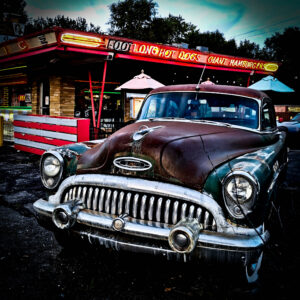
1953 Buick Special Eight (again)
I like Ypsilanti, where we are now: I feel like I’m surrounded by Americana, that I’ve come to an America that, while not as mythical as the Europe of the Renaissance Festival, is nevertheless an idealised version of a way of life.
I’ve said often in the past that America is somewhere that I enjoy visiting but have no great desire to live. There are many reasons for that, although at the most basic it’s because I’m too British and European by inclination to be comfortable anywhere else. If circumstances meant that we were to move to the US, though, it would be to somewhere like Ypsilanti.
There’s a drive-through diner down the street from us with a gently decaying, endlessly photogenic 1953 Buick parked outside. And, while we’re not in O Winston Link territory, there’s something evocative about the sound of an Amtrak train horn in the night against a background of countless cicadas.
***
Holiday reading so far:
Babylon Berlin : Volker Kutscher. The first of a crime novel series set against the fall of the Weimar Republic and the rise of Nazi-ism. I enjoyed this one (set in 1928) enough to want to look at the rest of the series in due course, but I also thought it too long. Shortly before we left the UK I read Dashiell Hammett’s The Thin Man which was, I guess, around 75,000 words with none of them wasted: Babylon Berlin would have benefited from the same concision.
Playback : Raymond Chandler. The last of the Philip Marlowe novels and somewhat overlooked in Chandler’s canon. Like Hammett, Chandler doesn’t mess around, but Chandler is far and away the greater stylist. Classic noir and hardboiled crime fiction doesn’t go in much for metaphor, sticking to acerbic one-liners. One character, Chandler says, ‘was as easy to spot as a kangaroo in a dinner jacket.’
Annihilation : Jeff Vandermeer. I’m a great fan of Alex Garland’s film of this, but the novel is just as good. It’s a sustained feat of imagination and unsettling weirdness that, rightly, doesn’t go in much for explanation of what’s going on. I’ve ordered a copy of the remaining two books in the series.
Sinner Man : Lawrence Block. Currently reading. I bought this on spec. and have been drawn unto the unpleasant world of the protagonist. It isn’t a mystery as such, more of an extended character study. It is sold as a ‘pulp’ classic but it is a lot more than that. Like the pulps, though, it doesn’t mess around with unnecessary ornamentation and tangents, and has pleasingly sharp dialogue.





Recent Comments