We went to the Michigan Renaissance Festival and Highland Fling. I was warned in advance not to be too critical or pedantic, but the truth is that I enjoyed it on its own terms.
To be sure, it had almost nothing to do with the renaissance, although there was a lutenist performing some nice pieces and a couple playing music from Tudor England; in fact, it bore only a tangential relationship to any recognisable period in European history at all. The ur-source for most of it, at least amongst the attendees, was Tolkien and his many, many children, with a healthy dash of Disney. Key recurring motifs were Lord of the Rings, Game of Thrones and the Witcher. Once or twice I had to bite my tongue and not comment that ‘viking’ was more of a job description than an ethnicity or cultural identity (and to the extent that viking can be described as a cultural identity, it is a contested one).
Nor did it have a lot to do with Scotland: sure, there were many kilts on display, but there was also that curious American confusion between Scottish and Irish, and the historical costumes were influenced more by Mel Gibson than authenticity.
For all that, it was fun to mingle under a hot sun with a good-natured crowd that seemed to consist of every LARPer and cosplayer in the state. A lot of thought and care had gone into most costumes even if, for the women at least, the ‘renaissance’ dress code seemed to be to leave no boob uncovered.
***
We went to The Ark in Ann Arbor on Friday to see BeauSoleil, featuring Michel Doucet on fiddle and vocals. I first became aware of Doucet when he was on the second series of Transatlantic Sessions in 1998 but I saw the band earlier when they backed Mary Chapin Carpenter in 1991 on Down at the Twist and Shout. They’ve been playing as a band in one form or another for 47 years and wore their virtuosity lightly. Great show – and a great venue.
***
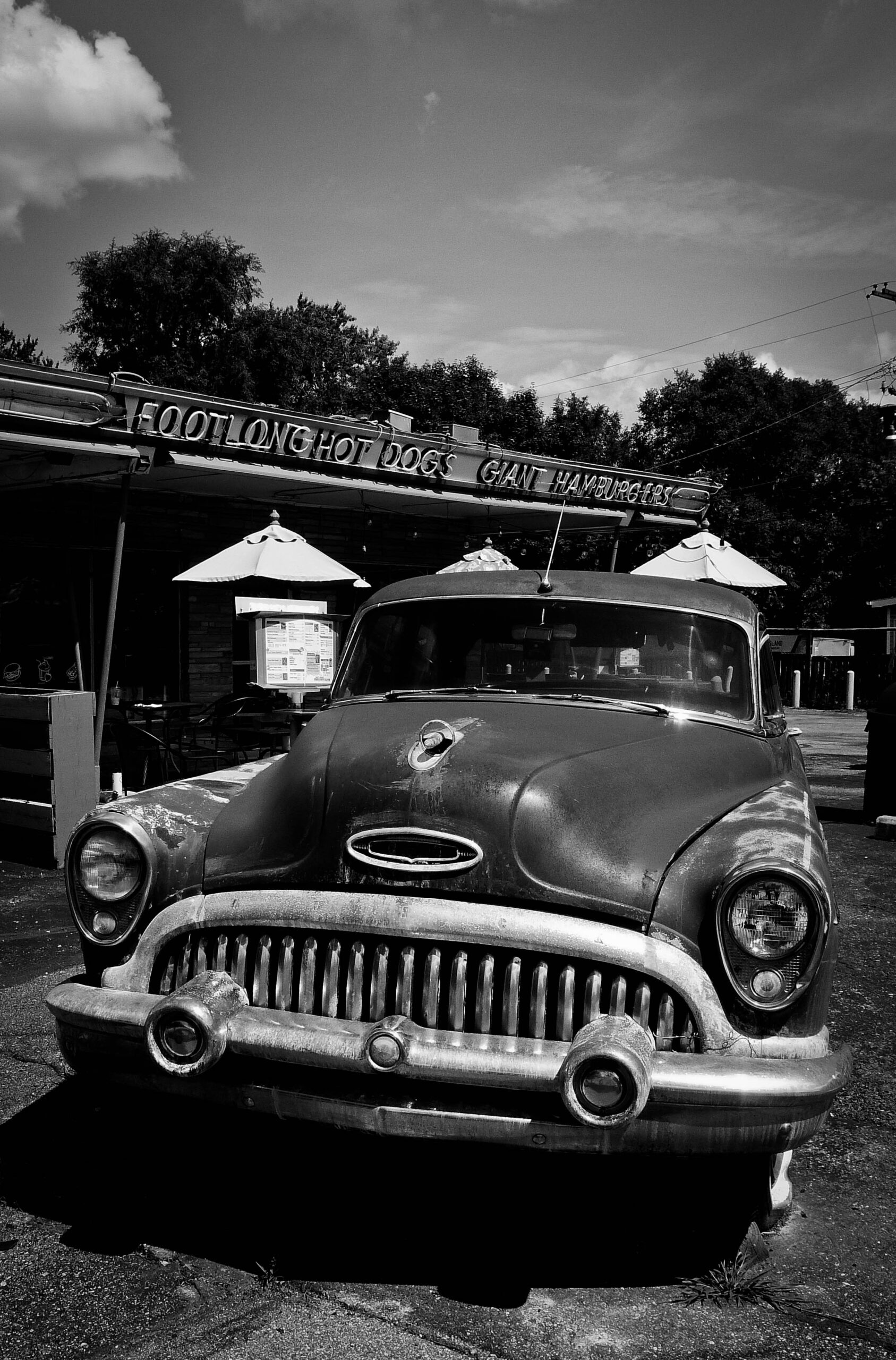
1953 Buick Special Eight (again)
I like Ypsilanti, where we are now: I feel like I’m surrounded by Americana, that I’ve come to an America that, while not as mythical as the Europe of the Renaissance Festival, is nevertheless an idealised version of a way of life.
I’ve said often in the past that America is somewhere that I enjoy visiting but have no great desire to live. There are many reasons for that, although at the most basic it’s because I’m too British and European by inclination to be comfortable anywhere else. If circumstances meant that we were to move to the US, though, it would be to somewhere like Ypsilanti.
There’s a drive-through diner down the street from us with a gently decaying, endlessly photogenic 1953 Buick parked outside. And, while we’re not in O Winston Link territory, there’s something evocative about the sound of an Amtrak train horn in the night against a background of countless cicadas.
***
Holiday reading so far:
Babylon Berlin : Volker Kutscher. The first of a crime novel series set against the fall of the Weimar Republic and the rise of Nazi-ism. I enjoyed this one (set in 1928) enough to want to look at the rest of the series in due course, but I also thought it too long. Shortly before we left the UK I read Dashiell Hammett’s The Thin Man which was, I guess, around 75,000 words with none of them wasted: Babylon Berlin would have benefited from the same concision.
Playback : Raymond Chandler. The last of the Philip Marlowe novels and somewhat overlooked in Chandler’s canon. Like Hammett, Chandler doesn’t mess around, but Chandler is far and away the greater stylist. Classic noir and hardboiled crime fiction doesn’t go in much for metaphor, sticking to acerbic one-liners. One character, Chandler says, ‘was as easy to spot as a kangaroo in a dinner jacket.’
Annihilation : Jeff Vandermeer. I’m a great fan of Alex Garland’s film of this, but the novel is just as good. It’s a sustained feat of imagination and unsettling weirdness that, rightly, doesn’t go in much for explanation of what’s going on. I’ve ordered a copy of the remaining two books in the series.
Sinner Man : Lawrence Block. Currently reading. I bought this on spec. and have been drawn unto the unpleasant world of the protagonist. It isn’t a mystery as such, more of an extended character study. It is sold as a ‘pulp’ classic but it is a lot more than that. Like the pulps, though, it doesn’t mess around with unnecessary ornamentation and tangents, and has pleasingly sharp dialogue.
Our visit to Chicago began with tacos, which, all things considered, is a pretty good way to start. The flight over wasn’t without its dramas, what with delays and limited menus on the flight, but let’s not dwell on that.
We were in Chicago just for a couple of days, during which we walked a lot. Despite the short time, and despite our concentration on the touristy bits, the city rapidly became my favourite of all the American cities I’ve visited. The whole of the area around the river has been well and thoughtfully developed, and everything we ate or drank was great, albeit expensive.
We had two great breakfasts downtown – the second, a shakshuka at Egg Harbor Café, with strawberry orange juice and coffee, was outstanding. On Sunday, three blocks of State Street were closed off and given over to music and craft stalls etc. That was where I found an excellent local brewery, Black owned, and enjoyed a can of their Imperial Porter – although at 8.5% it was only one can.
I’m looking forward to another weekend in Chicago in September before we fly back to Scotland.
***
We Amtraked from Chicago to Michigan. I used Amtrak previously to travel from New York City to Philadelphia in 2018 and the experience this time was a little different – disorganised and chaotic at Chicago Union Station and noticeably older rolling stock. The seats were comfortable, though, and so was the ride, although it was not high-speed by any European or Asian standard.
The Zephyr slowed for us on the great curve around the edge of the Feather River Valley. David and I jumped into the morning sunlight, as the hum and ring of the tracks decayed. Without warning, I was lost in a vision of a future with no railroad, where everyone drove automobiles that only they occupied; an America where countless millions withdrew into solitary selfishness while the steel ribbons that bound the country together rusted into memories and museums, and a great dream died, taking its power with it.
Amtrak
I was reminded of that as the train snaked its way along freight tracks through Indiana. I saw something a couple of weeks ago (that I can’t find now) about the contentious subject of high-speed rail in the US and specifically the New York-Chicago route. It currently takes 19-22 hours by rail when using any European or Asian network it would take 5 hours. I’d have said that the climate crisis, and the change that will pretty much inevitably follow from that, means that the route will sooner or later require the infrastructure for electric cars or mass passenger transit.
Anyway, America was outside the train. Southwards from Chicago and through Indiana was a journey through industrial dereliction for the most part. Just like the last time I was on Amtrak, Jean Ritchie’s voice was in my head as we clattered past rusting wagons and flatbeds and the skeletal remains of more-or-less abandoned steel mills. It was a journey through the archaeology of a long-past economic and industrial model and no one has the inclination or the wherewithal to clean it up.
Ypsilanti
Michigan was different – wetlands and forests and an abundance of deer interspersed with farms and small communities. Just as in the UK, there was the depressing sight of clusters of modern homes, uniformly unimaginative and uninspiring in the cookie-cutter conformity of their design and construction.
That’s a shame: there is a great American vernacular style of property familiar from any movie of the forties and fifties through to the seventies. Cable channel obsessives will remember the properties that used to be renovated by Steve and Norm on This Old House. I’m not sure how things shifted from style and individuality to modern bland designs, but shift they did. Happily, Ypsilanti, where we are now, is full of classic old buildings, including some dating from C19, and it’s all the better for it.
Nearly five years ago I made a post (Not Fade Away) in which I outed myself as a Deadhead. This time, I have another confession to make, a shambling, shuffling, feet-gazing muttering sort of confession: another outing.
I started writing fiction more seriously when I had early retirement thrust upon me. Since then, I’ve published a collection of short stories and a novel and have more in the pipeline. In the last week or so I’ve admitted to myself that I no longer think of writing as a retirement hobby: I think of myself as a writer. It’s something I’ve been reluctant to do; a step I’ve been reluctant to take. There were several reasons for that, notably an inhibition against letting my ego loose and a certain resistance to opening myself up to ridicule for pretension, but the time has come to take it seriously.
In a sense, I’ve been a writer since I first began my blog on 17 August 2002 – twenty years ago: imagine that. Blogging is a form of journaling but, nonetheless, a form of writing, and I’ve written and published an awful lot of words in those twenty years (as well as a lot of awful words 🙂 ). But now, as well as friends, I have strangers buying my stuff and respected editors giving me their support when they don’t have to.
I’ve said many times over the years that I don’t know what I want to be when I grow up; I do now – I want to write and I’m doing it. At nearly sixty-three, this has been a long time coming, but better late than never. I’m not a hobbyist, I’m a writer.
I’m pleased to say that I sold some copies of The Raven and the Hart. In terms of sales, it did better than Coyote in the Corner did in it’s first two weeks, but I reduced the price so my actual revenue was slightly less. It has to be said that it wasn’t a huge amount, but I could see from Amazon information that a lot of the sales were to strangers, and I sold a handful of eBooks through Draft2Digital too, and they are likely also to be to strangers. By that I mean it wasn’t just family and friends buying out of a charitable disposition. There’s only one review so far, but it’s a good one so I’m happy with that. Of course, all of you have already bought at least one copy of each of my books, haven’t you?
The sequel novel to Raven is written and out with beta readers now. Once I’ve had their responses and put it through a further revision, I expect it to be released in early 2023.
So what next?
Well, I have a dauntingly long list of things I’d like to write, including finishing a sequel to Coyote in the Corner and sorting out a heap of short stories I have on my laptop into something like useable form. So it was with some dismay that an idea for a completely new series hit me this week, inspired in part by a conversation with an old friend from the Registers of Scotland days. I’m still figuring it out, but it will be set in 1930s Edinburgh. I emailed my editor to ask for her gut reaction and it was immediately positive, which is a good sign (I discovered quite by chance this week that she used to be Alasdair Gray’s editor, which is nice.)
I can short circuit some of the creation of the new one because I can abandon a half-thought-out story in my notebook and reuse the same research for the new one, although I anticipate spending two weeks or so in the National Library of Scotland combing through period copies of the Scotsman, the Edinburgh Evening News and the Evening Despatch. I also have a Freedom of Information request in for some criminal trial records currently locked under the 100-year rule. Beneath its prim, Calvinist veneer, Edinburgh in the 1930s was a hotbed of vice and immorality, and that’s where I’m focusing.
Also, these guys are likely to feature, at least by reference: The Mills Brothers.





Recent Comments