This is probably a niche post, so feel free to look away now.
I came across something last night that entertained me – a piece Ian Fleming wrote in 1962 (possibly published in Books and Bookmen in 1963) on his writing process. He wrote:
The next essential is to keep strictly to a routine. I write for about three hours in the morning – from about 9:30 till 12:30 and I do another hour’s work between six and seven in the evening. The whole of this four hours of daily work is devoted to writing narrative. I do it all on the typewriter, using six fingers. The act of typing is far less exhausting than the act of writing, and you end up with a more or less clean manuscript. At the end of this I reward myself by numbering the pages and putting them away in a spring-back folder. I never correct anything and I never go back to what I have written, except to the foot of the last page to see where I have got to. If you once look back, you are lost. How could you have written this drivel? How could you have used “terrible” six times on one page? And so forth.
If you interrupt the writing of fast narrative with too much introspection and self-criticism, you will be lucky if you write 500 words a day and you will be disgusted with them into the bargain. By following my formula, you write 2,000 words a day and you aren’t disgusted with them until the book is finished, which will be in about six weeks. I don’t even pause from writing to choose the right word or to verify spelling or a fact. All this can be done when your book is finished. When my book is completed I spend about a week going through it, correcting the most glaring errors and rewriting passages. I then have it properly typed with chapter headings and all the rest of the trimmings. I then go through it again, have the worst pages retyped and send it off to my publisher. They are a sharp-eyed bunch at Jonathan Cape and, apart from commenting on the book as a whole, they make detailed suggestions which I either embody or discard. Then the final typescript goes to the printer and in due course the galley or page proofs are there and you can go over them with a fresh eye. Then the book is published and you start getting letters from people saying that Vent Vert is made by Balmain and not by Dior, that the Orient Express has vacuum and not hydraulic brakes, and that you have mousseline sauce and not béarnaise with asparagus. Such mistakes are really nobody’s fault except the author’s, and they make him blush furiously when he sees them in print. But the majority of the public does not mind them or, worse, does not even notice them, and it is a dig at the author’s vanity to realise how quickly the reader’s eye skips across the words which it has taken him so many months to try to arrange in the right sequence. But what, after all these labours, are the rewards of writing and, in my case, of writing thrillers? First of all, they are financial. You don’t make a great deal of money from royalties and translation rights and so forth and, unless you are very industrious and successful, you could only just about live on these profits, but if you sell the serial rights and the film rights, you do very well. (Source: Web Archive.)
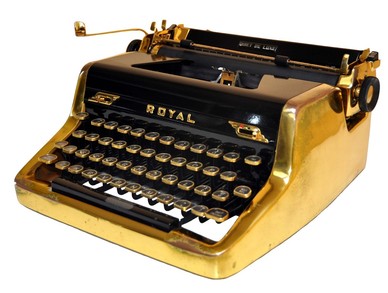 I rather like the louche insouciance of his description of his process. His ‘keep typing and revise when it’s done’ approach is one I’d like to emulate, but fail at miserably, falling into the habit of constant revision, made easier by laptops. Hence my interest in typewriters.
To celebrate the success of Casino Royale, Fleming bought a gold-plated Royal Quiet Deluxe typewriter in New York. Somewhat vulgar ostentation if you ask me, but there we are. I believe Pierce Brosnan owns it now.
In a slightly different version of that article (found here), Fleming writes:
My heart sinks when I contemplate the two or three hundred virgin sheets of foolscap I have to besmirch with more or less well chosen words in order to produce a 60,000 word book.
Two things strike me about that. The first is ‘foolscap’ – an imperial paper size, once ubiquitous, now rarely seen. It wouldn’t surprise me to see it reintroduced by the Tories as a benefit of Brexit, international standards be damned. The second is ‘60,000’ word book: send that to a publisher these days and they’ll ask where the rest of it is.

Although Ian Fleming’s standpoint is of an internationally feted writer and mine, er, is, n’t, his process makes much sense to me. I have, for my part, recorded bass and vocal parts for a smattering of bands – in your face, Fleming ! – and the process is similar : you play your part of the song through and only stop if a massive cockup occurs, and when you have it down, that’s the point where you quantize your fingering to the beat, overdub the odd note and adjust and mix the sound. You’d never get a song down at all if you stopped every time you noticed you weren’t quite on the beat.
Re: the pile of foolscap at which he’s looking in trepidation : Ian F, you’re only putting psychological pressure on yourself. Hide it in a drawer and only take a handful of pages out at a time.