Boxing Day, and I thought I’d take a trip into town, partly to get some exercise after spending most of yesterday either cooking or eating, but also to see what was happening in the sales.
I got my exercise, but a lot of places were closed so I just wandered around, marvelling at the ‘sale’ prices in the places that were open: even at steep discounts they were more than I would usually spend. Indeed, a lot of my ‘new’ shirts and jackets come from charity or vintage shops at relatively low prices. Given that most of my tastes were formed between 1974-1979, this isn’t a huge hardship.
When my 10,000 steps were nearly ticked off, my knee was protesting so I decided to do what I sometimes do and stop off for 15 minutes peace and rest in St Mary’s Cathedral on Palmerston Place; it was closed. I thought I might instead take the holy drink at a secular temple of the ineffable but Ryrie’s was closed too.
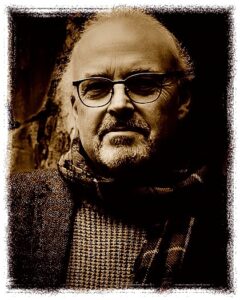
We lost a lot of good’uns in 2025; here’s one of them
After the prostate stuff on Wednesday I’ve been focusing on my novel-in-progress and taken a detour, for reasons that will one day be apparent, into English alliterative verse and specifically Middle English alliterative verse with its distinct scheme. This stuff is hard to write. I don’t need to write proper Middle English verse – I don’t have the vocabulary for one thing – but I do want to it to be more than a rough pastiche.
The verse is driven by the pulse of the alliteration on the stressed syllables rather than by formal meter or a rhyme scheme and that gives it a distinct flavour. I think it lends itself much more to recitation in a predominantly oral society as opposed to a form of written literature for quiet reading to oneself. I hope it becomes an exercise of getting one’s ear in after a while, but getting to that stage is work, though it also means diving into some truly great historical material to get a feel for the rhythm of it.
Anyway, the process is to work out what I want to say and then wrestle it into the proper form and part of that is being up in the shed reading it aloud to see if the syllables flow or jar. That should all keep me out of mischief over the Christmas period, or most of it: I make my mince pies on Christmas Eve and I prepare the meal on Christmas Day.
I probably won’t be online much so I’ll take this opportunity to wish a Happy Christmas to all my readers. Here are two of my favourite Christmas tunes: Dr John and the great Leon Redbone, and Steeleye Span..
To the hospital yesterday to have three gold seeds inserted into my prostate; these will be the focus for the radiotherapy when it starts in late January.
If you are reading this because you have been searching for information on the procedure, I can tell you that it was quick (less than 5 minutes) and nothing at all like the experience of the biopsy. There was definitely an uncomfortable sensation but not what I would call painful. The longest part was sitting around in the waiting room beforehand. Afterwards, I was quite able to walk the fabled 10,000 steps before coming home for a cup of tea with my feet up.
More broadly, the only real side effect I’ve had of the hormone implant is that my weight has been creeping up. I am still in the same 30″ waist jeans but there has definitely been weight added around my tummy – possibly because of fluid retention. I’m hoping that I’ll be able to lose it again once the course of treatment is over which means late spring.
***
Looking for a title for this post, my first thought was Eliot’s Journey of the Magi and I fell into a rabbit hole of assorted actors reading the poem on YouTube. It was an interesting exercise in changing styles over the years, especially the final line which is often read as fatalistic as if by a weary narrator; I think the meaning is sharper than that and is to do with the turning of the religious tides, the death of the old and (implicitly) the birth of the new. Anyway, of all the readings, including a recording of Eliot himself reading it, I thought the best was by Alec Guinness. I also enjoyed Malcolm Guite’s spirited reading which ties the poem to Eliot’s sources, and Tim Martin’s more dramatised reading.
As most readers of this blog will know, my first degree was Divinity. I began the degree in October 1977 with the intention of taking the cloth but there’s nothing like a rigorous theological education to make you question your faith – that, indeed, is the point of it. I completed the degree from an academic rather than vocational standpoint and enjoyed it. For a long while I described myself as an atheist; I no longer do. It isn’t that I profess any particular belief, just that I distrust dogmatic unbelief as much as I do dogmatic belief. It’s why I don’t have much time for prominent humanists qua humanists: they’re too dogmatic.
Despite my loss of faith, or maybe precisely because of it, my interest in religion and spirituality remains just as strong as it ever was: one of my favourite novels, and one that I reread often, is Hermann Hesse’s Siddhartha which, if not explicitly tied to a particular world religion (in fact the protagonist rejects the Buddha’s teaching and goes off in search on Enlightenment in his own way) ties into deep themes of Being and Self. Whenever I meet my friend Neil, now retired from parish ministry, we always end up talking about theological themes and topics that usually revolve around the New Testament and what one might call Christian origins and the process of transition from Jewish cult to Roman establishment as well as side ventures into Gnostic thought and the many varieties of Christian faith before canonicity became a thing.
And lurking beneath all that is something else: I was brought up at the bells and smells end of Anglicanism and, like learning to swim or riding a bicycle, it never really leaves you. To this day an old church saturated with living memories of incense and choral music reaches parts of me that even Carlsberg cannot reach.
I mention all of this because I have been dipping into the thought of Owen Barfield. Amongst other things in his long life, Barfield was an Inkling, friend of and fellow pipe smoker with Tolkien and CS Lewis, and influential on both them in both their belief and aspects of their literary output. Barfield took the position that Christianity was a/the true myth, a/the master myth that unlocks all the others (I paraphrase wildly for the sake of a blog post of course). I don’t agree with that; I think that is a form of motivated reasoning from a pre-existent position of Faith rather than profundity, but it did get me musing on aspects of my own belief and lack of it.
To be fair, this is something that I often think about and it undoubtedly feeds through into my fiction, but I generally end up with fairly vague outlines of things that I probably think rather than reaching any conclusions. This time, however, what struck me was that there are aspects of High Anglican ritual that I find deeply attractive even though I do not share the framework of belief that houses it. This relates as much to sung Evensong as to the Eucharist. My sticking point is what the jargon calls Christology: as a minimum, to call oneself a Christian means believing that there was something of universal significance about the man Jesus; I do not believe that. But the act of participating in ritual, in the encounter with the numinous, however you wish to define that, and the sharing of it with other people in a ritual context remains appealing: Reducing some experiences to mere words always involves a degree of loss, but I think we are creatures of symbol, myth and ritual and it is something we should embrace.
Common to all major belief systems whether one of the ‘big’ religions or whether something more diffuse and demotic such as the many strands of paganism are three things,
reflection
behaviour
ritual
I spend a lot of time in reflection and I do my best with ethical behaviour: ritual is the thing that is missing, by which I mean interaction with and participation in Myth. So something I want to focus on now is teasing out aspects of my relationship with the numinous (for want of a better word) and finding appropriate symbols and then working something out for myself. It would be grand to find other like minded people and meet in the sanctuary of a good pub (which means real ale, good whisky, and no TV) or to share a dram or two by an open fire.
Recent Comments