I’ve seen this famous exchange from near the beginning of The Lord of the Rings crop up a lot lately,
‘Always after a defeat and a respite, the Shadow takes another shape and grows again.’
‘I wish it need not have happened in my time,’ said Frodo.
‘So do I,’ said Gandalf, ‘and so do all who live to see such times. But that is not for them to decide. All we have to decide is what to do with the time that is given us.’
JRR Tolkien saw service in WW1. He was posted as a second-lieutenant to the 11th Battalion, The Lancashire Fusiliers. From July onwards his battalion went in and out of the line along the northern sector of the Somme. He occupied front line trenches in Beaumont-Hamel, Serre and the Leipzig Salient. On 28 September they undertook a successful raid against the Pope’s Nose opposite Thiepval and on 21 October helped to capture Regina Trench. In both of these actions, Tolkien served as Battalion Signalling Officer. (information from Imperial War Museum). Like most of that generation, commissioned or not, he had to make that decision what to do with the time given him, and he did.
I was born in 1959 and am in the middle of my 66th spin around the sun. I have not had to make any such decision; I have enjoyed the benefits hard won by previous generations. The world order has been relatively stable despite all the violent clashes and conflicts and horrors of our years: for better or for worse, there were things we could more or less rely on if push came to shove.
It has taken POTUS 47 thirty-nine days to unravel that, probably decisively. Whatever happens now, nothing will be the same. Meantime, men and women in Ukraine are making their decisions every day. Perhaps there’s nothing I can do about it except offer passive support, and I wish it hadn’t happened in my time or my children’s time. But that is not for us to decide.
Is the reaction to 47 and his VP’s trashing of America’s dignity yesterday going to make a difference? Who knows. Lots of condemnation and online reaction, but that don’t butter no mushrooms.
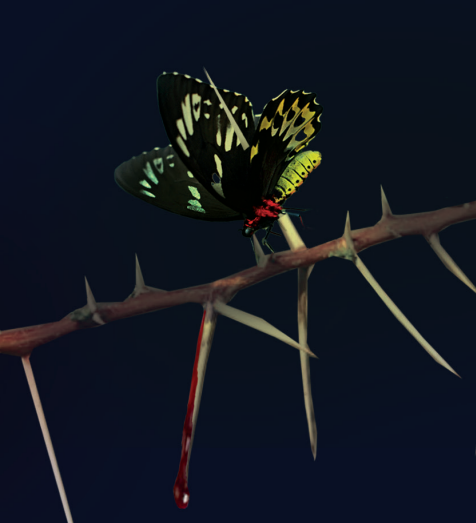
I’m delighted to announce that The Butcher Bird will be published 6 March 2025.
The blurb – which will make more sense to those of you who have read Coyote In The Corner, to which this is a sequel – reads:
Humans are all but wiped out, struggling to recover in a changing climate. Margaret, the butcher bird, haunts her domain, craving blood. The key to the future of both species is in the oldest stories of the vampires, hiding in myth and memory.
But myth and memory are unreliable witnesses and the past is as hard to predict as the future.
The concluding stories in the seductive Gaia Cascade sequence that began in Coyote in the Corner.
Kindle pre-orders are available on Amazon now, but physical copies can’t be bought until publication day (Amazon’s rules, not mine). The UK Kindle link is: The Butcher Bird. Outside of the UK, just change the .co.uk of the link to your local Amazon site – .com, .ca for example, and it should work.
If you are a Kindle reader then it would be really helpful if you pre-order.
***
If you wonder why writers are keen on pre-orders and reviews, it is because that is how the ubiquitous algorithms select books to promote more often to a broader readership. In essence, if it is selling and if people care enough to leave (positive) reviews, then it is worthy of attention. The current version of the algorithm is trying to discriminate against review farming and also notes how much of the eBook has been read – for example it does not like 5* reviews from people who have only read a few paragraphs of the eBook, assuming that it will not be a credible review.
It can’t do that for physical books, but physical books can’t be pre-ordered and tend to be more expensive. For physical books, ‘verified purchases’ are important as a proxy for reviews not generated on the back of freebies for friends and family.
If you are further wondering why I am publishing through Amazon alone, it is because that is where the market predominantly is, including for Kindle Unlimited readers (for which I get a small royalty for pages actually read). I have previously published on multiple platforms and I always use ISBNs that I have bought in my own name so I can ‘go wide’ again in future if it becomes appropriate, but I do not sell enough books to make it worthwhile as yet.
One of the joys of the transition from 45 to Joe Biden was that I no longer woke up wondering what lunacy had come from the Twitter account of 45 overnight. That joy has been extinguished. Consequently, I have largely switched off all broadcast news sources and severely cut back my already scant time on short-form social media.
There is a negative reason for this – the news comes at you like one of those French farm protests where they spray silage and manure at municipal buildings through a hosepipe. I don’t need that. More to the point, constant repetition of that stuff on a half-hourly cycle distorts understanding: it’s hard to maintain perspective when you’re soaked in shit. Of course I have opinions, but I don’t see the need to shout them and add to the signal:noise confusion, at least at present (this is my blog and I reserve the right to be opinionated and inconsistent in the future.)
There are also positive reasons for the change. The main one is that it shifts my attention to local and personal concerns that have more immediate impact on my life. But it also seems to me that refocusing on the personal and, in my case, putting out a book shortly (more news to come very soon) and focusing on writing chapter one of another novel are my own minor acts of rebellion: creativity is resistance.
As I wrote in my previous post, The Butcher Bird is finished. Since then, I’ve been through the proof and found all the silly things I thought I’d already found, and have just about agreed the final cover. There are some technical things I need to do and decisions to make, but I also have to think about marketing and sales.
I was impressed by the efforts of the late David Lynch to avoid describing or explaining any of his work. Similarly, Alex Garland declined to go into much detail about Civil War (1) suggesting instead that people should just watch the film and react to it without prior knowledge. You can do that if you’re David Lynch or Alex Garland but not if you’re an unknown struggling to be seen in the surf of all of the other unknowns.
The cover, with the title, is the start of the process. Whether you are in a bookshop or scrolling on the internet, it is the cover that catches your eye. Ideally, it should be an arresting image that gives some information to the potential reader of the broad genre of the book. You then pick it up and, hopefully, are hooked by the short descriptive text (‘the blurb’) which might be written by a marketing professional or, in my case, is written by me. If the reader is intrigued in the shop, they might read the first page; online they might look at the preview. At that point they decide whether or not to buy the book.
So if I’m happy with the title and cover, as I am, and am confident in the writing of the first few pages, which I am, it is the blurb that is the missing link, the hook into the text. It needs to be short and memorable, 20-odd words to entice a potential reader into, in this case, the remaining 107,000 words.
Orwell, in grumpy mode, commented on this in 1936 (In Defence of the Novel) in respect of blurbs written by professional publicists.
Question any thinking person as to why he ‘never reads novels’, and you will usually find that, at bottom, it is because of the disgusting tripe that is written by the blurb-reviewers. There is no need to multiply examples. Here is just one specimen, from last week’s Sunday Times: ‘If you can read this book and not shriek with delight, your soul is dead.’ That or something like it is now being written about every novel published, as you can see by studying the quotes on the blurbs. For anyone who takes the Sunday Times seriously, life must be one long struggle to catch up. Novels are being shot at you at the rate of fifteen a day, and every one of them an unforgettable masterpiece which you imperil your soul by missing.
I was tempted to use part of that as part of the blurb, but I suspect Amazon wouldn’t let me.
The key thing is not to attempt obsessively to describe or summarise the book’s contents. Interview With A Vampire (Anne Rice, 1976) has, ‘In a darkened room a young man sits telling the macabre and eerie story of his life – the story of a vampire, gifted with eternal life, cursed with an exquisite craving for human blood.’ I like that: it doesn’t actually tell you anything of the detail of the contents but tells you all you need to know about what to expect. A Discovery of Witches (Deborah Harkness, 2011) had ‘It begins with absence and desire. It begins with blood and fear. It begins with a discovery of witches,’ although it then elaborated detail, possibly unnecessarily.
All that I have to do is figure out something similar, distilling the essence of the book in a way that entices, bearing in mind that what I think and what a potential reader might think are not the same at all.
(1) I enjoyed Civil War very much, but it was somewhat on the nose in the current political climate in the US.

Recent Comments