I Will a Round Unvarnish’d Tale Deliver
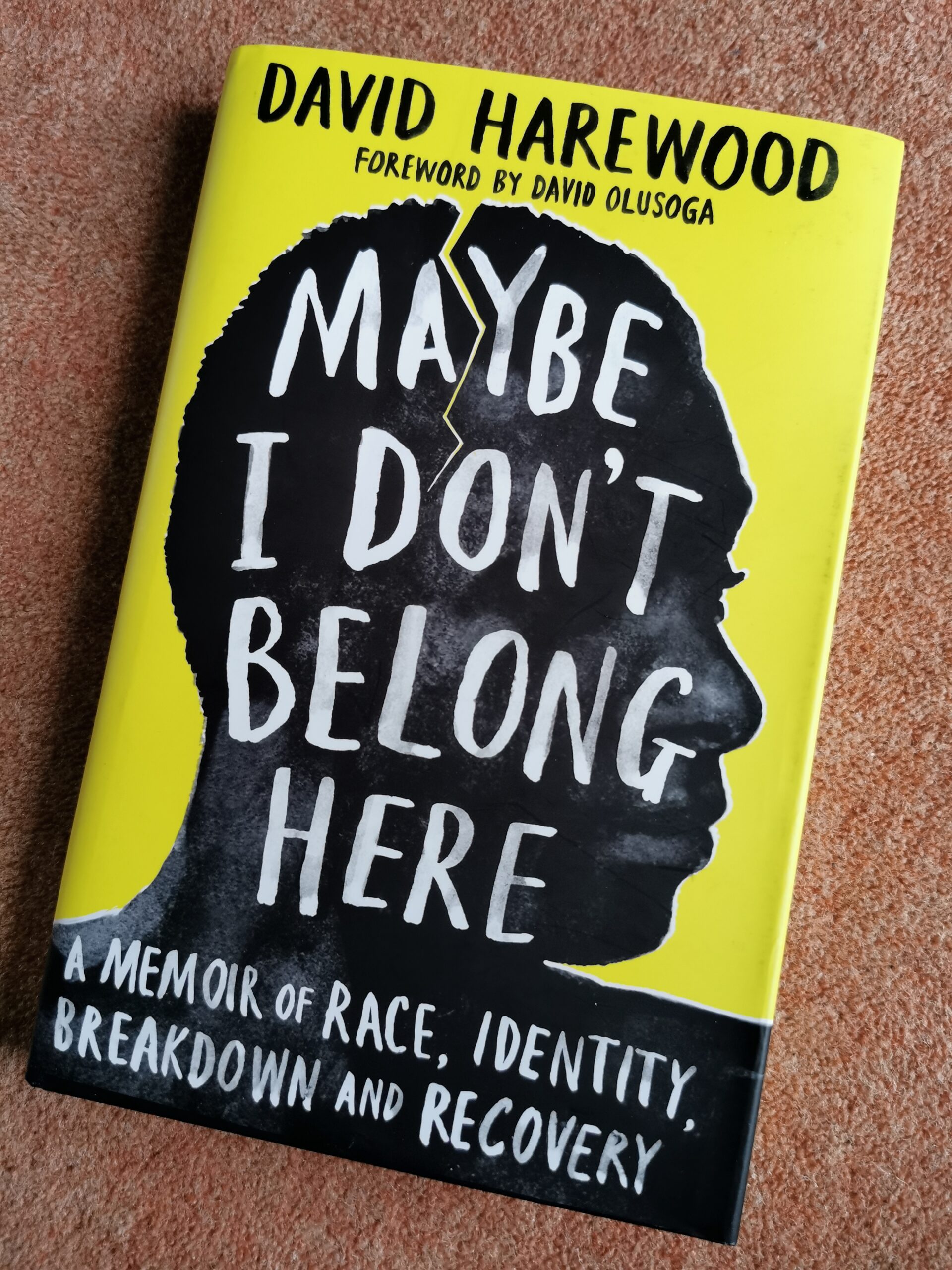
Maybe I Don’t Belong Here
I knew some of David Harewood’s work as a screen actor, though sadly not his stage work, but he really came into focus for me as a person when I watched his May 2019 documentary for the BBC, Psychosis and Me. I wasn’t alone in this, of course: the programme had and continues to have an impact even though, inexplicably, it isn’t currently available on iPlayer. When his book, Maybe I Don’t Belong Here, was announced, I ordered a copy right away. My hardback, first edition arrived in early September, then sat in my to-be-read pile until this week.
David’s book has its own – many – merits and I recommend it to anyone, without hesitation. But it had a lot of value to me as a 62-year-old White man, forcing me to consider – and reconsider – my own life. That’s what this post is about.
***
I’m a 50s kid by the skin of my teeth, born in late 1959. I grew up in Derby in the East Midlands of England until March 1969 when we moved to East Kilbride, just south of Glasgow, Scotland.
My recollection of my 1960s was that it was entirely White. Of course, I was child and didn’t know what was happening in workplaces or in the town (as it then was) more generally, but I can’t remember any Black or Asian faces at school or at Cubs or anywhere else. I don’t really remember Black or Asian faces on TV or at the cinema either at that time. Derek Griffiths, whom I remember from Play School and Play Away, didn’t appear there until 1971, though he was in Please Sir! In 1968 according to the internet. I now know that Man From The Sun aired in 1956 looking at issues of immigration and discrimination post-Windrush, and Barbara Blake was a reporter for Thames TV News in the late 60s – but I had to go and look them up.
There must have been more. As well as Man From The Sun, racial issues in post-WW2 UK were certainly present elsewhere in the arts, for example in Colin MacInnes’s novels (Absolute Beginners was published the year I was born) and, notoriously, on Til Death Us Do Part, a programme so popular that I guess many of the audience didn’t realise that Johnny Speight created the monstrous Alf Garnett as a figure of satire. Only as I grew older did I find out more about what was happening in the USA at the time.
I couldn’t find any analysis online prior to writing this, but I think that it’s significant that I left Derby in 1969, prior to the immigration that happened into the Midlands from around that time. I do remember visiting the now city of Derby in the in seventies and being struck by the number of non-white faces.
East Kilbride had its own challenges. The West of Scotland was and remains a very different place to the East Midlands. At least in the 1970s, the cultural divides were strongly sectarian rather than overtly racial (unless you were Irish). The sectarian divide operated, and perhaps still does, as a variable independent of class. We didn’t see it in our new council house, but the peripheral schemes of Glasgow had shocking levels of poverty and deprivation, perpetuating a health divide that certainly continues to the present.
East Kilbride was also, though, overwhelmingly White. The first non-white faces I remember from high school came in 1972 following Idi Amin’s expulsion of Asians from Uganda. Later, we had a French teacher from Nigeria. By this time there were far more non-White faces in popular culture, though they mainly only impinged on me from American TV shows (such as Antonio Fargas in Starsky and Hutch) or through music – funk, disco, and reggae, in amongst the progressive rock.
I could go on through University and my working life, but my key point is that in my 62 years I have had almost no personal interaction with people of Afro-Caribbean descent (as opposed to Asian) in the UK, and I am an educated man who was involved in professional undertakings. Nor have I led a particularly sheltered life, my tendency to introversion notwithstanding.
In the past, I’ve put this down to a quirk of my age and the slipperiness of demographics. What David’s book suggested to me is that it could also be because the White spaces where I am most often found are not necessarily places where non-White people would have any inclination to go.
***
There is another reason David’s book resonated deeply with me. His book sat in my tbr pile for two and a half months because I’ve been busy. I’ve spent a lot of this year revising two novels to be published during 2022. One of the characters is Constance/Connie Williams, an 18/19 year-old Black girl from Swindon. I had an interesting conversation with my editor who wondered why I had ‘made’ her Black, but the truth is I didn’t – that’s not how it works for me. I knew she was Black from the moment I met her, the evening she manifested herself on the page as I wrote the first novel.
I then had a problem. The first novel, The Raven and the Hart, is told first person by a (White) priest on the verge of retiring and Connie is seen through her eyes as a bright, brave girl. But I knew I had made the acquaintance of a good character in Connie, and I wanted to tell more of her story. I didn’t see how I could, though, given the differences between us, and I certainly didn’t want to write a surrogate white character. So I shelved the idea.
But stories have a way of insinuating themselves and demanding to be told. In the second novel, The Magpie Rhyme, Connie is coming to terms with the supernatural, but racism is one of the themes of the story and I was acutely self-conscious when writing the first draft that I had to do her justice, write her honestly and avoid stereotyping. In some ways I was, perhaps, too restrained. I have arranged for a sensitivity read of the manuscript once this draft is complete. What David’s book has done is to point me to places where I have to do more with this draft, particularly the notion of ‘navigating White spaces,’ not in a heavy-handed way, but as part of her learned reality.
The key thing is that the reader must hear Constance’s voice and interact with her, and not with me. Especially for the non-White reader, Constance’s voice has to ring true – as true as David’s does in Maybe I Don’t Belong Here.
Psychosis and Me is unavailable, but this extended interview is online.
Recent Comments