Jan 29, 2018 | Dead Water
New Scientist carried an article in its 20 January edition by Laura Spinney, looking at notions that western civilisation is “starting to crumble” (NS 3161, p29). The leader column (p.5), downplayed the claims, but also made the point that we should treat them seriously, and that is impeded by the politicisation of them. NS suggests one of the problems of the climate change debate is that the degree of politicisation has turned it into a facet of a culture war. That seems to me to be a fair warning.
I thought of that article when I saw, in today’s Guardian [29 January] a lengthy piece by Bruno Maçães called At the Crossroads of the New Silk Road in which he asserts:
We live in one of those rare moments in history when the political and economic axis of the world is shifting. Four or five centuries ago, it shifted towards the west. Europe, for so much of its history a quiet backwater, came to rule practically the whole globe.
Now this axis is shifting east.
Maçães, who has a new book out on the subject, states this to be the context in which to understand China’s Belt and Road initiative, the full scope and ambition of which seems to me not to be well enough understood here in the UK. Although there are dangers in identifying specific initiatives with suggested ebbs and flows in the tide of history, especially when one is living in the midst of them, this rings true to me.
Where I’m not so sure about Maçães’s argument is his assertion that:
Let us forgo the more spectacular pronouncements and settle on a compromise: this century will not be Asian, but neither will it be European or American, as the previous 300 or 400 years so clearly were. I suggest the alternative of “Eurasian” as a way of signalling this new balance between the two poles. It is increasingly a composite world – as Eurasia itself is a composite word – where very different visions of political order are intermixed and forced to live together.
I suspect that is too optimistic about the extent that the European end of the deal can get its act together in the short to medium term in the face of a resurgent and confident Asia. Be that as it may, it is more bad news for the UK. The rail infrastructure that forms part of Belt and Road certainly wends its way to Britain, but, as the axis shifts east, the route comes right through the European block which we are leaving, putting our competitors between us and China both physically and metaphorically.
The idiots in our Government can rattle on all they like about striking new deals on our own terms, but we are not only ceding influence, we are actively colluding in our own irrelevance.
Jan 28, 2018 | Music

Hannah Peel
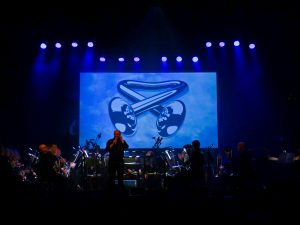
I only had tickets for one Celtic Connections event this year, Hannah Peel and Tubular Brass at Glasgow’s Old Fruitmarket.
I knew Tubular Brass from when it was released; the idea of working Mike Oldfield’s classic for an expanded brass ensemble struck me at first as a novelty; then I heard it.
It’s based partly on the original album and partly on David Bedford’s orchestral arrangement, but scored for the strengths and dynamics of brass instruments. It works brilliantly, and is obviously a labour of love by Sandy Smith.
It was entertaining to look around the audience to see so many of us of a certain age, who remember Tubular Bells from schooldays. At least four of us still had the hair to show for it 🙂 It is a strange piece of music (I remember our chemistry teacher disparaging it in class). One of the odd things is that part two (or side two) hangs together better as a piece of music, but it is the first part that contains most of the memorable themes and riffs. I need to listen to the original again.
The concert opened with Mary Casio: Journey to Cassiopeia, composed for synths and brass band by Hannah Peel. I have the CD and was looking forward to hearing the suite live. It didn’t disappoint.
I’m old enough not to be frightened by the notion of a concept album, and as concepts go this is a beauty: an elderly woman in Barnsley dreams of flying to the stars, and the seven pieces reflect aspects of the journey. It ends, in The Planet of Passed Souls, with a recording of Peel’s grandfather as a boy soprano in Manchester in 1927. I really enjoyed the performance.
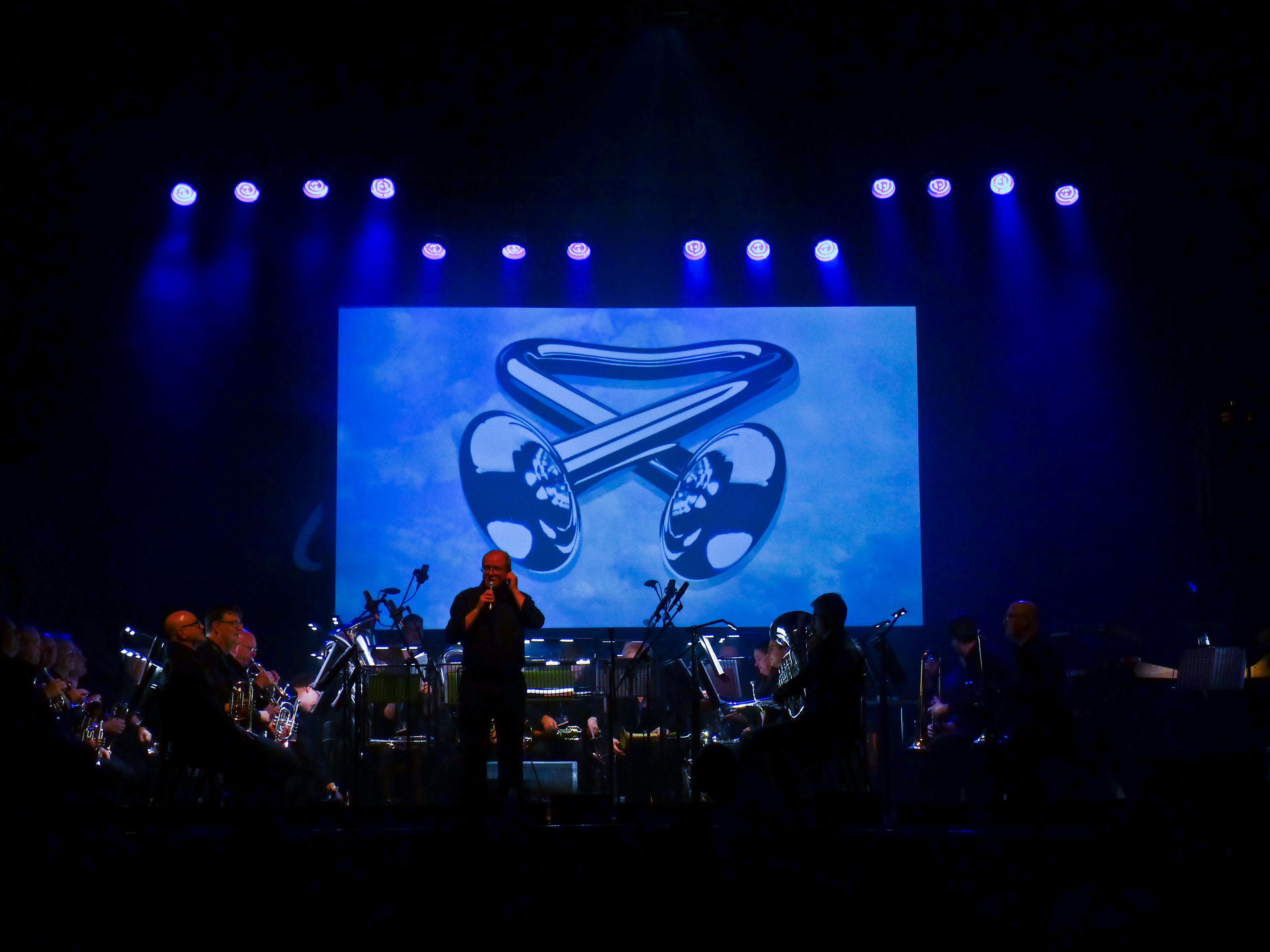
Tubular Brass
I’ve seen a number of things online where Peel is referenced with Delia Derbyshire, and this kind of irritates me, not because Peel isn’t good, but because I think it’s a lazy reference point (woman, electronica: let’s reference Delia.) Delia’s principle influence was Musique Concrete, coupled with her own compositional skills and mathematical gifts. At least until White Noise with Brian Hodgson and David Vorhaus, she worked with manipulation of tape rather than early synths.
I love Delia’s work, but feel Peel deserves better than a lazy comparator given the impressive body of work of her own she is building. It struck me during Deep Space Cluster, for example, that Phillip Glass’s music for Koyaanisqatsi would be a better reference point.
This was the first time I’d been at The Old Fruitmarket and sat down–both shows I’d seen there previously were all-standing. The Old Fruitmarket is long and tall with a PA at one end. I asked the soundman where the sweet spot was, and found myself pretty much in the centre of the hall as opposed to standing at the front. This was fine for Tubular Brass, because the sound of a brass ensemble is a sui generis thing. During Hannah Peel’s performance, though, I missed some of the immersion I get from listening to the CD on headphones, and I think it was because some of the dynamic range was lost in the venue. I noted during Andromeda M31 that it could have done with a couple of monster bass cabinets to really drive the deeper synth tones, or even some element of surround sound, difficult as that might be to achieve. This isn’t to find fault with the performance, just the way the acoustics work in that particular room.
All that aside, a grand night out, and I look forward to them coming round again.
Jan 25, 2018 | Goggle-eyes, Writing
All quiet since my last. Aside from the day job, I’m 39,000 words into the first draft of the novel I’m writing. it’s nothing like I originally thought it might be, but that’s OK and I’m enjoying myself.
I have kept myself entertained with several movies. I mentioned last time Bladerunner 2049 and various versions of Ghost in the Shell (I watched the undubbed Japanese version too, with subtitles) and I will write about them sometime. I’ve also finally watched Thor: Ragnarok, which I thought was great entertainment, and The Shape of Water, which is just wonderful. The Thor movie was pretty much the first of the Marvel movies, with the possible exception of Dr Strange, to remind me of the comics that it was based on.
The only TV I’ve watched is David Olusoga’s “A House Through Time” on BBC (should be on iPlayer) and it has been excellent.
Jan 8, 2018 | Biopsy, Dead Water
3 conversations with medical professionals:
DENTIST: Have you checked with your doctor about that? Probably isn’t anything.
DOCTOR: Probably nothing, but I’ll get a dermatologist to have a look.
DERMATOLOGIST: Nothing to worry about, but we’ll schedule a biopsy anyway.
*
I spent a lazy Sunday watching three films linked by similar themes:
- Bladerunner 2049
- Ghost in the Shell (1995)
- Ghost in the Shell (2017)
I feel a longer post coming on, but I’m going to give them all a second watch before I do
Jan 4, 2018 | Uncategorized
When I was a student the first time round, a significant figure in my life was Gianfranco Tellini, the college Vice Principal. I don’t honestly remember much about that period in my life, though I get flashbacks now and then, but getting to know Gian and his family was a delight. In my final years at University, 1980-82, I took Gian’s classes in Liturgy for two years, and my Honours dissertation was on Baptism considered anthropologically as an initiation rite, with him as my tutor.
Gian was originally from Trieste, and was a Roman Catholic priest before converting to Anglicanism and marrying Clare. He was many things in his life, including (if my memory is correct) a Vatican adviser on Eastern liturgies; but, my lasting memories are of friendship, discussing science fiction, his lessons on how to drink vodka in the Polish style, playing the devil’s music on an old guitar he had in his apartment, and a way of thinking about myth and ritual that has never left me.
I’ve also never forgotten, but never managed to replicate, the ferocious coffee brewed in the traditional Turkish style in a small copper pot over a calor gas burner in his small study, the grounds being settled by adding a touch of rose water (or the afternoon we beat a hasty exit from his office when the calor gas container started leaking.)
The last time I was in touch with Gian was 5 years ago when we had a brief email exchange touching on patterns in Celtic Christianity, and how the communion rail in the 4th century church (ecclesia plebana) of Old Muggia near his native Trieste is decorated with a frieze that could have been taken from the Book of Kells.
I’m currently writing a story that has deep origins in my memory of elements of Gian’s teaching, and I was looking through my old class notes just this week. I decided to drop him another line to keep in touch and pick up on a half-remembered theme, but I found out yesterday that Gian died on 23 November 2017, aged 81.
Although we had been only in sporadic contact, I will treasure his final words to me in his last email: So glad to have heard from you. It is nice to hear again from a friend.
RIP
Recent Comments