Respectable Horror
Available now via amazon.com and amazon.co.uk
Available now via amazon.com and amazon.co.uk
I went back on FaceBook last week; as I said there, it was purely for self-promotion because of Respectable Horror.
It’s been interesting to dip my toes back in, and advertising the book there certainly drew a response. However the main reason I left, the pollution of my newsfeed by increasingly toxic and/or moronic political stuff, has not abated one whit; in fact it seems worse, although it may be that by being away I’m more sensitised to it on my return.
So I’ll be turning it off again soon.
I’m keeping away from Twitter at present too. I like the immediacy of Twitter, and its liveliness, but it is also a cesspool of horribleness to rival even the awfulness of BTL comments in Newspapers (and YouTube). The idiotic stirring of the pot on Scottish Independence has ramped up the stupids even more, so I’m restricting the time I spent there to dipping in every so often to get a flavour, then going and doing something more wholesome instead.
I ought to be writing, of course, and I need to refocus on that.
A couple of posts ago, I mentioned Once More With Feeling, the magnificent 6th season episode of Buffy the Vampire Slayer. I’ve been asked a couple of times since then why I like the episode so much, and this is my explanation.
Soliloquies in Song
Off the top of my head, I can only think of three TV dramas in which the characters sing where it has worked: the communal singing of The Pogues’ The Body of An American at funerals in The Wire; the cast singing of 4-Non Blondes What’s Up in Sense8; and Once More With Feeling. The common factor in all three is that the singing was integral to plot and character.
Of these, Once More With Feeling is the greatest.
All the world’s a stage…
If characters are to be more than cyphers, they must have depth and an inner life, and it is the inner life that has to be conveyed to the audience. There are many accepted ways of doing this, from “show don’t tell” techniques, to characters saying what they think out loud or into diaries or letters, to characters giving insights into each other.
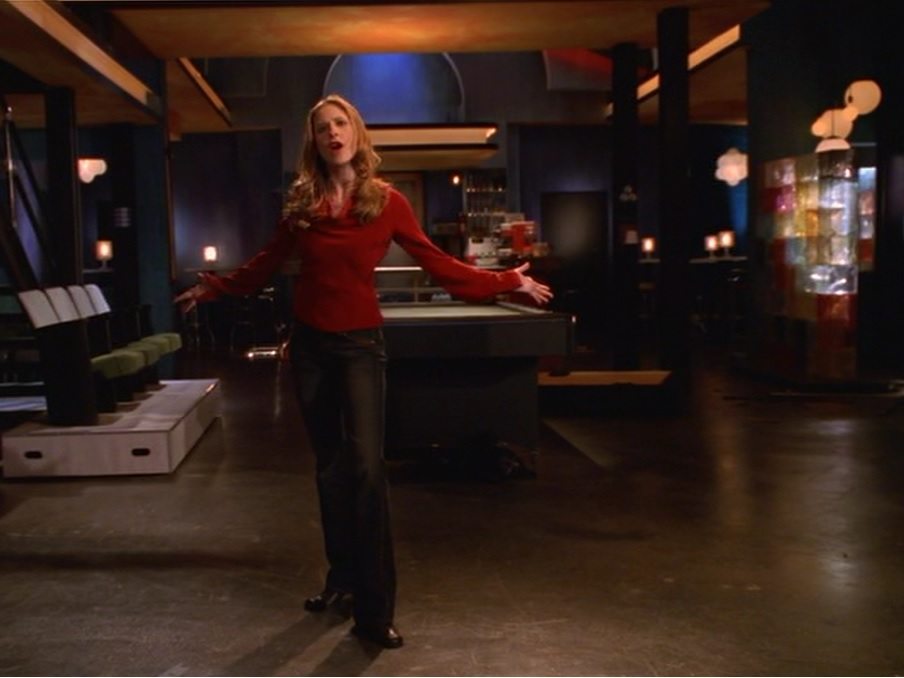
In theatre a character may well break into a soliloquy, speaking directly to the audience. Life’s a show and we all play our parts, sings Buffy, echoing As You Like It (All the world’s a stage, and all the men and women merely players…)/and when the music starts, we open up our hearts… So we are dealing with theatre, and soliloquy.
In Once More With Feeling the core McGuffin is that a demon forces characters to reveal their innermost secrets and fears as soliloquies in song. The genius of the script is that it takes the undercurrents of previous episodes and, through the cathartic and involuntary revelation of painful truths, triggers the unfolding of the remaining episodes of season 6, rippling through into season 7.
Once More With Feeling is not a novelty musical interlude: it is the pivot on which season 6 turns in terms of character and plot. And it isn’t forced; within the mythos of the Buffyverse, the McGuffin makes sense. The characters realise what is happening and react against it; “That was disturbing, says Xander after I’ve Got a Feeling/Bunnies/If We’re Together.” “I’m just worried this whole session is going to turn into a training montage from an eighties movie,” says Buffy; “Well, if we hear any inspirational power chords we’ll just lie down until they go away,” replies Giles. “It’s getting eerie, what’s this cheery singing all about?” sing Willow, Tara and Anya.
Soliloquies are a device to breach and bridge the divide between character and audience, something else not lost on the script: “And you can sing along,” sings Buffy, looking knowingly through the camera at the audience; “I felt like we were being watched, like a wall was missing from our apartment, like there were only three walls, no fourth wall,” says Anya, going all meta on us.
Songs and Characters
Of course the songs have to work, and they do. They cover a lot of styles, but lyrically and musically they are beautifully constructed, even if they use a few old tricks, such as “Walk Through The Fire” having the characters musing in a minor key (Dm) before transitioning to the relative major (F) for the power-chorus. It pulls a similar move with the bridge, hitting the major chords and a three chord trick for the emotional resolution ((C) We’ll see this through, it’s what we’re (Bb) always here to do, and we will (F) walk (C) through the (Bb) fire). “Something to Sing About” pedals from Bm to Bm(dim), a deliberately unsettling motif for Buffy’s big reveal.
And the songs intersect lyrically, sometimes reversing what you think the initial meaning is (the ambiguity of Under Your Spell) or commenting on inner turmoil: What can’t we do if we’re together, sings Tara in the harmonies of Walk Through The Fire, throwing Buffy’s own words back at her, as does Dawn later, repeating a line from the season 5 closing episode; Going through the motions, walking through the part, sings Buffy in the same song, repeating words from her opening number.
Because each song is in essence a soliloquy, except for the first part of I’ve Got a Theory, it must tie to and reveal aspects of the character performing it. Every single song hits the mark in this respect.
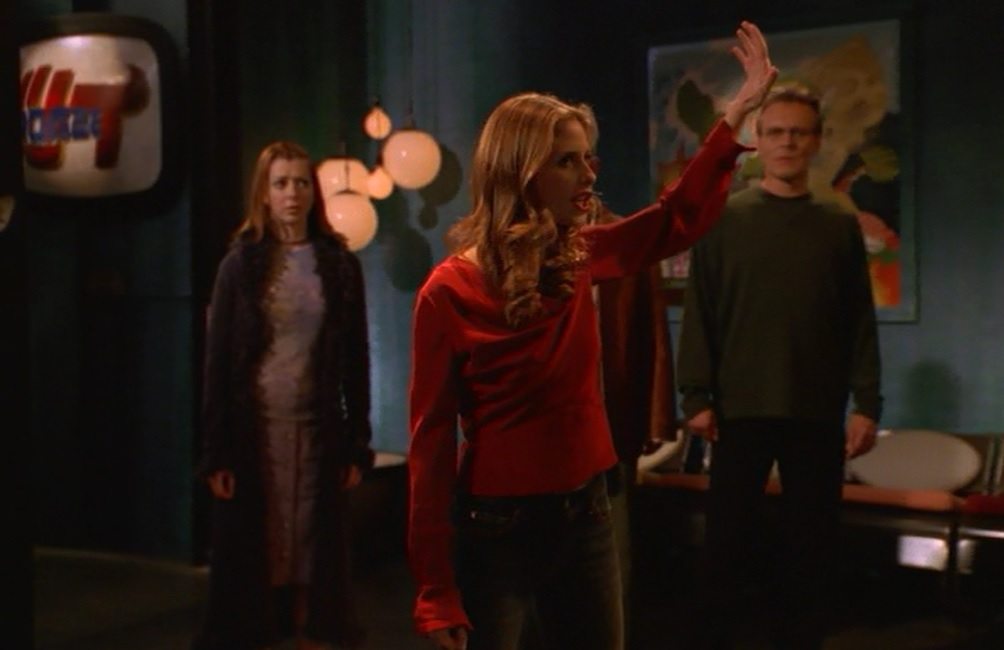
Secrets and lies
A final word on Sarah Michelle Gellar. A lot is made in commentary on this episode of the strength of, particularly, Amber Benson and Anthony Stewart Head’s voices (Emma Caulfield should be added to that list as well I think). I agree. What is less often noted is that SMG had to deliver 4 key songs (Going Through the Motions, If We’re Together, Walk Through the Fire, and Something to Sing About). She lands every one with the force and precision of Buffy kicking down a door. SMG’s performance in this episode is astonishing; she had a hard time with the episode because she never held herself out to be a singer or dancer. It doesn’t matter, because we don’t hear the voice of SMG in the songs, we hear the authentic voice of Buffy Anne Summers.
And that performance, to carry the episode, is the catalyst that raises it into the ranks of the extraordinary.
Buffy
After my previous post, Lindsay suggested I could probably complete a Buffy DVD collection just by visiting our local charity shops. I went for a walk at lunchtime, and whatdyaknow? Each season at £5 a pop.
I pondered long and hard, but in the end succumbed to seasons 5, 6 and 7, thinking all 7 seasons would be a time vampire, in a way that only 66 episodes won’t be…
Anyway, I had a couple of episodes playing in the office in the early afternoon in the background, resisting the temptation to dive in head first. I did watch the last ever episode over lunch though, reminding myself how neatly it tied things up (yes, I know there was a season 8 published, but I wasn’t that taken by it).
But then late tonight I thought I’d watch a couple of episodes of season 5 only to find the DVDs in that particular boxed set were Region 1, which was kinda sucky. Happily, although Windows Media player threw a hissy, VLC played the DVD without a problem. So big thanks to VLC and Lindsay.
Once More With Feeling
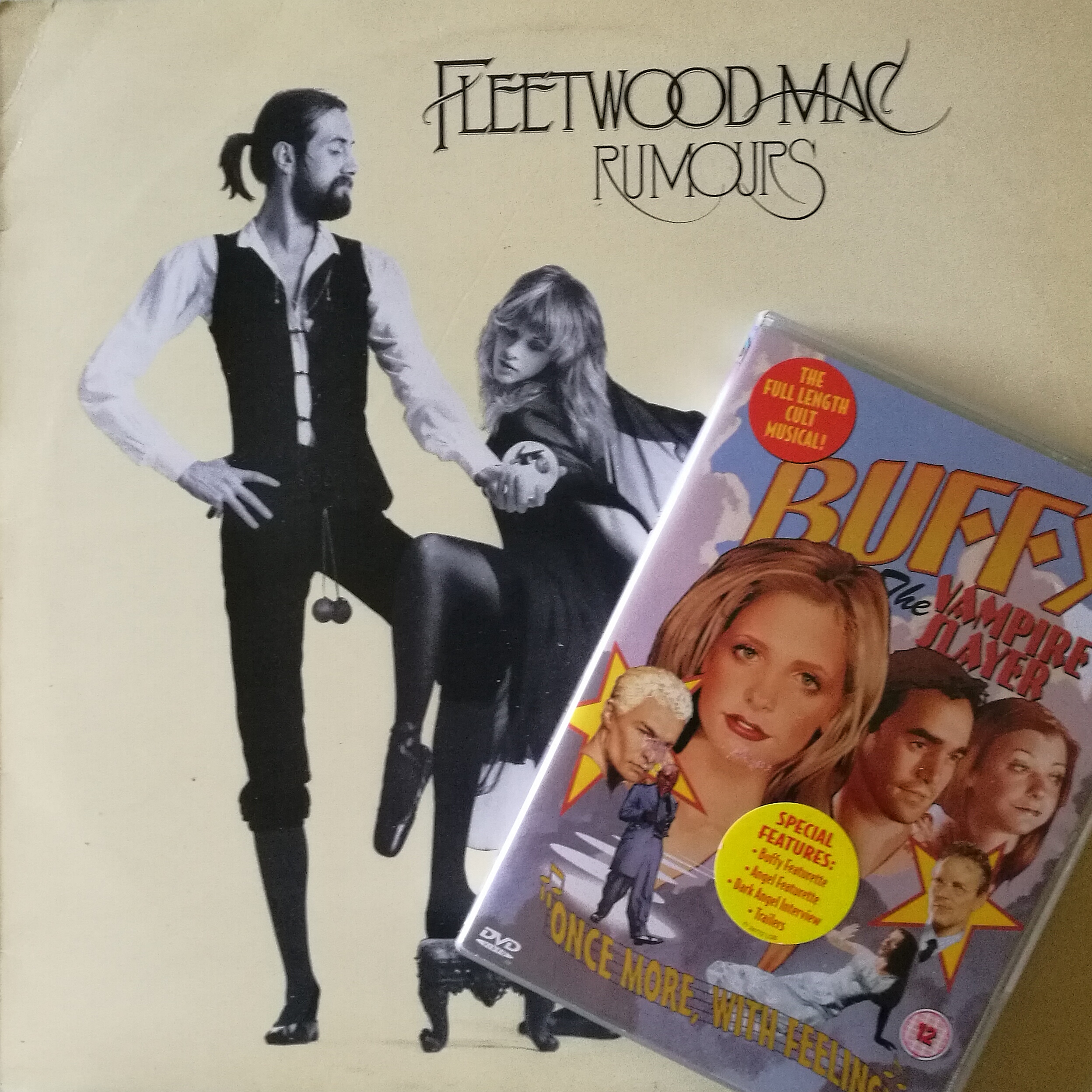
A couple of anniversaries have been on my mind: Rumours is now 40 years old; Buffy the Vampire Slayer hit TV screens 20 years ago. I’m sort of depressed in both cases that things so fresh in my memory have acquired such a weight of years.
I have vivid memories of buying 3 copies of Rumours from Listen records in East Kilbride at Christmas 1977, one for myself and 2 for presents. For a while the album became ubiquitous to the point of cliché, and The Chain is forever associated with Formula 1 (though it may be claimed shortly by Guardians of the Galaxy 2). As often happens, its ubiquity masks its excellence and the qualities that elevated its status in the first place are overlooked: great songs and musicianship (John McVie’s bass on Go Your Own Way–wow!), expertly put together.
And, 40 years on, I can still sing along with every song. Rumours survives because it works and connects and has weathered every change in the musical weather of the last 40 years. Lindy effect, anyone?

I want the fire back
To mark the Buffy anniversary, I’ve re-watched the frankly magnificent musical episode Once More With Feeling more times than a sensible person would think reasonable. In part this is because, since I ditched a load of VHS tapes, it is the only episode I still own (on DVD); but I would watch it anyway because, in a full field, it is probably my favourite of them all.
Rewatching it has been a treat for all sorts of reasons. Distance brings perspective. The songs are all still great, but better is that it isn’t, in one sense, a standalone “musical episode”: it is a normal episode that just happens to have an oratorio and score.
And it wasn’t until this rewatch I became aware of just how effortlessly Emma Caulfield (Anya) steals every scene she’s in.
Sarah Michelle Gellar, though she didn’t really want to make the episode, committed to it wholeheartedly, as did all the cast, and turns in a fabulous performance, including probably my favourite of the songs: Walk Through the Fire.
In other news: Respectable Horror is out today. My story The Estate of Edward Moorehouse leads it off. Buy it on Amazon!
And finally, Nicola Sturgeon was stirring the pot of IndyRef2 today. Idiot. As Buffy would say, a world of No!

Recent Comments