And the winner is – er….
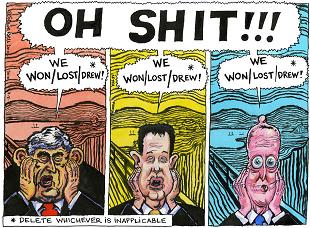 Back in June 2007 I wrote this
27 June 2007
I have written here in the past about my wish for Tony Blair to resign: I had thought that it would be forced upon him with the death of David Kelly and the persistent exposure of the falsehoods told with respect to the invasion of Iraq but he staggered on and he has finally gone at a time more or less of his own choosing. I continue to adhere to the view that ongoing tragedy of Iraq is the poison which has laid him low and is the septic boil which has had to be lanced. This is not to forget or deny his achievements in dragging the country out of the mire of eighteen years of Thatcher and Major and his persistence in pushing through change in Northern Ireland, nor to deny the memory of the spring in my step on the day that Labour came to office on 2 May 1997.
And so to Gordon Brown. He has a habit of not being visible when things haven’t been going so well and his ascendancy to Prime Ministerial office is overshadowed both by his longstanding support for Iraq and his insistence on pursuing quasi-privatisation policies in public sector reform which have simultaneously failed to deliver improvement while piling on un-necessary costs. It may be that freed from the shackles of following he will stand revealed as a genuinely reforming leader: I hope so, but I doubt it. We shall see.
And here we are three years on and the great British electorate have spoken. Unfortunately they mumbled.
There is an irony to the discussions and analyses which have filled the airwaves today. One of the key themes which has emerged has been that of electoral reform. By this is meant a shift away from “first past the post” towards some form of proportional representation. Now this would have consequences for a number of things including the way in which we have to think about electoral calculations in the situation where no party is a clear “winner” (which is the automatic consequence of proportional representation). In fact we have to consider the very notion of “winner”.
 Mr. Clegg has taken a principled stand in that he is speaking first to the party which has gained the most seats and the largest share of the vote. This is honourable but tacitly denies the real-politick of PR – which rewards the groupings which can make a deal, not the ones with the most votes or seats. It is, after all, another party which lost seats which is now cast in the role of kingmakers.
I listened to Any Questions on Radio 4 this evening and was quite taken by the very civilised – very British – way in which the interplay of arithmetic and morality was discussed with great seriousness and sincerity but in the end – for those who believe in PR – the issue is not ethical but arithmetical.
For myself I am ambivalent about PR. I last thought about it in any depth when I was studying Constitutional Law some years ago. Perhaps I should find my essay to remind me what I think!
I am getting irritated as well by the notion that “the public has spoken” (see above!). The fact is that there is not a homogeneous “public” which speaks in some spooky gestalt tones. Several million people cast their votes as they saw fit for reasons which seemed to be reasonable to them at the time. And that’s it.
Recent Comments