It’s unusual for me to become invested in a TV series—I don’t watch much TV at the best of times, and more often than not I’m playing catch up on the internet. Recent exceptions have been Game of Thrones and Penny Dreadful, as well as old favourites like Dr. Who.
Three series are on my watch list at the moment; two of them are very good but follow a traditional episodic pattern—Agent Carter and The Expanse, both of which I enjoy very much. However, in both cases it’s because I like them as stories that I’m caught up in them, together with the excellent casting and acting.
The third is somewhat different. I realised that I had been seeing Tuppence Middleton a lot recently, beginning with Jupiter Ascending, which I originally disliked but enjoyed more on a second viewing. I read a profile of her in the Guardian that mentioned that she was starring in a Netflix show co-written and produced by J Michael Straczynski and the Wachowskis called Sense8. Curious, I went and had a look.

sense8
Sense8 is the first show in a very long time with which my engagement is not just intellectual but emotional: I really want to know what is going to happen with these characters. It is also one of the few examples of true science fiction, rather than space-opera, I can remember for a long time: the scientific McGuffin of it forms part of the core metaphor underpinning the whole narrative.
I won’t post major spoilers here in case some of you want to go and watch the programme (which I basically did as a binge-watch and then rewatched obsessively), but there are some spoilery bits below, so consider yourself warned if that’s your thing.
Sense8 is conceived, like JMS’s Babylon 5, as a story told long-form. Given that Babylon 5 is one of my favourite programmes ever, partly because of the way the trivial stuff in Season 1 suddenly exploded in Seasons 3 and 4, I took that as a good sign. Apparently Netflix only sent the first 3 episodes out to reviewers and this caused some early poor reviews: there were complaints that people couldn’t work out what was going on (nonsense by the way, but there we are). The thing is, with the long-form approach used, the viewer was working out what was happening at the same pace as the characters who were equally confused. Also, although it is somewhat episodic for presentational reasons, it is also novelistic in that it is conceived as a whole.
Ironically enough, it is in Episode 4, titled What’s Going On? that it all comes together for the psychically-linked lead characters (in San Francisco, Chicago, London, Berlin, Mumbai, Nairobi, Seoul and Mexico) in a magnificent and surprising way, around a 4 Non-Blondes song (the perfect soundtrack for a lobotomy, as Amanita comments) in a sequence that begins at around 43 minutes in. From that moment on, the show does not look back (the clip below is only part of the sequence, which runs for 8 minutes or so).
However, the scene/sequence that, for me, defines what the show is about is in Episode 9, Death Doesn’t Let You Say Goodbye, introduced by a melancholy piano-reading of Mad World by Marius Furche.
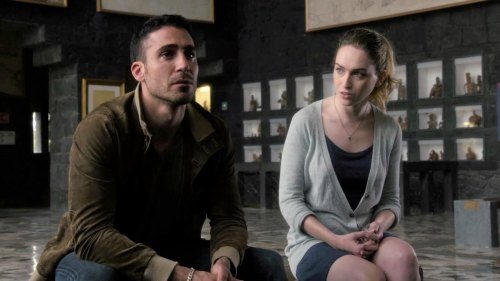
Lito and Nomi
The scene opens, around the 21 minute mark, with Lito (Miguel Angel Silvestre) in the Diego Rivera Museum in Mexico, mourning the breakup with his partner Hernando. Lito recalls their first meeting there, and Hernando’s monologue on Love and Art, both of which, he says, are uncontrolled and must be free. He joins with Nomi (Jamie Clayton). The scene shifts to Korea, where Sun (Doona Bae) is visited by her father who talks to her about Love and Truth, finding love and finding identity, and doing the right thing for love, the dilemma that confronts Lito.
The scene shifts back to Mexico, where the discussion turns to art that is not free, but is “pimped out” by banks and censored by authority. But, says Hernando, “fuck with art and you’ll get fucked by art”: and so, by metaphorical extension, fuck with Love and you’ll get fucked by Love–which is Lito’s story. This all leads up to a reflection by Nomi, who talks about bullying earlier in her life:
The real violence, the violence I realised was unforgivable, is the violence that we do to ourselves when we’re too afraid to be who we really are.
Love; Truth; Identity: A beautifully conceived and constructed sequence. It reads as rather precious on the page, but given what we have invested in the characters in the previous episodes, and the unflinching excellence of Silvestre and Clayton’s portrayals, the effect is to define one of the underlying premises of the show. For Lito, whose story has hitherto been characterised by the slightly comedic aspects of his position as a closeted telenovela actor in macho roles, his humanity and self-realisation come to the fore and his story turns completely on its head to become one of the strongest and most fully realised love-stories in the show (and the show is not without its love stories: Nomi and Amanita, Riley and Will, Kala and Wolfgang).
I have only begun to touch on what I like about this show. For example I like the way each individual’s story is told in its own style—telenovela, Euro-tech thriller, a splash of Bollywood—but never loses its overall thematic unity; I loved the horse in the school (really, I grinned from ear to ear); I love how it is performing a “show don’t tell” on what I believe is one of Lana Wachowski’s personal tenets of faith: we should be responsible to and for each other. The acting is unswervingly excellent by the whole cast, including Tuppence Middleton who is both luminous and tragic as Riley.

Riley Blue (Tuppence Middleton)
And there is an extraordinary scene featuring all the principle players remembering their own births while Riley’s father performs Beethoven’s Piano Concerto No 5 on stage in Reykjavik. The cinematography and music selection is fabulous throughout, and, although I may have given the impression of seriousness above, there is a playfulness about the whole enterprise which charms. And was that a cheerful shout out to Team America: World Police in Episode 10?
Have I gushed?
The show attracted ‘mixed’ critical reaction, but it has a second season in production and I am one of many who simply can’t wait.
An edited version of the Lito/Nomi scene is embedded below (the full scene runs for nearly 13 minutes):

Recent Comments