Oh the joys: I reached a point with the writing that I recognised–I’ve been there before; the realisation that the previous few hundred words have taken me up a blind alley. There’s really only one solution: put the offending words into a separate file ‘just in case’ then delete them from the primary text.
That prompted me to look at the chronology of the story against a calendar. That wasn’t so much to put a structure on the plot as to keep me in line with some specific dates. For example, I realised that, logically, a chapter I’ve already written, and am quite content with, must take place during the Edinburgh Festival. That makes no difference to the story, but it adds a sentence of description to the text.
***
The blessed St. Jerry
Otherwise, I’ve spent a lot of today with the cd player on, reading. As I’ve said before, it keeps me happy but doesn’t make for a great blog. I did find the picture to the right, though, that I’ve been looking for for a while. I took it near Harvard Square in Cambridge MI in late 2010. You can probably guess what I’ve been listening to.
I’ve also mostly stayed off social media and news sites, so there hasn’t been much to irk me from that source.
However.
Three years ago, I had a rant here about Google searches (Just Google It). In it I wrote:
The notion of Google indexing pages, then searching the index and ranking results based on the pages most commonly linked to, as a proxy for accuracy or helpfulness, was a good one. But that was then. Now the internet is a sprawling thing, like a ragged old duvet draped over a cesspit. And the search algorithms are increasingly unhelpful as people game the system. Yes, I know the search companies try to correct for this, but the task is too large.
I was trying to find something very specific today, a historical search that shouldn’t have been difficult. Instead, the Google algorithm threw up pages and pages of frankly irrelevant shite. I tried, out of desperation really, to use some Boolean operators to control things; if anything, that made matters worse.
I don’t have much to say tonight, so I’ll just pick up some bits and pieces, two of which follow on from my post yesterday. I then finish off with some Grateful Dead talk and a John Coltrane piece, so those of a nervous disposition might want to look away now.
The first, to answer a question, probably tongue in cheek, by my friend Stuart in a comment, no I hadn’t had extra coffee when I wrote yesterday. I have a couple of cups over breakfast; any more than that and I risk migraines.
More seriously, I went out to the shops today and picked up the latest Private Eye. I spotted the paragraphs I’ve copied to the right. It says pretty much what I think, but in many fewer words 🙂
The trip to the shops was ‘interesting’ as they say. There were noticeably more masks/face coverings being worn, but, given that wearing them is about to become mandatory in shops in Scotland, there was still only around 50% usage. Are people holding out until 10 July?
***
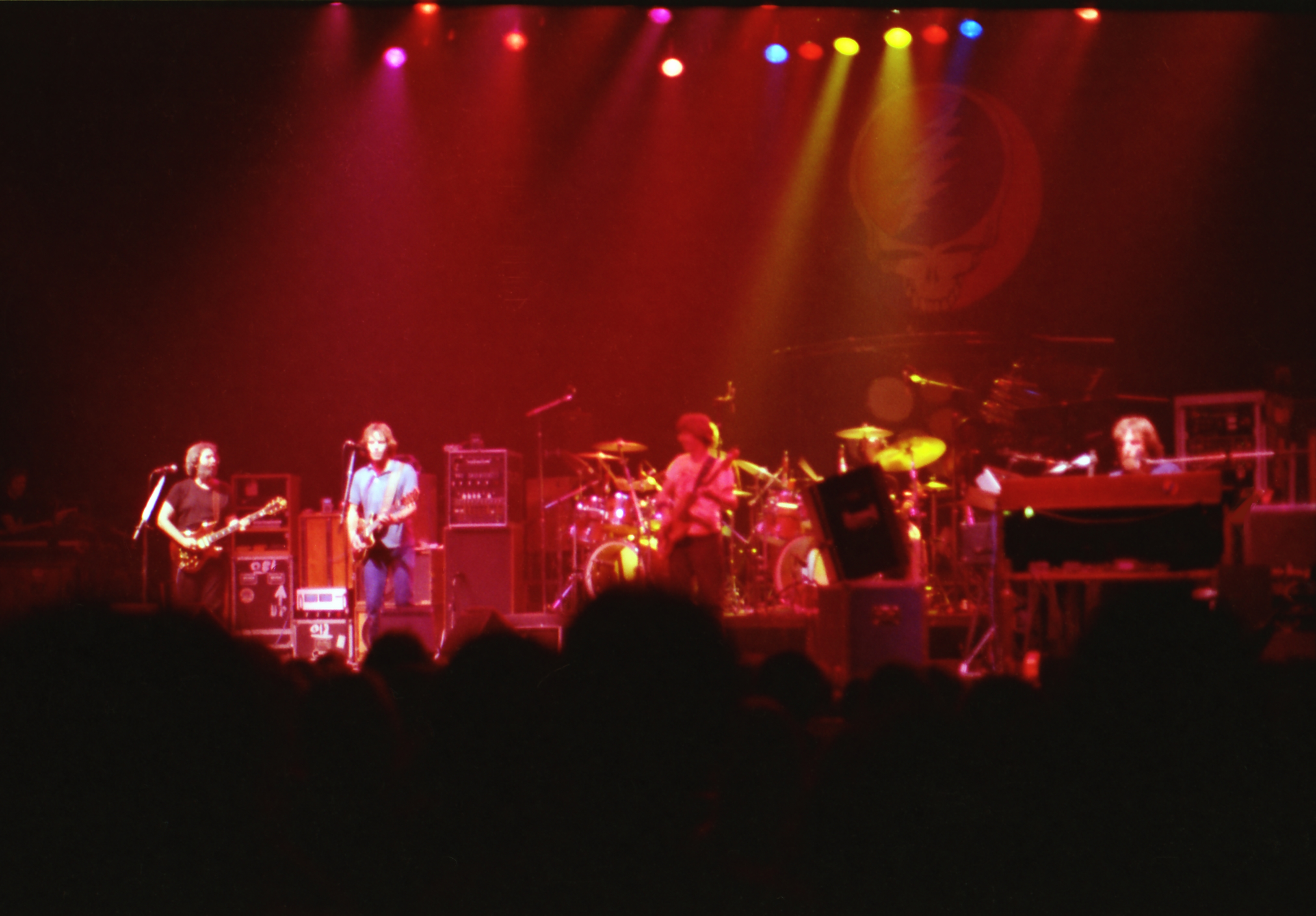
Much more prosaic and I dare say of niche interest only, I listened last night to a Grateful Dead show I’d never heard before. In itself that isn’t unusual: they played at least 2500 shows in their career. However, they only played four shows in 1975, the year they released my favourite of their albums, Blues For Allah. At Winterland in San Francisco on 17 June 1975, billed as Jerry Garcia and Friends, they played almost the whole album to an audience of Deadheads who’d never heard it before.
Several audience recordings are available on the Internet Archive and I listened to two of them. I was stunned by how tight and rehearsed they sounded. They played a 23-minute sequence that would thereafter become a standard until the end of their career: Help On The Way>Slipknot>Franklin’s Tower. It was utterly spellbinding, and I sat here in the kitchen with headphones on, wishing fervently I could have been there. Unusually, it was almost entirely instrumental because they hadn’t learned the words yet.
They also played a cracking version of Blues For Allah itself. They only played it live three times as far as I know. It is one of their most experimental pieces, and divides opinion.
Music. Someone I was chatting to on the internet a few days ago said he thought the Grateful Dead were really a jazz band who inadvertently played rock. I know what he meant but don’t agree. It is true, though, that they had a deep background in jazz, though more as listeners than players. Bob Weir based his approach to rhythm guitar on what McCoy Tyner played on piano for John Coltrane, Phil Lesh was a jazz fan from the late fifties onwards. At some point, they spent a lot of time listening to Coltrane’s Africa Brass, but that’s a bit hardcore for a Sunday night.
So here’s John Coltrane from late ’57 (released January 1958) when he was still playing bebop but on the cusp of developing his signature style. And what a cracker of a band he put together for the session:
John Coltrane – tenor saxophone
Lee Morgan – trumpet
Curtis Fuller – trombone
Kenny Drew – piano
Paul Chambers – bass
Philly Joe Jones – drums
It’s December 2018 and the Cosmic Surfer, pseudo-eponymous writer of this blog, is reading Jesse Jarnow’s Heads, A Biography of Psychedelic America. He found the book by way of a random tweet by Steve Silberman and downloaded it, legally, there and then–a sentence that would have been meaningless while the Surfer was growing up but is central to Jarnow’s tale.
As he reads he recognises elements of the unfolding story from other places, notably John Markoff’s What the Doormouse Said: How the Counterculture Shaped the Personal Computer Industry. Elements are also known to him by osmosis, strands absorbed through finger-contact with time, the obscure lore and hidden knowledge secreted by gatefold album sleeves. Most of it is new.
Deep into the book Jarnow tells the story of Jacaeber Kastor, out in the wilds of Mexico, at the source of the sacred peyote, tripping under the heavens when
suddenly the peyote is not only easy to find, it’s everywhere, veritably glowing like some strange seabed creature.
The Surfer remembers reading something like this not so long ago, of someone out on a Scottish hillside munching on Liberty Cap mushrooms, once hidden in the grass but suddenly ubiquitous, calling out to be picked and eaten. And the Surfer perceives a path through his memories, recollections of bands and music and connections flowing even to his screen name and the tag line of his blog, joined together in a kind of asynchronous mesh, temporally-challenged coincidences, or possibly nodes on hidden tendrils of mycelium-like interconnectivity.
And he finds himself thinking and blogging in the present historic tense deployed by Jarnow, and resolves to kick the habit before it takes a firmer grip.
***
I was born in late 1959, a child of the fifties by the skin of my teeth, missing out on sixties psychedelia by virtue of being too young. But when I started listening to music in the early seventies, I followed a well-worn path away from the singles charts to albums, catching the wave of mainly Brit bands coming out of the psychedelic underground and into the grey morning light of the seventies. I listened to as much as I could, and still have some of the records I bought then, but was conscious of being one of a small number who went looking for the (relatively) obscure. I didn’t always understand it, or even like it, but I knew I was listening to something qualitatively different. As symbolic a moment as any was when I first heard Roxy and Elsewhere by Zappa and the Mothers, though it could just as easily have been Court of the Crimson King or a Saucerful of Secrets or Camembert Electrique or Pawn Hearts or Tales From Topographic Oceans.
There was a drugs scene of a sort in East Kilbride as I got to my late teens and the seventies wheezed their way to their emergent Thatcherite conclusion. I wasn’t an enthusiast, though I did join in (Apocalypse Now on the big screen of the Sauchiehall Street Odeon while stoned? Sure thing). Most commonly available was what were called Moroccan, Lebanese or Pakistani cannabis resins, though their true provenance was always uncertain and they as likely came from an allotment in Sheffield. Several people I knew were enthusiastic tokers, and unlike Bill Clinton I did inhale, sometimes heroically, but I moved quickly onto cask-conditioned ale and whisky. I had reasons for this, one of which was observing my stoner acquaintances progressively flattening their personalities and intellects and consciously deciding I didn’t want to go there. The only time I was offered something more exotic, by someone in the music business, I declined.
But music was a constant, and from an early stage I was drawn to bands that appealed to me for reasons I couldn’t quite put a finger on. In the early days this was Syd Barrett-era Pink Floyd and Gong, but over the years has included the likes of Quintessence, Hawkwind, Ozric Tentacles, Banco de Gaia and Shpongle. What links them is, one way or another, psychedelics.
Meanwhile, out in the Mexican desert:
Jacaester leans back and watches the sky as the stars communicate with each other, shooting zaps from one light point to another, until all of a sudden one zaps earthward and hits Jacaester Kaster in the head. He feels it move down his spine and there it throbs.
Whoa, spooky! I wrote something similar in a story two or three years ago, Coyote in the Corner, using images that came into my head while writing; more asynchronous coincidence, more non-quantum entanglement. Moreover it reminds me a lot of Paramahansa Yogananda’s description of Kriya Yoga in Autobiography of a Yogi, the book that both inspired Tales From Topographic Oceans and led to me to quietly chant Om and attempt circular, continuous breathing in the gym, not that I’ve ever told anyone about that until now.
Jarnow builds his book around the story of the Grateful Dead and those who moved in their circle and afterwash. I only saw the Dead once and they were on average form, comparing badly to, say, Weather Report who I saw on sparkling, spellbinding form around the same time, giving every indication of actually having, you know, rehearsed. It took me a long time to appreciate the Dead, though I now listen to them more than any other band and this blog post was written to the accompaniment cd3 of Dick’s Picks Volume 4 and Fire On The Mountain Vol. 1.
Looking back, I don’t regret preferring good beer to toking and making choices that separated me from my acquaintances from those days (being careful with language there, I still have contact with friends). But of late I do regret that I didn’t find the time and safe space then to try psychedelics when I had opportunities. These days I don’t have the wherewithal and there is an ever present worry about what exactly one might be given. Also, as I approach 60 and manage blood pressure issues it might not be the most sensible thing to do.
Over on the Internet Archive, someone posted an edited version of the Grateful Dead’s Dark Star made up from 30 performances in 1972, including most of the European tour (looks like one of the Paris shows has been left off). It runs to 11 3/4 hours long and is mesmerising. It may be the perfect background music for a day in the office.
I said a couple of posts ago that I thought there were interesting documentaries to be made about the other members of the Grateful Dead aside from Jerry Garcia. Little did I know at least one such exists, and its a cracker. The Other One: The Long Strange Trip of Bob Weir.
I should have known. The first indication was probably my post of 1 January 2016. I wrote there:
Something odd has been happening to me lately: something unexpected, troubling almost. After 34 years of indifference I have been listening to the Grateful Dead. I say specifically 34 years because it was in September 1981 that I went to see the Dead play at Edinburgh Playhouse and came away feeling distinctly meh.
I have always liked some of their songs, notably Ripple and Truckin’ as well as covers I’ve heard of Friend of the Devil. I also like American Beauty as an album. But overall I’ve always found them too ramshackle and approximate to pay them any mind.
But for some reason I’ve had the opening of Friend of the Devil running through my head as an earworm for a couple of days. To exorcise it, I opened up Wake of the Flood on Spotify, and found myself enjoying it, especially the Weather Report suite.
I still don’t care much for their extended cosmic jams, and I much prefer Jerry Garcia’s bluegrass stuff with Peter Rowan et al, but I’m obviously mellowing in my middle years.
A couple of days after that, in a further post, I wrote:
Further to my last: after some listening on Spotify, I’ve concluded that I like the Grateful Dead’s albums that are more song based (say from Workingman’s Dead through to Blues for Allah), but don’t really get the extended jams, which don’t do much for me. Mind you, extended jams by just about anyone don’t do much for me. There may be other Dead albums I’d like, but I haven’t heard them yet.
Something has changed in the 18 months since then. Aside from listening to more of their albums, I’ve recently taken a deep dive into the Dead’s live archive and have been listening to them a lot. The proximate cause of this descent into madness was the Amazon documentary, but it’s nagged at me for a while that I ought to go further into how they made their name–as a live, improvising band.
So I did the obvious thing and searched for opinions on the best shows to listen to. This, I’ve discovered, is a rabbit warren of strongly held opinions, but you’ve got to start somewhere, right? Whatever, I came up with a list of 25 shows that seemed to be the ones most commonly mentioned (although someone will always crop up to contest the choices).
It will come as no surprise at all to any Deadheads reading this that heading the list was Barton Hall, Ithaca, 8 May 1977. I’ve also been listening to:
Buffalo, 9 May 1977
Boston, 2 April 1973
New Year 1982 (with Etta James and Tower of Power Horns)
Veneta, 27 Aug 1972, and
Winterland 9 June 1977
And… I’m a convert on the basis of just 6 of the 25 shows. I’m not deaf to the faults, especially the approximate qualities of the live vocals, but nonetheless I’m beguiled.
Grateful Dead: Edinburgh, September 1981
I need to add that, apart from the music, there are other aspects of the band that interest me. Some of this is their creative process itself, which I think I can use in writing (particularly first drafts), but also I find the band members themselves interesting as characters.
I commented in my previous post that I thought there were several films that could be made about the band that focused on people other than Jerry Garcia, and I’m reinforced in that view from the listening. To give only two examples: Phil Lesh is an articulate man and as interesting a musician as Garcia, and his autobiography is a fascinating insight into where he was coming from musically; and I am intrigued by Mickey Hart’s early and continuing interest in what we now call ‘World Music’ and as a musicologist.
So yeah, I guess I’m a newby Deadhead, and this is my coming out post.


Recent Comments