It’s been filthy weather today, just as it was overnight. You may have seen that Edinburgh made the papers this morning thanks to so-called ‘thundersnow’. The second of the peals of thunder woke me at around quarter to five, when it was still snowing, though turning to sleet. A pair of foxes were scampering along the street at the same time, sticking to the middle of the road rather than investigating bins. I watched them chase each other into the weather.
Throughout the day, the rain had persisted down and, last time I looked, our back garden was waterlogged. As you might guess, this means I haven’t really done much today. I did consider starting a Star Wars marathon on the DVD player, but then I remembered that The Phantom Menace would mean Jar-Jar Binks, and I decided against it. You’ll find my thoughts from last time I attempted such a marathon (three years ago) here: Many Bothans Died To Bring You This Post, and my thoughts from a year ago on the most recent film here: The Recumbancy of Skywalker. I don’t mention Solo because I couldn’t finish it. I recently watched Star Wars : Rebels and thought it was pretty good, and The Mandalorian continues to be excellent.
My desert island Star Wars films continue to be Star Wars, The Last Jedi and Rogue One
***
Aside from making supper, then cleaning up afterwards, I haven’t done much else today, although I have made a dent in a new pile of unread magazines. I feel no guilt about this at all. Hibernation looms as a possibility.
***
Music: there can be only one. From the album Songs In The Key of 666, this is Swedish scamps Hellsongs with their lounge-metal cover of AC/DC’s Thunderstruck.
The latest in the Star Wars saga is a strange one. On the one hand I enjoyed it as a generic Star Wars movie, on the other it is deeply, deeply flawed. It reminded me of Avengers: Endgame in the sense that the spectacle was impressive, and it did have plenty of enjoyable sequences; but, in the end, it was more spectacle than substance. Like the prequels, I got the sense that there was a decent movie in there waiting to get out, but, in this case, it was smothered by fanservice.
Of course we’re dealing with Star Wars here, and, if cinemas full of 9 and 10 year olds around the world are happy, then mission accomplished. Star Wars is not Tarkovsky, and that’s fine. But still, I expected better.
None of this is to criticise the cast and crew who do a great job. It is to criticise JJ and his producers who have turned in, effectively, ultra-safe, corporate fanfiction. Coming after the thing of wonder that was The Last Jedi, that’s a shame.
What’s not there is revelation, mystery or genuine emotional danger. Nothing is at risk. The pictures are made to satisfy a specific set of demands, and they are designed as variations on a finite number of themes.
They are sequels in name but they are remakes in spirit, and everything in them is officially sanctioned because it can’t really be any other way. That’s the nature of modern film franchises: market-researched, audience-tested, vetted, modified, revetted and remodified until they’re ready for consumption.
That’s pretty much my overriding thought about The Rise of Skywalker. Maybe I’m overthinking it 🙂
Back in December 2017 I wrote, in connection with The Revenge of the Sith, that:
this is the one that suggests that Anakin is the creation of the Sith Lord Darth Plagueis, meaning that the entire Skywalker line is a creation of the Sith.
Looking back at the scene in question, I realise I was wrong, the suggestion was that the Skywalker line was the creation of Palpatine/Darth Sidious. It isn’t explicit but is implicit in the origin of Anakin who is father to Luke and Leia. This, I think, is why Episode nine is called The Rise of Skywalker and why we hear the Emperor’s laugh in the teaser. My guess is that JJ is bringing the whole sequence starting with The Phantom Menace to a conclusion.
This is the scene I had in mind, around the 2 minute 30 mark
After my initial thoughts on The Last Jedi (spoilers) I’ve watched all 9 of the Star Wars movies in timeline order and seen The Last Jedi a second time. I don’t think I’ve done that before and most of the earlier movies I haven’t watched for some time.
This post is the result of that immersion. I’m not going to claim there are any great insights ahead, it’s just my thoughts. Nor am I going to attempt a ranking of the films other than to say the prequel trilogy and The Return of the Jedi are, for different reasons, the weakest of the series, and that’s hardly a controversial view.
If you haven’t seen it yet, this post contains spoilers for The Last Jedi
I acknowledge from the outset that the films are adventures for children not old farts like me. Lindsay said she loved The Phantom Menace when she was eleven, but doesn’t have the same sense of enjoyment now, so mission accomplished by George Lucas in that sense.
Lindsay is responsible for the production stills used below.
The Prequels
Bruce Lee as Obi-Wing Chunobi, in Enter the Jedi (1973), an early inspiration for Lucas’s Star Wars
I’ve written previously that I liked Star Wars because of its call backs to Saturday morning serials in the cinema when I was 10 or 11. There was little or no attempt at any more backstory than absolutely necessary for a simple tale. The prequels differed in that they were a deliberate attempt to add a complex history to turn the six films into the saga of the fall and redemption of Anakin Skywalker.
I watched all of the movies for this post on my laptop on DVD, except Rogue One which I played on Blu-Ray with the sound through the HiFi, and The Force Awakens which I have on Blu-Ray but watched on Netflix. I watched The Last Jedi at the cinema, first in 3D then on an IMAX screen. It was obvious from the beginning that the prequels do not play to best effect on the laptop screen. Effects shots just didn’t look great, and the matte scenes looked like gameplay rather than cinematic. Or maybe that’s just my old laptop.
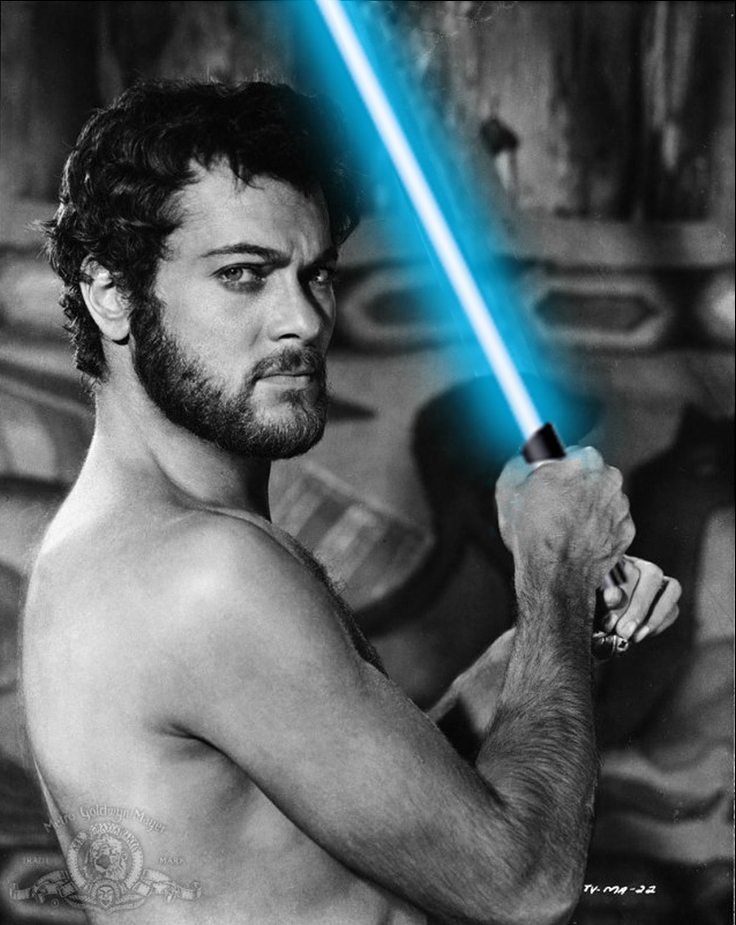
Tony Curtis as Long-Gone Jones in the 1958 original of The Phantom Menace
The Phantom Menace. Good story, but not well executed. There is far too much exposition and explanation; ‘show don’t tell’ holds as true for the cinema as for prose. The dialogue is as wooden as a forestry plantation. A tighter edit might well improve it a lot. And then there’s Jar-Jar Binks who, if nothing else, stands as testimony that George Lucas learned nothing from Ewoks about putting stereotypes on screen.
Flash Gordon and Buck Rogers never felt the need to delve too far into the history of the villains, or to turn their stories into redemption arcs. If the Saga had started with The Phantom Menace in 1977, there would never have been any subsequent movies and this would be an oddity shown late at night on obscure cable channels.
Attack of the Clones. I enjoyed this much more than The Phantom Menace. It is quick to action and Ewan McGregor comes into his own when Obi-Wan gets to go off on an adventure of his own. Another wooden script, though, and I’m not in the slightest bit surprised Anakin got shirty when continually patronised as ‘my very young padawan’ and condescended to by Obi-Wan and everyone else on the Jedi Council.
Revenge of the Sith. The first 15 minutes are good, though perhaps a little overdone. Throughout the film the beats are slightly off, somewhat too plodding, like when Eric Clapton ditched the original Layla for his acoustic dirge rendition. Too digital, and the soundscape is not great, at least on headphones. The dialogue is stilted. In terms of Star Wars lore, though, this is the one that suggests that Anakin is the creation of the Sith Lord Darth Plagueis, meaning that the entire Skywalker line is a creation of the Sith. The digital Yoda is crap.
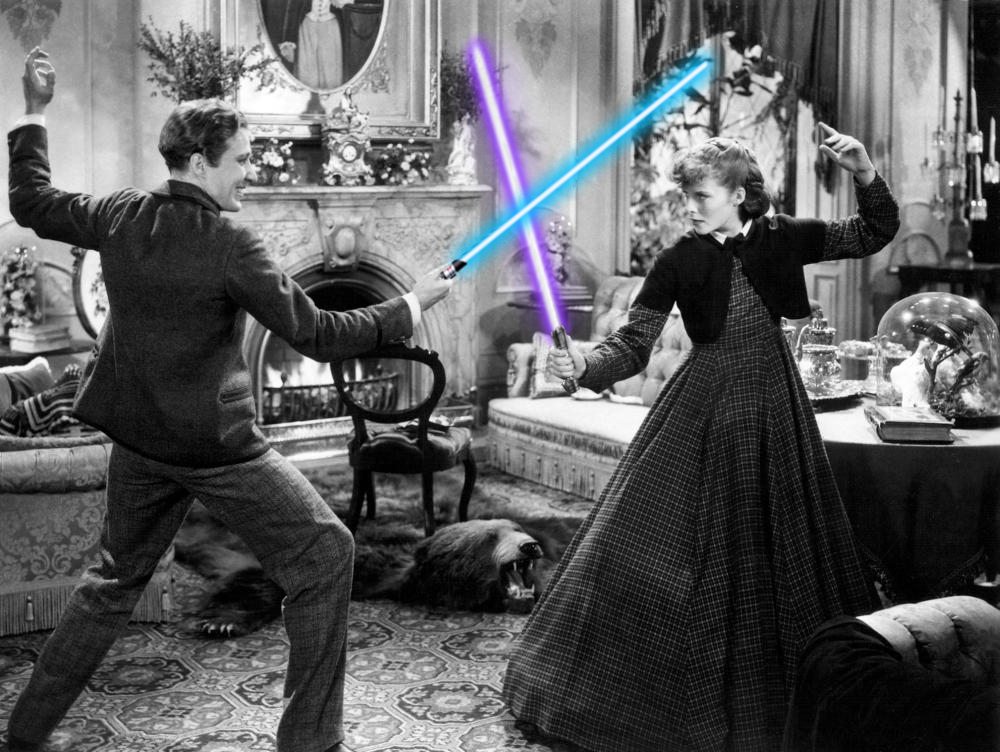
Douglass Montgomery and Katherine Hepburn in the 1933 Children’s Film Foundation production of Little Jedi (aka The Younglings in UK cinemas)
Overall I’d say the prequel trilogy is three potentially good movies trapped inside three mediocre ones. Annoyingly, given the whole point of the trilogy is to set up the tragedy of Anakin and Padme, it was those scenes I ended up fast-forwarding through. Natalie Portman was better than the scripts deserved.
Rogue One. And boom! When I saw Rogue One in the cinema I emailed some friends to say “the first third is a bit clunky but the final third is pure Star Wars.” My view has changed; I like Rogue One more and more every time I watch it. Deliberately, it plays on a very different set of tropes to the first Star Wars; it is basically The Battle of Britain, 633 Squadron, Where Eagles Dare and Sands of Iwo Jima. It also reminded me a little of 13 Assassins, though I’m not sure why.
Olivia de Havilland, the original Jyn Erso, with Errol Flynn; production still from the 1935 Captain Rogue
In an earlier age this film would have had Richard Widmark and Clint Eastwood as leads, with Yul Brynner, Richard Burton, Tony Curtis et al as the ragged band of heroes. Telly Savalas might show up. Ingrid Bergman or similar would have stayed at home to wring her handkerchief and bear her loss stoically. Rogue One instead has Felicity Jones being fab and carrying the movie. In terms of action, script, cinematography, story beats and all the rest it is leagues ahead of the Prequels and only let down by the digital-overlay Leia. The perfect beer and pizza movie, and we even have Darth Vader in Barad-dûr.
Star Wars. Where it all started. I expected this to pale somewhat on the back of Rogue One, but it holds up really well. It is straight in with action, no messing. Although it is an earlier generation of effects, it looks much better than the prequels. The back story is minimal and honed down to the point necessary to keep the story going, but no more than that. Where it falls down is the dialogue is not great (and some of the additional dialogue doesn’t quite synch. with what’s happening on screen). Also, Hamill, Fisher and Ford in their earliest film appearances are still learning their trade. I’ve never liked the medal awards thing at the end, even when I first saw it. However until that moment the film never loses focus on the primary story for a second, and, quibbles aside, it still hits the spot.
The Empire Strikes Back. Often cited as the fan-favourite of the original trilogy, The Empire Strikes Back also starts in with a WW2-movie vibe, very well done, and sharply edited. The Empire Strikes Back starts to lay the mythology in place in the way Star Wars didn’t. Luke is set up in a way that comes to be mirrored in the prequels (much anger in him, like his father), and Yoda initially declines to train Luke, who is shown to be flawed in this film.
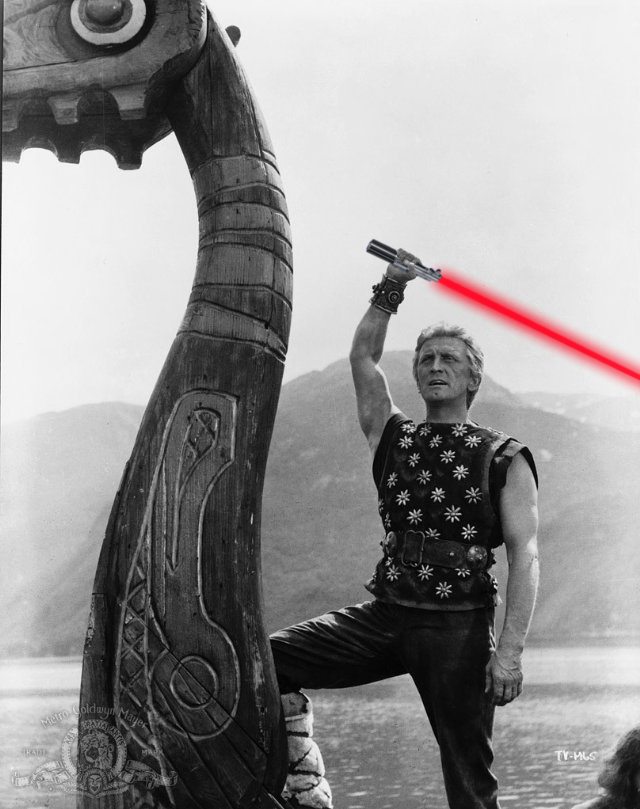
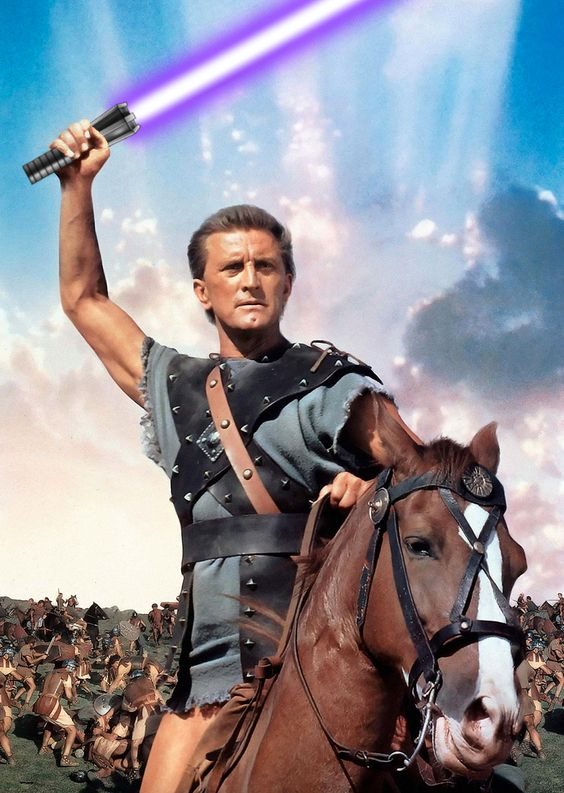
Kirk Douglas as Darth Spartacus in Revenge of the Vikings, after his seduction by the Dark Side.
Hamill and Fisher are still finding their way as actors, and the dialogue is hokey. It’s a good movie though, entertaining to watch, and worthy of the high regard in which it is held. See also my thoughts on The Last Jedi below.
The Return of the Jedi. This is a strange one. The opening, as you might expect from the final film in a trilogy, expects you to know what happened in the first two films. Even allowing for that, this felt to me like an episode rather than a fully formed movie. There are a lot of creature effects and, looking at them now, after The Lord of the Rings, Jurassic Park, and Planet of the Apes, they are embarrassingly poor. Notably Jabba isn’t very good. The matte art looked really bad on my laptop screen.
And then there are the Ewoks; not only do they look ludicrous, there is a dismaying play on colonial tropes of bumbling, comedic natives.
Somewhere in all of this is the final encounter between Luke, Vader, and the Emperor, but for me it gets a bit lost in the Tarzan pastiche.
There are interesting bits of lore in the movie, and, as with The Empire Strikes Back, various cues that Rian Johnson picks up and plays with in The Last Jedi. It is in this movie that Yoda says to Luke When gone am I the last of the Jedi you will be. And it is Obi-Wan who comments that many of the truths we cling to depend greatly on our own point of view.
Also, no one can watch Return then complain with a straight face about the recent ‘Disneyfication’ of Star Wars; Lucas did this all by himself.
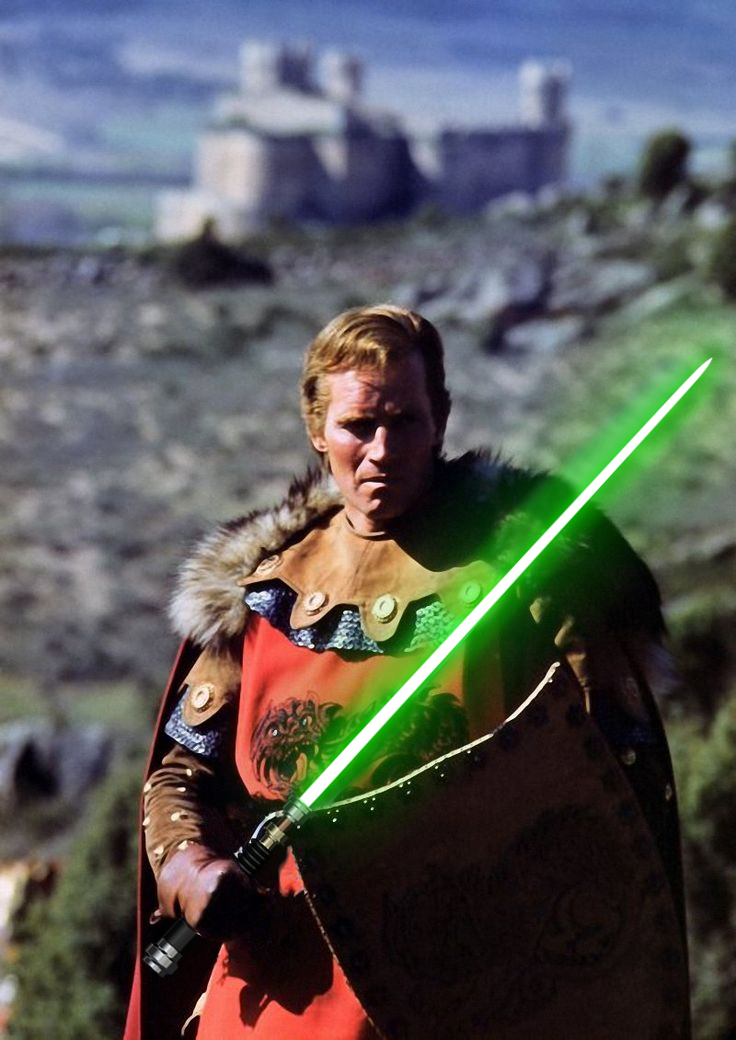
In the 1961 blockbuster El Cith, Captain Phasma was a hero, played by Charlton Heston
The Force Awakens. It is apparent right from the opening that this is an order of magnitude different to the older movies. It’s not just that film making has moved on over forty years; we have good actors delivering plausible dialogue, great cinematography, and a presentation of the First Order drawn on contemporary experiences of terror and oppression. John Boyega makes an impact even while wearing a helmet; Rey is introduced brilliantly and with economy; Daisy Ridley is believable from her first scene and never lets go. Even bit players deliver their lines with conviction.
There was a lot of talk at the time of The Force Awakens as a remake of Star Wars, as a JJ Abrams reboot. But I don’t think it is that at all. It obviously takes its cues from Star Wars, but it plays with them for its own purposes rather than replicates them. Rey is not Luke, and her journey is different. In a way it pays homage to what Star Wars is in the childhood memories of its creators, and what an homage it is.
The Force Awakens is a very, very good Star Wars movie that doesn’t neglect to stir mysteries into the pot of Star Wars lore (why does the light sabre choose Rey over Kylo Ren? Is it because it is Anakin’s light sabre not Vader’s?). Crucially, the film gives us no serious expository set up other than The First Order are on the up using the Dark Side of the Force, Luke has disappeared, and Leia’s band of rebels are in trouble; enter our new heroes.
The Last Jedi
Kirk Douglas as Mac Windows in Clone of Spartacus, before his seduction by the Dark Side of the Force.
The Last Jedi is a thing of wonder. On my first watch I enjoyed it but had reservations; I was spellbound on my second viewing.
Rian Johnson takes his cues from The Empire Strikes Back but refashions them into something very special. Importantly, this is not a remake of Empire, but the conclusion to it. Just as Yoda first refuses to train Luke in Empire, Luke first refuses to train Rey, but for different reasons, and Luke’s hesitation, his lack of belief in himself, is exactly the same lack of belief that plagues his training in Empire. Always with you it cannot be done, says Yoda in Empire, adding that Luke fails because he doesn’t believe.
In The Last Jedi, Luke has to face his failure to train Ben Solo, just as Obi-Wan failed in his training of Anakin. Yoda finally helps Luke complete the training he started all those years ago, and complete his own arc, finding for himself the truth in Yoda’s words in Empire: luminous beings are we, not this crude matter.
In Empire Luke confronts the Dark Side in a grotto and kills an image of Vader only to see his own face beneath Vader’s mask; in The Last Jedi, Rey confronts the Dark Side in a cave and, asking to see her parents, sees herself. Luke sees his fear realised in his own face, Rey sees something else, something puzzling, and her destiny goes its own way, setting up something special, I hope, for Episode IX.
The Last Jedi is visually gorgeous and pretty much perfect tonally throughout. It is both a serious film in its own right and a fitting second part in a trilogy. It engages deeply with Star Wars mythology, and also opens up a grand toy box of possibilities for future writers and directors to go and play.
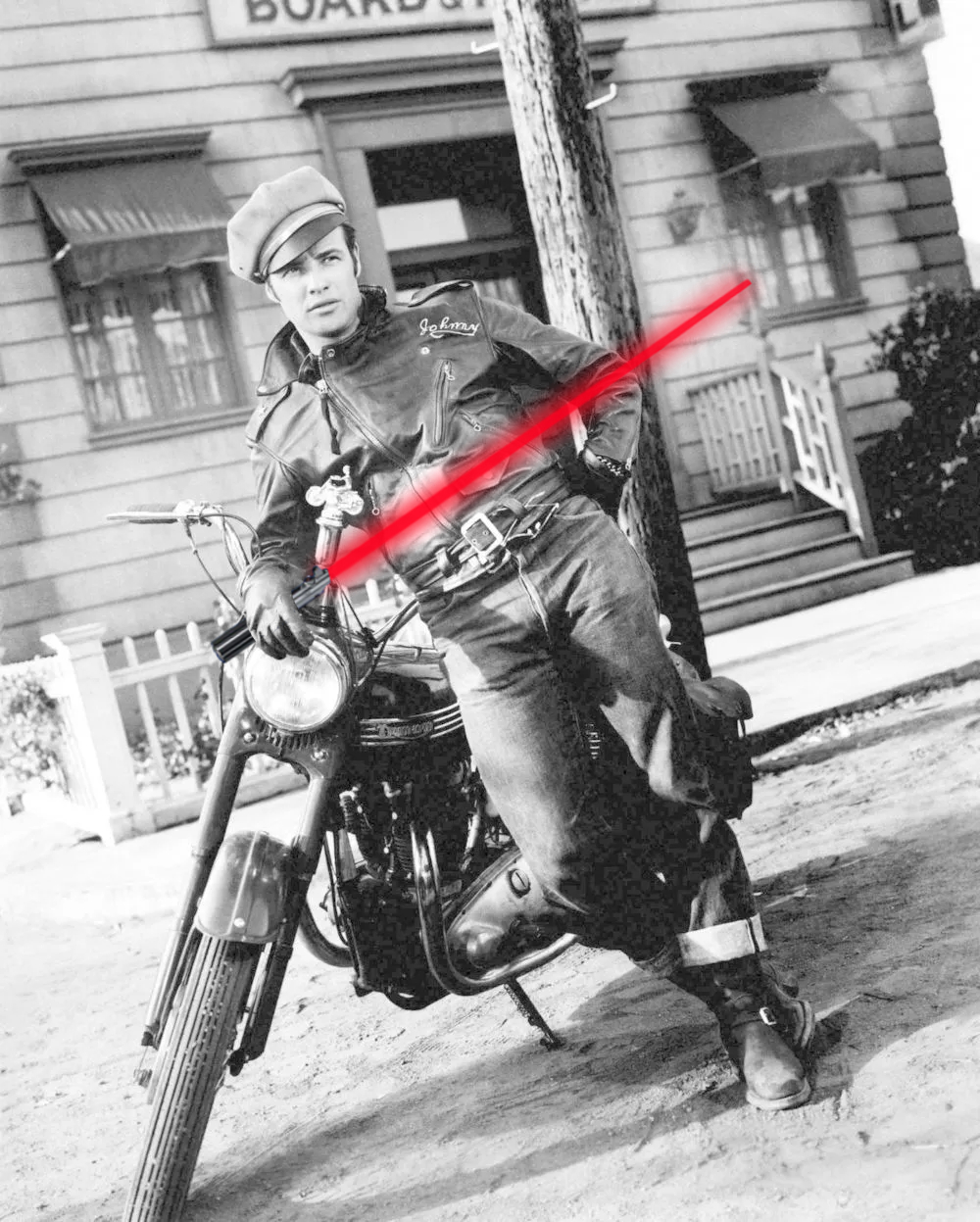
Marlon Brando as Carlo Renson in 1953’s Rebel Without a Mask
Daisy Ridley and John Boyega impress again, as do all of the lead and supporting cast. I still have some quibbles but they are precisely that, quibbles. The main one is I remain unconvinced that Kylo Ren is a big enough villain, however superbly Adam Driver plays him. But that is one for Episode IX to deal with.
I’ll take The Last Jedi as it is, a wonderful addition to the canon.
***
Finally, something occurred to me only as I was revising this: when Star Wars was released in the US in 1977 (78 in the UK), it was only five years after Cernan, Schmitt and Evans flew the last of the Apollo missions to the moon. Space flight was a real thing in our minds, especially all of us who’d been woken up to watch the first moon landing in 1969. Return of the Jedi was released after the Space Shuttle programme was flying, but before the Challenger disaster of 1986. The modern films are for an audience of children who were not witnesses to the Apollo landings, and who have no experience of spaceflight outside of near-earth orbit.
For us fifties (just) kids, space flight was a real and present thing, and a source of optimism in the future, not a thing to read about in history books. Perhaps like Luke we have to face our own failure as a generation to shape the future of which we dreamed.
As part of the festive fun I’ve been watching Star Wars DVDs in sequence. I’ve just finished the prequel trilogy again. Some thoughts to come once I’ve watched the rest. Rogue One up next.
Note: the post below was written after my first viewing of The Last Jedi. I have now seen it a second time and my opinion has changed. You’ll find my updated thoughts at the end of this.
This is written the day after watching The Last Jedi. If you haven’t seen it yet, look away now as you will find spoilers ahead.
***
In the early seventies, East Kilbride Cinema used to do children’s matinees on a Saturday morning. My routine was always much the same: go to the cinema, enjoy sugary sweets and drinks, then drop into a shop to buy something from Airfix.
The children’s matinee followed a standard format: Tom and Jerry cartoons (hooray! especially directed by Fred Quimby), sometimes a Disney cartoon (boo! never as good as Hanna Barbera/Warner Brothers), something from the Children’s Film Foundation, and an instalment of an old serial, sometimes Robin Hood, most memorably Flash Gordon and Buck Rogers.
It was in that same cinema in 1978 I first saw Star Wars, and thrilled to the edge-of-your-seat rush when Gold Squadron dived into the trench of the Death Star for the first attack run. I recognised the film straight away as the production of someone who had seen and loved those same 1930s serials and was trying to distil the same pure pulp spirit.
40 years on, I still think of Star Wars in that same way, as the heir of Flash and Buck and Dale Arden and Princess Aura, Ming the Merciless, Robin and Marion and the Sheriff of Nottingham and all the rest; my touchstone for a Star Wars movie is still: does it transport me back to being 10/11 years old at the children’s matinees? It’s why I was never bothered too much by the trade dispute backdrop to The Phantom Menace, Attack of the Clones and Revenge of the Sith, I was fine with all of that narrative so long as the movies remained pulp space opera with a hint of noir.
I enjoyed The Last Jedi, but it was a qualified enjoyment. I wrote on Twitter that my first reaction to The Force Awakens was Holy Crap! I have to see that again! whereas The Last Jedi was wait, what? I think I’ll need to watch that again to process it.
The things The Last Jedi gets right, it gets very right indeed. I like Luke’s story and also how Rey develops. Adam Driver’s Kylo Ren is well done; John Boyega and Kelly Marie Tran impress in their sub plot. But I’m not convinced the whole exceeds the sum of its parts; there was so much going on that the narrative got muddied. In part this might be because it is the meat in the sandwich of a trilogy and we need the final part to make it whole.
Some things niggle at me 24 hours later; some is detail–in the opening battle there’s a bunch of First Order cruisers hanging around in space doing nothing while their comrades get blasted, for example. I found the whole Canto Bight sequence entertaining, but redundant, serving only to give Finn and Rose something to do, and Benicio Del Toro’s character is underdeveloped and unnecessary. The least said about Leia in space the better.
More substantially, I’m not keen on the psychic connection that apparently now comes with the Force. To be sure this has always been present in some sense (“I sense a great disturbance in the Force”) but not the full-on communication. I can almost accept it with Luke and Leia, brother and sister, but not for Rey and Kylo/Ben; it’s an innovation for no better reason than as a plot device (a device that suggests a family connection between Rey and Ben, although we are being directed away from that?)
The same is true for the conclusion of Luke’s story: when did he get to be that powerful? (answer = when the script required it). But, dramatically, overcoming limitation and hardship is always more interesting as a denouement than deployment of suddenly acquired powers.
Also, although I see the psychological drama, I’m not sure that Kylo Ren has enough narrative heft as a character to be a convincing principle villain, if that is what he is, in the next movie. The late Supreme Leader Snoke was correct that Kylo is just a boy in a mask.
Samira Ahmed has a good post on The Last Jedi (spoilers) that I mostly agree with. In the end, though, what niggles me most is the sense that, amongst all the spectacle, something of the spirit of the saga is lost, the spirit of Flash and Buck and Robin. If you think I’m over-analysing, that’s kind of my point; it’s Star Wars, I shouldn’t feel it necessary.
Roll on the next viewing (iMax, 26 December), when some of this may click into place.


Recent Comments