Feb 15, 2020 | Family Tree
I had two bit of news yesterday that cancelled each other out.
The first was that an old friend of mine from my late teens and early twenties has died. He was a year younger than me. I’m not naming him because I don’t yet have clearance from his family and don’t want his name to show up on a search. I hadn’t seen him for several years, but there was a time when we were very close.
It knocked the wind out of my sails on what might otherwise have been a fun day. A chance breakthough on the family tree research appears to show two separate lines of descent from William the Conqueror and his sister to my Mum. Now, there are an awful lot of contingencies in that, not least faulty research and all the things I mentioned in my post yesterday. Also, it is pretty much a nailed-on certainty that those of us with largely British descent, and also European descent, are all descended in one way or another from William. It’s nice to see it written down, though, even if there are substantial caveats.
If true, then I probably also share common ancestry with the Presidents Bush. More interestingly (sorry George), it pushes my family tree research, previously stuck at 1746, back into the first millenium CE via identifiable people. I’d like to make similar breakthroughs on my other lines.
I also have to say that, after the first rush of discovery, it is still all just names on paper and my interest, wherever possible, is in the people, how they lived, and the society they lived in, not just their names and dates.
Feb 14, 2020 | Family Tree
Since my previous post, I’ve been immersed in trying to sort out the paper trail of my family tree again. As many of my ancestors were labourers of one kind or another, with one or two in skilled trades (cabinet maker, painter and decorator) or mariners, this means most lines hit a practical stop in the early 19th century (mid 18th century in the case of ‘Burdon,’ who were miners then colliery engine men). This is because civil registration and census data run out in the early 19th century and, for English and Welsh ancestors at least, one is subject to the whims of surviving parish registration and other sundry records. Scottish records are somewhat more organised, though, again, practical issues of survival of records come into play. As I have ancestors from Ireland and the Isle of Man, further complexities arise.
In many ways, this makes the DNA stuff largely irrelevant. Even allowing for the chance element of what admixture is passed from parents to children, it is still an aspect of a problem that is familiar to anyone who has tried to draw conclusions from two different datasets created for different purposes using different standards. In an ideal world, the information from both should be congruent and complementary, but we are not in an ideal world. In one sense the DNA doesn’t lie, but it is also a contingent truth for recent generations, and largely useless without paper evidence to make sense of it, unless you are asking very specific questions, which consumer DNA tests don’t.
But there’s also a problem with the paper trail. In a first draft of a family tree, one is inclined to take the paper trail at face value, particularly as regards the identity of a child’s father and siblings. This continues to be so unless some other evidence comes along to cast doubt on things. And it may be true that the named ‘father’ is the father for all social purposes, and believes the information to be genuine. But in the end it is still just a name on paper. I’m not casting a slur on women, by the way, just noting that until very recently, determination of parentage by scientific means was practically and financially infeasible for the average person.
There were also deliberate deceits that were too frequent to be random, and look to me like tacitly accepted ways of addressing social stigma, such as illegitmate grandchildren appearing on censuses as the children of the grandparents.
I’ve been pondering this because in one of my family lines I’ve encountered two, possibly three, ‘illegitimacies’ which disrupt the paper trail. Across all of my lines, there are plenty of other examples of children born well within 9 months of marriage. In the latter case, I have no particular reason to doubt that the social fathers were also the biological fathers, but neither have I any reason to think that the mothers were not as human as the rest of us.
That makes the family tree thing a social construct.
Feb 3, 2020 | Brexit, Family Tree
Almost exactly 3 years ago, I received the results of a consumer DNA test linked to my sloth-like family tree research. I posted about it at the time. Shortly after that, in March 2017, I posted a map produced by the company showing my genetic markers within the UK. In the latter post I commented that
Also, because the company that did it doesn’t have good reference data for Ireland yet, I have reason to believe the map might change on later re-examination when that reference data becomes available.
I got the update results through today, and I was right: addition of Irish data has made a difference. I knew it would because of the Heaney family in the mid-nineteenth century. What I didn’t expect was the new North and West Europe markers (tagged Northwest Germanic), and the reshuffling of the British regional markers.
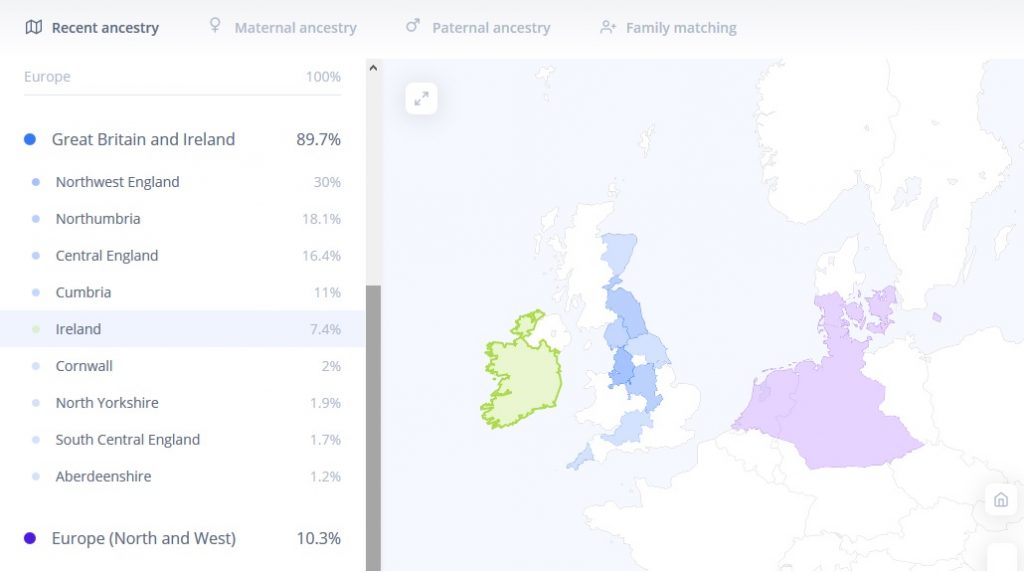
Autosomal Me
On the face of it, this is a refreshed set of data for the last 10 generations or so, to the extent that the markers have been shuffled up and passed to me via Mum and Dad. I daresay it is accurate in that sense. The problem is I only have paper records for some of it and, in most cases, only back to around 1800 (1745/6 in the best). This puts some of these markers safely before I have evidence, and without the other evidence they don’t get me very far.
From a genealogical perspective, without a paper trail, this is just a curiosity, as is my mtDNA and yDNA make up. From a much broader and more political perspective, it helps give the lie to the petty nonsenses of nationalism. Like every other human being on the planet, what links me to everyone else is overwhelmingly more than the supposed divisions between us.
Mar 10, 2017 | Family Tree
Further to the post of 17 Feb, this map indicates nicely the spread of my antecedents, or at least the genetic markers they carried, over the past 10 generations or so. This represents the identified parts of the admixture of my autosomal DNA. It will be different for my sisters, in proportion at least, because we all inherit different bits from our parents. Also, because the company that did it doesn’t have good reference data for Ireland yet, I have reason to believe the map might change on later re-examination when that reference data becomes available.
The map was produced by LivingDNA

Autosomal Me
Feb 17, 2017 | Family Tree
I had an update from LivingDNA on my autosomal heritage. They increased the time period out from 6 generations to 10; the big 4 regions are unchanged in % terms, but South Central England and Cornwall have appeared in the mix at 7.5% and 3.6% respectively. As I said in the original post, I’m from everywhere.
===
On 25 January I posted a link to a video on big data and analytics with reference to the Trump campaign. Buzzfeed have investigated further . They take the approach I hinted at in my original post, that there is a hefty chunk of marketing in that video.
Feb 13, 2017 | Family Tree

A fine figure of a genetic mix
I had a DNA test done. It was a spur of the moment thing, out of curiosity more than anything else, and I’ve got the results back. I used a new company called Living DNA and the process was simple: buy the kit, take a couple of mouth swabs, post them off, and wait.
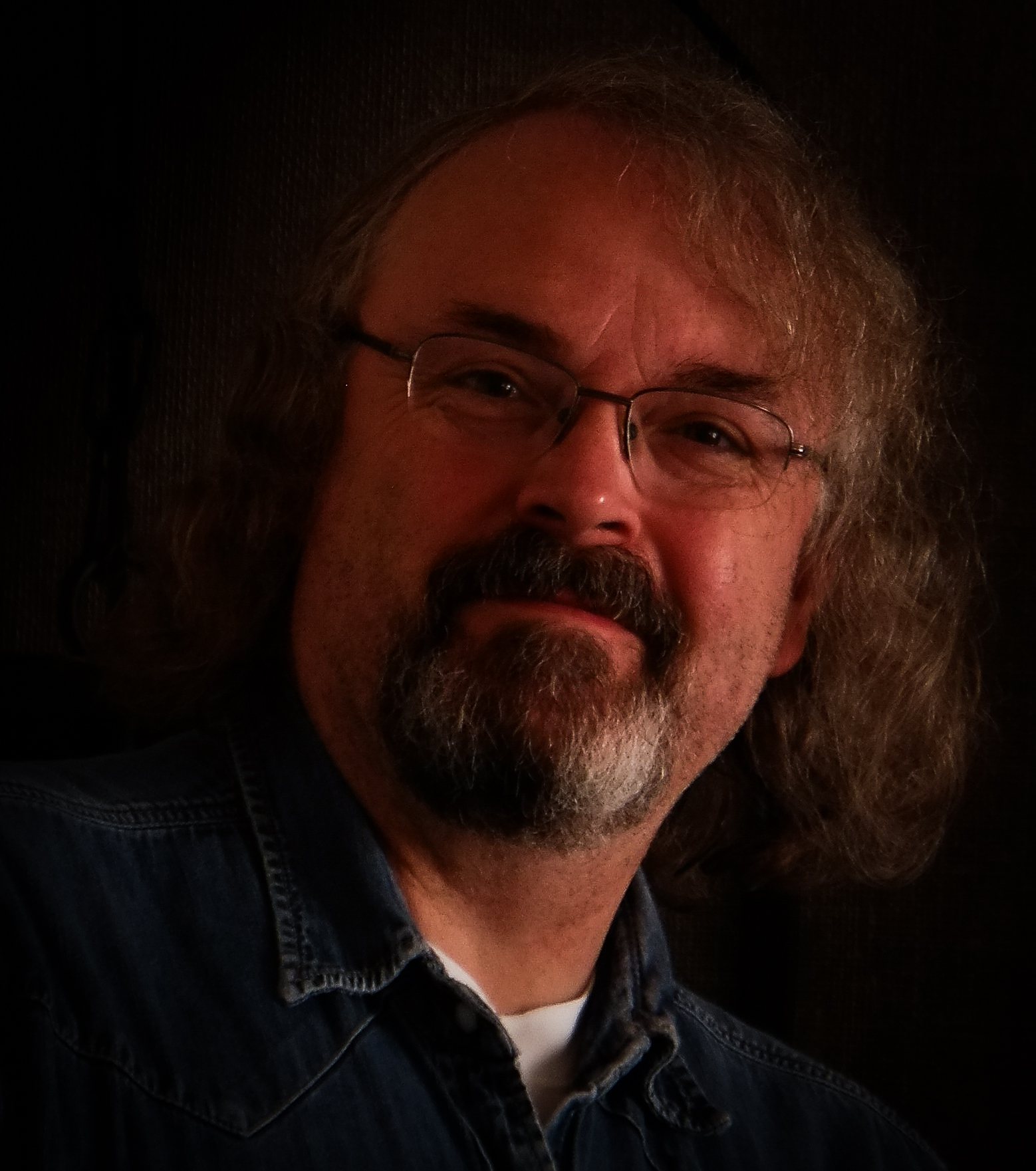
Do you want to know the genetic make up of the fine figure of a chap pictured to the right? No harm in that.
My autosomal DNA is 100% Great Britain and Ireland in the last 5 or 6 generations. I already knew that, but it’s nice to have that extra piece of the story. That’s what LivingDNA call the “standard” results and I believe the “cautious” and “complete” results, which are more detailed, are due soon, though I don’t know when.
The test indicates 78.8% of my DNA is from 4 of 21 GB and Ireland regions:
- NW England (22.6%)
- Northumbria (20.6%)
- Central England (19.6%)
- Cumbria (16%)
Trace levels are from SE England, S Wales, Sth Yorkshire, Aberdeenshire, and SW Scotland/N Ireland. You can find the regional definitions on the site. Note the labels are fairly broad–Northumberland stretches from Durham to Southern Fife; Cumbria includes Dumfries and Galloway. My friend Cath Ingham will note that South Yorkshire includes West Yorkshire. Perhaps, then, I’m genetically disposed to Timothy Taylor’s beers? That would explain a great deal, frankly.
More generally, that mix looks about right given what I know of my family history back to 1745. I’m not sure where that Aberdeenshire (Aberdeenshire, Angus, Fife, Moray) comes from, though, so maybe there is something there to have a look at.
My Y-DNA puts me in Haplogroup R-L21, subclade R-DF13. As far as I can tell this makes my Burdon side about as British as British could be, and I can now tell all sorts of fairy stories about the Celtic Twilight (as long as there’s no Enya. Please: no Enya. Really.)
My mtDNA is somewhat more exotic (thanks Mam): Haplogroup V. Apparently this is uncommon in the UK and may, or may not, have origins in Spain around the end of the last ice age. My mam was pleased to know this means she shares a genetic heritage with the Sami people of Lapland and folks from the Basque country.
Where does this get me? To be honest, aside from that trace of Aberdeenshire, probably not very far. One way or another we are all out of Africa, though we took different routes to get here. There is a certain interest in knowing how those routes led to me, but not much more. I see a lot of activity online by people (mostly men, actually; why is it always men?) trying to hone their genetic heritage to prove a link to some Clan or other, which seems to me to detract from the greater message: we are more similar than we are different.
On my Dad’s side, we were only ever one 18th or 19th century mining accident away from non-existence. My Dad told me once that, of those with whom he did his basic Naval training on National Service towards the end of WW2, half stayed in Europe, but half were posted to the Pacific and most of them died when their ship was torpedoed. My sisters and I, and our children, are here because of the accident of having a name at the beginning of the alphabet. And no doubt my ancestors managed to survive the Black Death, famine, drought, wars and skirmishes and goodness knows what other horrors going back into pre-history. That’s more interesting to me, more viscerally real, than my genetics.
The exception, I suppose, is in the context of the British political scene: I’m from everywhere.
My genes don’t make me special, they just prove I’m human. And if you want to know what that means, I recommend a read of Adam Rutherford’s A Brief History of Everyone Who Ever Lived


Recent Comments