
Bitches Brew (via Discogs)
What Made Miles Davis Go Pop! shouted Melody Maker on 13 June 1970 (the album was released in the US 30 March 1970 but didn’t hit the UK until June). Answering the question a week later in the same paper, Richard Williams correctly points out that Bitches Brew is not ‘pop’, or ‘rock’ as Americans were wont to call it, but something that defines itself by reference only to itself.
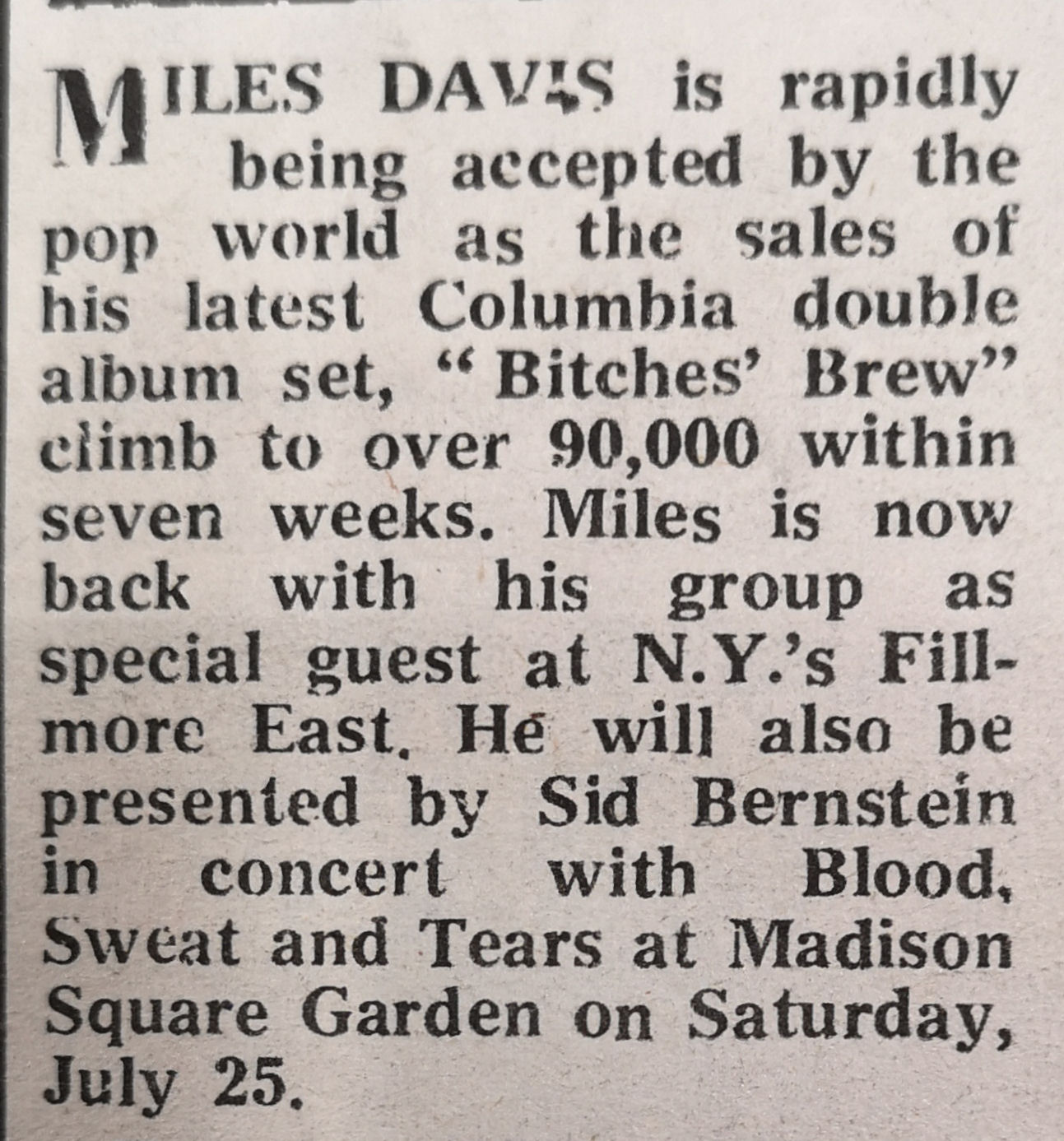
Wikipedia, of course, lists a slew of genres the album allegedly conforms to: jazz fusion, experimental jazz, avant-funk, jazz-rock and psychedelia. As usual, that’s bollocks. The Wikipedia entry also states the album received a ‘mixed response’, which is only true if you count 90,000 albums sold in seven weeks as evidence of some kind of ambiguity.

Melody Maker
For all the talk of fusion and jazz-rock, I hear no ‘rock’ here, except perhaps in Miles’s desire to to adopt the electric aggression of rock and also restore some commercial viability that was dwindling in the jazz scene. What I hear are musicians in search of a groove from which Miles would condense melody. Call it what you will.
In 1975 when I sat my Higher Art at school, we had an art teacher called Mr Bennett who took us through ‘Art Appreciation’. I remember one class in which I said I thought Van Gogh’s earlier work was more to my taste than the later paintings for which he is now famous. ‘Laddie,’ said Mr Bennett, ‘you’re no’ here tae like it, you’re here tae appreciate it.’ I thought he was daft at the time, but oddly enough that statement has stuck with me and resonated more over the years than anything else I remember a teacher saying. And it applies to Bitches Brew.
Melody Maker
It’s an album I’ve had for a long time; the cd sits next to my desk and gets played, though not as much as others of Miles’s albums. The odd thing is, sometimes I put it on and can’t stand to listen to it; other times I am held rapt. After all this time I can’t decide if I actually like it. But I certainly appreciate it, the milestone it represents, and how it influenced all that came after it. In that sense it is as important as Kind of Blue from 1959. In the end it doesn’t matter if I like it, and I’ll keep playing it anyway, for those moments when something in it does speak to me.
You need to let go of preconceptions and take this as it comes. If I have a preference it’s the 2nd cd (sides 3 and 4 of the original album); there’s more variety there and the music is closer to my tastes.
I played the cd, but it’s on Spotify, of course. It’s also all on YouTube.
note: regular readers might observe I’m running a day behind in this series. I plan to catch up in the next couple of days.

Recent Comments