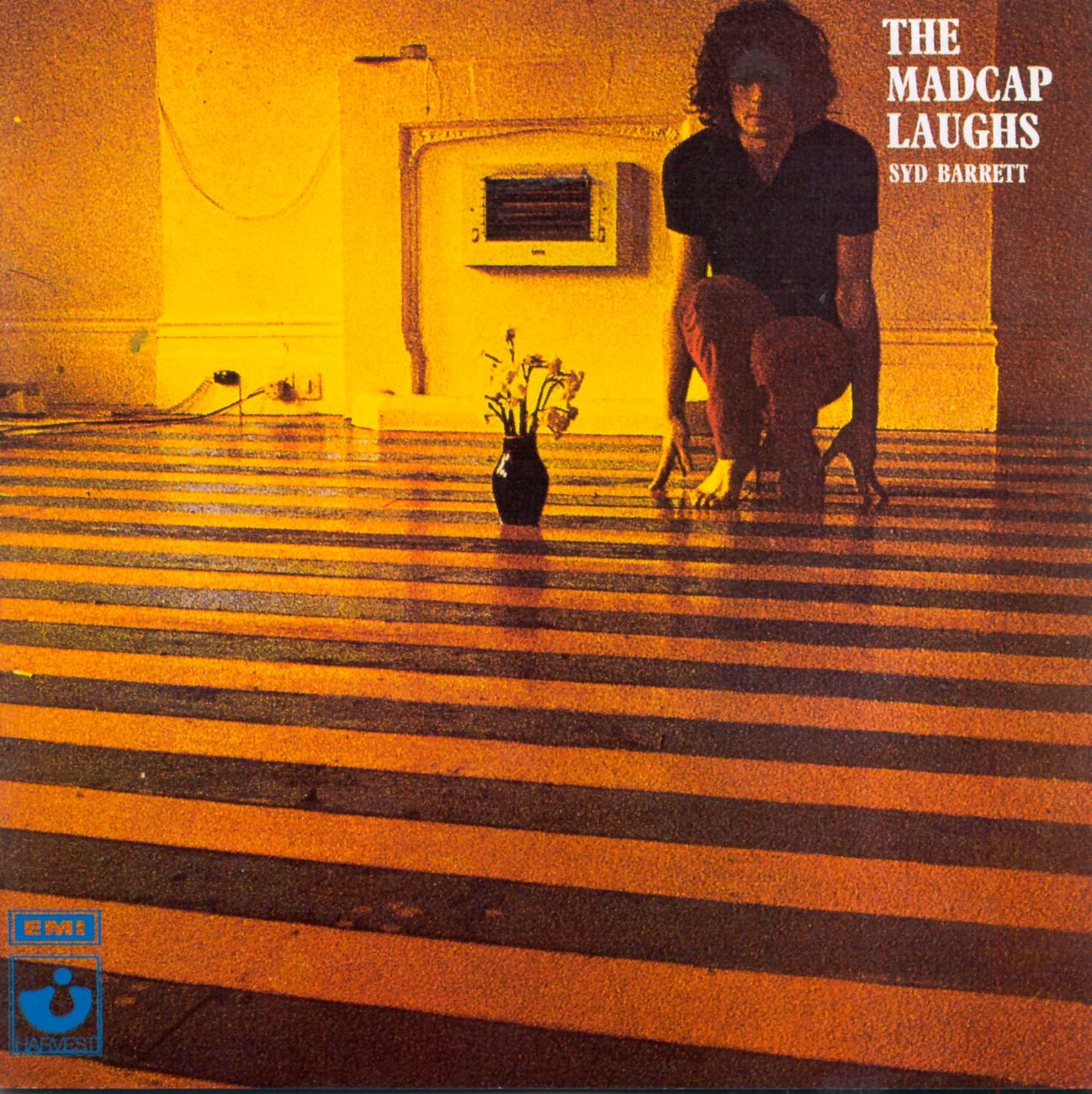
The Madcap Laughs
Pink Floyd are one of the bands who have soundtracked my life. My earliest memories of them are One of These Days being used on Horizon on BBC2 as a camera whizzed along a particle accelerator, listening to Dark Side of the Moon on an old cassette player (especially Brain Damage/Eclipse) and buying A Nice Pair, the repackaging of their first two albums.
Over the years I’ve had an up and down relationship with them. Dark Side of the Moon became so ubiquitous that, for many years, I simply couldn’t listen to it. My point of departure with them was The Wall, but two albums have been a constant in my listening: Meddle (1972) and The Piper at the Gates of Dawn (1967). Of those two albums, the one that gets played most is probably Piper at the Gates of Dawn, the only album that predominantly features the writing of Syd Barrett, who also wrote their two hits, Arnold Layne and See Emily Play.
Syd has become a mythological figure in British psychedelia. Famously, or infamously, he became unable to continue in Pink Floyd and they made the rest of their careers without him while he eventually retreated back to Cambridge and a quiet life. But before that, he did try to keep making music, and released two albums in 1970, The Madcap Laughs and Barrett.
Todays album is The Madcap Laughs, released 3 January 1970. It’s an album I haven’t listened to for a while: I’ve never thought of it as casual listening, and it’s hard to escape the knowledge that you are listening to a man who is undergoing severe difficulties in his life, to the extent that I was apprehensive about including it here at all. And yet, revisiting it reveals an album with a charm of its own, however difficult the circumstances of its recording and release, and however ramshackle some of the performances are.
And although it is the sound of a man in difficulty, it’s also the sound of a man borrowing someone else’s dreams for tomorrow, a man whose friends are trying to help–and his friends are Pink Floyd and Soft Machine. Still, Chris Welch (in Melody Maker, 31 Jan. 1970) could write:
SYD BARRETT is a happy, creative if somewhat confused young man, who gave the Pink Floyd hits and headaches when still in the group of his own creation, and after many months of slightly mysterious obscurity has returned with an extraordinary solo album of odd, eccentric songs.
Well, yes.
The second time listening through the album, I was drawn in much more than I expected. Most of the tracks have the feel of demos., but this increases their intimacy in a way. Long Gone is not hard to imagine as an early Pink Floyd song with some work. If it’s In is very rough, but his chat with the control room sounds self-aware and coherent, while the song takes obvious cues from the Beatles, particular the Lennon-Harrison axis.
The upshot is that, although it is the sound of a man in difficulty, it is also the sound of a man struggling to carry on despite the problems; a man whose creativity is intact and struggling to get out.
Also, the immediate effect of listening to the album again after all this time is that I bought it.

Recent Comments