Dec 22, 2019 | Star Wars
The latest in the Star Wars saga is a strange one. On the one hand I enjoyed it as a generic Star Wars movie, on the other it is deeply, deeply flawed. It reminded me of Avengers: Endgame in the sense that the spectacle was impressive, and it did have plenty of enjoyable sequences; but, in the end, it was more spectacle than substance. Like the prequels, I got the sense that there was a decent movie in there waiting to get out, but, in this case, it was smothered by fanservice.
Of course we’re dealing with Star Wars here, and, if cinemas full of 9 and 10 year olds around the world are happy, then mission accomplished. Star Wars is not Tarkovsky, and that’s fine. But still, I expected better.
None of this is to criticise the cast and crew who do a great job. It is to criticise JJ and his producers who have turned in, effectively, ultra-safe, corporate fanfiction. Coming after the thing of wonder that was The Last Jedi, that’s a shame.
Martin Scorcese recently made comments, deemed controversial by some, about Marvel movies and franchise movies. Writing in the New York Times, he said:
What’s not there is revelation, mystery or genuine emotional danger. Nothing is at risk. The pictures are made to satisfy a specific set of demands, and they are designed as variations on a finite number of themes.
They are sequels in name but they are remakes in spirit, and everything in them is officially sanctioned because it can’t really be any other way. That’s the nature of modern film franchises: market-researched, audience-tested, vetted, modified, revetted and remodified until they’re ready for consumption.
That’s pretty much my overriding thought about The Rise of Skywalker. Maybe I’m overthinking it 🙂
So, following my look at all of the films in December 2017, I would now say:
- Best of the original trilogy: Star Wars
- Best of the prequels: Attack of the Clones
- Best of the new trilogy: The Last Jedi
- Most frequently on our Blu-Ray: Rogue One
Were I to pick three of those for a desert island, they would be Star Wars, The Last Jedi and Rogue One.
Dec 15, 2019 | Dead Water
The best book published this year that I’ve read is Chris Arnade’s Dignity. Seeking Respect in Back Row America. Dignity is an attempt to recognise and respect human beings who are increasingly depicted as ‘left behind’ and ostracised from ‘progressive’ society. Arnade did the simple, yet most difficult, thing: he talked to people, took them seriously, told their stories and photographed them.

Dignity
Arnade is, by the way, a talented photographer who’s developed his craft by an instinct for not only composition and exposure but also ethics. His subjects trust him. He takes portraits, not trophies from a poverty safari.
In telling people’s stories, Arnade came up with a way of analysing what he experienced. At the core of it, as well as Arnade’s own process of self-discovery, is the disrespect shown to the dispossessed. It is about the dissonance between policy makers and policy takers, and the way the former sneer at or dismiss the latter, the way the economic category of ‘underclass’ undergoes a not-too-subtle transformation into a moral category.
The core simile (pp 44-47) is that the ‘elite’s’ background, including his own background, is like the kids in the front row of a classroom, anxious to ‘get ahead’ and learn and follow a path through education and mobility to elite jobs and communities. This is contrasted with the ‘back row’ kids who couldn’t, or didn’t, want to leave their home towns but instead were content to finish school, get a job, have a family, and be part of the same community they grew up in. Instead, the back row are
left in a world where their sense of home and family and community won’t get them anywhere, won’t pay the bills. And with a world where their jobs are disappearing. (p47).
Policy makers are invariably drawn from the front row; their victims are mostly back row.
When I first read Dignity (and there is a lot more to it than the brief introduction I’ve given), I had doubts about this approach, that shifts from simile to metaphor to model, and still do. Of course, in Arnade’s terms, my very instinct to pick apart the minutiae of the model is a very front-row thing of me to do, as is my casual deployment of minutiae.
This isn’t a review of Dignity to expand my doubts, but, for present purposes, whatever the limits of Arnade’s approach, and all approaches have their limits, it has considerable utility as a way to begin thinking about things. And it is that sense that I think it has utility in the context of this week’s General Election in the UK.
***
I’ve written several times here and in my old blog about aspects of my 1960s childhood, but I’m going to repeat myself.
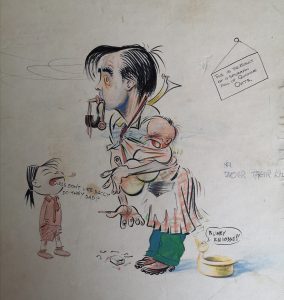
Me, Dad and my sister Cathryn. 1963
From 1959 to 1969 I lived in Derby in the East Midlands. Dad was a Technical Illustrator at Rolls-Royce, drawing the inside of Avon, Spey and RB211 aero engines with pencils, ruler, ellipses and Rapidograph pens. He trained as an illustrator after national service in the Fleet Air Arm at the end of WW2 with 816 Naval Air Squadron, HMS Ocean, and an extra four year term afterwards. My grandad was a master painter and decorator in Annfield Plain in the Durham coalfields, and I know from family tree research back to 1746 that my direct forebears worked down or around the coal mines or associated industries in Northumberland, Durham or Cleveland. My dad’s Uncle George drove steam engines pulling trains that took coal to the steel works at Consett and steel in the other direction.
On Mum’s side, her ancestors were mainly agricultural labourers in Hertfordshire who moved north to Derby in the late 19th century to work on the expanding railway industry. Her dad was a boiler maker in the engine works, and her maternal grandfather a joiner who built railway carriages.
When we went to visit my grandparents in Annfield Plain we would take the train from Derby to Newcastle, originally pulled by steam trains, but I have a distant memory of excitement the first time a Deltic locomotive pulled the train into the glorious old Victorian Derby Midland Station.
Going north we would pass through Rotherham and Sheffield, all lit up with foundries and manufactureries, and eventually get to Gran and Grandad’s house, from which we could see the pits in operation out the front or, not far from the back gate, watch the trains that Uncle George drove (on which I once got a ride on the footplate.)
In 1969 Dad moved to East Kilbride, just south of Glasgow, with Rolls-Royce and we all came too. Although we were in a new town, Ravenscraig Steel Works wasn’t far away, and the journey into Glasgow and back would takes us either by bus through industrial infrastructure around and about Clydebridge Steelworks or, by train, into Central Station over the Clyde which was still alive with shipbuilding. My teenage East Kilbride nights were soundtracked by Joni Mitchell, Focus, and the Rolls-Royce engine testbeds.
I left home in 1977, a classic front-row kid in Arnade’s terms, to go to University. I could have gone to Glasgow or Strathclyde Universities in 1976 (I was accepted for Applied Physics, Production Engineering, Mechanical Engineering, and a couple of other courses I can’t remember) but refocused my final year at school on languages (English, French, Latin) and went off to study Theology in Edinburgh instead.
It was in 1979 that the UK elected a Conservative Government headed by Margaret Thatcher. I voted Labour in that election (and most since, until recently).
A decent case can be made that the heavy industries were already in decline when Mrs. Thatcher came to office; there’s no question that the decline was accelerated and completed during her tenure. The reasons why she pursued the policies she did are complex, but lurking amongst them is a economic analysis and dogmatism driven by Arnade’s front row kids (aided and abetted by some idiotic decisions on the left; the late Jimmy Reid of UCS was candid on this regarding the early 1970s, and we can only wonder what might have happened had wily and pragmatic Mick Mcgahey been leader of the NUM instead of Arthur Scargill.)
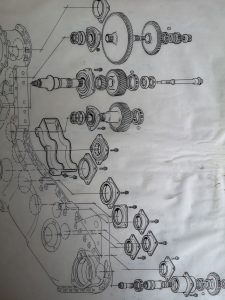
All done on computer now. Gearshaft assembly; Rolls-Royce Spey? 1960s.
It’s trite to note that the world has changed in the forty years since I left home, and done so in many ways. One of those changes is that all of the large-scale industrial infrastructure of my childhood has gone in my lifetime, and with it the communities and cultures it sustained, including the tacit knowledge that underpinned them. My Dad’s skilled job as a technical artist is done on computer now, and his generation, that was caught up in WW2 and the reconstruction of the UK post-War, is mostly gone too. Annfield Plain Co-op is in Beamish for the tourists to immerse themselves in heritage.
As the old story has it, you can take a bicycle apart and put it back together again, possibly better than it was before; to try the same with a frog leads to catastrophic failure of the frog. Communities are frogs, not bicycles, and destroying communities has consequences. Those consequences are fatal to the political and economic dogmas of the left that were developed in another time and place. This is because, to the extent that the conceptual analysis of the ‘socialist’ and ‘Marxist’ left was ever accurate, it isn’t now.
The front row kids, with their management by measurement and quantitative analysis, entirely miss the importance of community and tacit knowledge, the memory of shared experience of family, work, service, and the death of friends and comrades. The most important things, in this context, are precisely those things that can’t be measured, quantified, tabulated, dissected and analysed by spreadsheet and Powerpoint. The same front row kids, in a different guise as the analysts and ideologues behind the current Labour Party, also miss it, because they’re often too young ever to have known it, and so are surprised when their beloved working classes don’t do as they’re told, and vote for someone else.
The left never understood why the generation that rebuilt the country after WW2 was so pleased to be able to buy their council houses in the 1980s. Dad died young in 1983, but I remember how happy he was, after a lifetime of work that never, ever paid enough to support home ownership, to own his own home. This had precisely zero to do with the theoretical ins and outs of the policy or its structural consequences for local housing stock, and everything to do with identity, aspiration, security and self-worth.
***
Societies are complex systems, and communities are emergent properties of those systems. When society shifts and the communities and tacit knowledge that once held sway dissipate, new things emerge. The key to electoral success is to be attuned to the new. The new that is emergent is Nationalism in both England (Brexit) and Scotland (Indy.)
Cards on the table, I detest Nationalism in all its manifestations. I can see the surface appeal, but I think it is always corrosive and, in the case of both Brexit and Scots Independence, economically catastrophic. I say nothing of the ever-present risks of intolerance and racism. Nonetheless, it is dominant and politics has to recognise that and the reasons for it.
Nationalism is dominant, in my view, because it is an attempt to find again what has been lost; to find, or assert, a community in which to belong and an identity that has meaning. The unacceptable actions of the few must not obscure the genuine beliefs of the many or the reasons why they feel as they do. What should certainly not happen is for the ‘front row’ elite to sneer at, ignore, or denigrate, the values and feelings of the excluded ‘back row.’
Offering something better can’t be top-down. Three years ago, I wrote here about the assumption on the part of so-called ‘progressives’ that
It is enough to present facts and arguments to convince the ‘other side’ of the logic of your case, at which point they will shake your hand and thank you for correcting their misconceptions.
They will not.
Analysis and logic are important, but they are not sufficient; in fact they are easily sidestepped by portraying them as the nit-picking pettifoggery of “experts”. The SNP understand this, as does the loathsome Farage. For those of us who value an open, inclusive society, we need positions and arguments that appeal to people’s emotion and instinct, not just their minds.
***
Every week, for all the years I worked in an office, a man would be outside the gates one morning selling Socialist Worker. For the most part, the best he got for his troubles was an amiable nod as we walked right past him and into work. The people behind Socialist Worker, and the various associated groups, causes, factions and tendencies, were never able to make any significant headway at the ballot box, so instead they took over the Labour Party and proceeded to destroy it by turning it into the very thing voters have always rejected. Once there, they were happy to condemn, vilify, deselect and anathematise anyone and anything that had gone before, notably everything that had been successful with the electorate, heaping scorn and abuse on any who tried to gainsay them. They assert a political and economic analysis that was already out of date in when I was still at High School and Alice Cooper was singing about being elected, and which ignores everything that has happened in this country in the sixty years I’ve been alive.
David Cameron famously claimed that Britain was broken. He was wrong then, as The Economist argued at the time, but he and his successors have gone out of their way over the past nine years to ensure that it is broken now. I do not need to cite the ills that surround us. But we will not do anything to mend things while telling people they are stupid, thick, or misguided. We will not fix things by shouting about how much we ‘hate the Tories’ or trumpeting that we don’t know any Tories and wouldn’t want to. We won’t fix things by bossing Twitter, orchestrating pile-ons, saying we’d never be friends with a Tory (or other persuasion). We won’t change things by making promises in manifestos that no one reads except activists and journalists.
And we will not fix things by trying to analyse the fragmented society we now have in the conceptual categories and language of a society that has gone.
Of course, there are thoughtful people in the Labour Party who know this; off the top of my head I’d cite Bridget Phillipson in November 2016 and Liz Kendall in May 2015 but there are undoubtedly many others.
Blair succeeded in 1997, building on the work of Neil Kinnock and John Smith, for a number of reasons, the principal one being, I think, that he gathered about him a team that looked credible as a government-in-waiting. Crucially, he understood that the world was changing and the internal dynamics of the old familiar categories of working and middle class were also changing, and he changed the script.
In a general election, it isn’t enough for the incumbent government to be bad, it is also necessary for a challenger to be a credible alternative, or the electorate will stick with the Devil they know, even if they don’t like him or her. Labour hasn’t been a credible alternative for a long time.
Blair became Prime Minister 22 years ago and the world today is not the same as it was then. To have any chance of government again, any other ‘progressive’ party must likewise convince the electorate that it too is a government in waiting, not by mimicking Blair’s policies, but by looking at the country as it is and the risks that beset us, the ones that people most fear impact on their health and well being and that of their children and dependants, identifying solutions, and demonstrating that they are competent to carry them through. At the risk of deploying a front-row buzz word, that means demonstrating leadership.
Saying that your policies are radical is no good: people don’t want radical, they want credible. Saying that your policies are Socialist is no good: the word carries no meaning in modern discourse.
And by the time the next general election comes around, Brexit will be in process and the outcomes manifest, and it will be no good then saying ‘we told you so’. There will need to be a credible approach to the situation we find ourselves in then (including the overarching issue of climate change and the problems it generates) presented by people the electorate believes can deliver.
On present form, that won’t be Labour.
Dec 13, 2019 | Brexit, Dead Water
In a post in July 2016 I suggested the conservatives would have a substantial majority until 2025 at the earliest. I made a partial recantation of that in May this year when Mrs. May went. Given the results of GE 2019, I may as well jump on the bandwagon of everyone else with a hot take and claim I was right all along and the last GE was a blip.
One thing I’ve been certain of for a long time, though, is that Labour were dead in the water the moment Corbyn became ‘leader’. I said this on Twitter several times, for example:
I’ve also long held the view that it is not sufficient for a government to be unpopular and incompetent; for it to change there also has to be a credible alternative waiting to step into office. As matters stand, only one of those conditions has been in place for a very considerable time. Hence last night’s result.
Also as matters stand, I am politically homeless and have been for some time.
The morning after an election is a strange place, especially on social media. It was the morning after the last US Presidential election that I ditched Facebook. My Twitter feed has benefited the last few days from (a) not logging in much and (b) muting accounts that were full-on politics. My current view is that a wholesale reallignment of my Twitter feed is coming, and for similar reasons to my ditching of Facebook: I don’t need the daily negativity.
======
Added: Blog posts I ought to be arsed to write but probably won’t:
1: The malign influence of Grauniad columnists on left-of-centre UK politics from the SDP debacle to date.
2: Why traditional notions of working class attitudes have been wrong since Margaret Thatcher’s successes from 1979 onwards (something Tony Blair understood). In particular, the ‘working class’, to the extent that the category is valid, is not and never has been ‘socialist’.



Recent Comments