A couple of weeks ago I joined in one of those Facebook memes that do the rounds. This one was 10 books that made a lasting impact on you. The 10 that I listed (*) were, inevitably, a choice from a longer list, and one that I omitted was Susan Sontag’s AIDS And Its Metaphors (1989).
Sontag’s central premise was that the metaphors used when discussing something are revealing when looked at closely. In the case of AIDS (and, earlier, cancer), she considered how the metaphors stigmatised both disease and patient, often using language which implicitly offered moral criticism of the person with the condition. She also discussed the widespread use of military terminology and concepts when discussing the “fight” against disease.
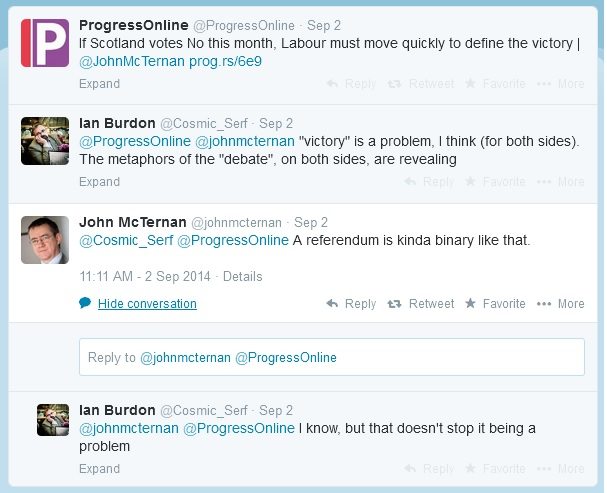 I was reminded of this during the referendum campaign and had a brief exchange with John McTernan on Twitter (see right). John’s response, that referenda are by their nature, binary, is correct–but therein lies some of my concern.
I thought continued references to Westminster rule was an example of a revealing metaphor, as well as the militarised language of campaigns, battles, breakthroughs and victories. The idea of “no” voters as quislings, cowards, traitors and unpatriotic, too, are indicative of barely disguised narratives and understandings.
This isn’t a dissertation and I do no more than to raise the point, however it would be a concern if the same language continues to be used in the political process that takes things forward from the referendum.
A couple of other short comments.
First: the role and relative importance of social media is worth a consideration and especially the signal:noise ratio. Relative to the size of the electorate, there are relatively few Twitter accounts in Scotland and they constitute a classic self-selecting sample, which seems not to be congruent with actual public sentiment. Despite that, continual reference is made to what people were (and are) saying on Twitter.
Also, it struck me that the abuse meted out to JK Rowling, for example, was similar in kind to the virulently misogynistic abuse of Anita Sarkeesian, Mary Beard, or any other woman in public life.
Second: John McTernan’s comment about the binary nature of referenda made me think about single issue politics and the historic role of the SNP as, essentially, a single issue party. Initial analysis indicates that something else was happening in this campaign. It looks as though some traditional narratives based on political allegiance (and the notion of a tribal allegiance is another interesting metaphor) are crumbling. The conclusion of that analysis is that the Yes vote was largely driven by two different things. One was a principled belief that Independence is something for which Scotland should strive, the other was inequality.
This is suggestive to me of a more nuanced analysis than is often found. This analysis is still linked to class, but not in the familiar C20 understanding of a working class because, cliche alert, a lot of the inequality is down to not working or being in marginal work with no prospect of improvement. This inequality looks to me very much as though it is structural and is something I have alluded to before. It is not something that is going to go away.
Finally, there are clear positives to be taken from the Referendum. These include the turnout, the enfranchising of 16/17 year olds, and the public engagement with questions of identity. The substantial negative, it seems to me, is that it has obscured a more intractable problem–the relationship of London to the rest of the UK.
(*) Those 10 books:
- Zen and The Art of Motorcycle Maintenance : Robert M Persig
- Mason and Dixon : Thomas Pynchon
- Vineland : George MacKay Brown
- Against Method : Paul Feyerabend
- On Writing : Stephen King
- The Aubrey/Maturin series (Master and Commander) : Patrick O’Brien
- A Canticle for Leibowitz : Walter M Miller
- The Foundation Trilogy : Isaac Asimov
- The Kraken Wakes : John Wyndham
- Crime and Punishment : Fyodor Dostoevski

I’m glad you say at the end of this “the relationship of London to the rest of the UK”.
Firstly London is huge. In people terms alone somewhere about the 8 million mark, twice that of Scotland, it dwarfs all other cities in the UK. Then it is the ubber capital not just political but cultural, financial, educationally etc. etc.
Therefore all roads lead to London in modern UK terms. I do feel that some of the calls for devolution to Scotland, Wales, Northern England, large cities from Birmingham north doesn’t recognise that actually you can live in an hour of London and still be in some of the most deprived areas in Britain. Look at Sheppey, Isle of Thanet, parts of North Kent – I know these well living in Kent but frankly these places are as far from the gold plated streets as anywhere. Also to some degree I think they struggle more since people assume that being in the South-East means prosperity – it doesn’t. So if all this devolution talk stired up comes to the fore I do hope we get a South East (not including London) government and able to increase the percapita spend in these areas – they need it desperately